
Research Signal – Source date 2022-10-07
An immune treatment can reach a digestive tumor and still have little to work with. Checkpoint drugs—the medicines designed to release a brake on immune cells—may help T cells attack cancer, but some tumors have too few T cells entering them in the first place. Tiny drug carriers, or nanoparticles, might help deliver immune-active drugs or alter conditions around a tumor. Yet delivery is only part of the problem: the cancer must also become visible or accessible to the immune system.
A 2022 review in the World Journal of Gastroenterology surveys experimental approaches in stomach, liver, bowel and pancreatic cancers. Its examples are not one treatment tested across all four diseases. They show why researchers have tried to match the carrier and immune strategy to the particular obstacle in each tumor—and why these combinations remain a research prospect rather than an established patient benefit.
A checkpoint brake is only one part of the problem
Checkpoint blockade can remove signals that restrain T cells. But if a tumor attracts few T cells, releasing that brake may not bring enough cancer-fighting cells into the tissue. The review describes approaches that try to make cancer cells more noticeable to the immune system, recruit and mature immune cells, or reduce the influence of cells that suppress an immune response.
One stomach-cancer example combines cell damage with immune stimulation. The researchers packaged a light-activated compound and platinum-based material in hollow silica-like nanoparticles. When activated by light, the compound produced oxidative damage, including damage to mitochondrial DNA. The resulting processes also activated a pathway that can alert innate immunity, the body’s early-response defenses, and were associated with more CD8-positive T cells entering tumors in the reported work.
The idea is to make dying cancer cells act more like an alarm. The scientific term is immunogenic cell death: cell death that also sends signals capable of drawing the immune system’s attention. In this design, that alarm could complement checkpoint treatment by addressing weak immune recognition as well as the brake on T cells. The example describes a proposed mechanism and experimental findings, not proof that the combination improves outcomes for people with stomach cancer.
Changing the cells that hold immunity back
Some strategies focus on inhibitory immune cells rather than trying only to make cancer more visible. In liver cancer, the review describes dual-target lipid nanoparticles aimed at two chemical signals that can push macrophages, a type of immune cell, toward an M2-like state. In that state, macrophages can help suppress immune activity around a tumor. In mice, combining the targeting approach with checkpoint blockade was associated with long-term survival.
That animal result points to one possible way of changing the local balance of immune cells. A pancreatic-cancer design took a different aim: limiting recruitment of myeloid-derived suppressor cells, or MDSCs, which can inhibit immune activity. The reviewed nanoparticle carried paclitaxel and was built from a modified heparin material described as inhibiting MDSC recruitment. These examples target different suppressive features in different cancers; they do not establish a shared treatment or comparable benefit in patients.
Keeping an immune stimulant near a bowel tumor
For colorectal cancer, the practical issue can be where an immune stimulant goes after it is given. Small toll-like receptor agonists—compounds that activate immune sensors—can spread away from the intended site, raising concern about systemic side effects. A nanoparticle carrier may change that distribution.
In one mouse model described by the review, researchers coated nanoparticles with platelet membrane and loaded them with the immune stimulant R848. The nanoparticle system enhanced retention of the drug in the tumor in that experiment and stimulated dendritic-cell maturation. Dendritic cells help coordinate immune responses by presenting signs of danger to other immune cells. The study reported complete tumor eradication in a mouse model, a striking preclinical result that does not tell us whether the same delivery or effect would be safe and effective in people.
Here the carrier’s proposed value is local concentration: keeping an immune signal closer to the tumor could limit exposure elsewhere while supporting local immune activation. Whether that tradeoff carries over to human bowel tumors is a separate question from whether the carrier worked in the reported mouse model.
Pancreatic cancer adds a physical barrier
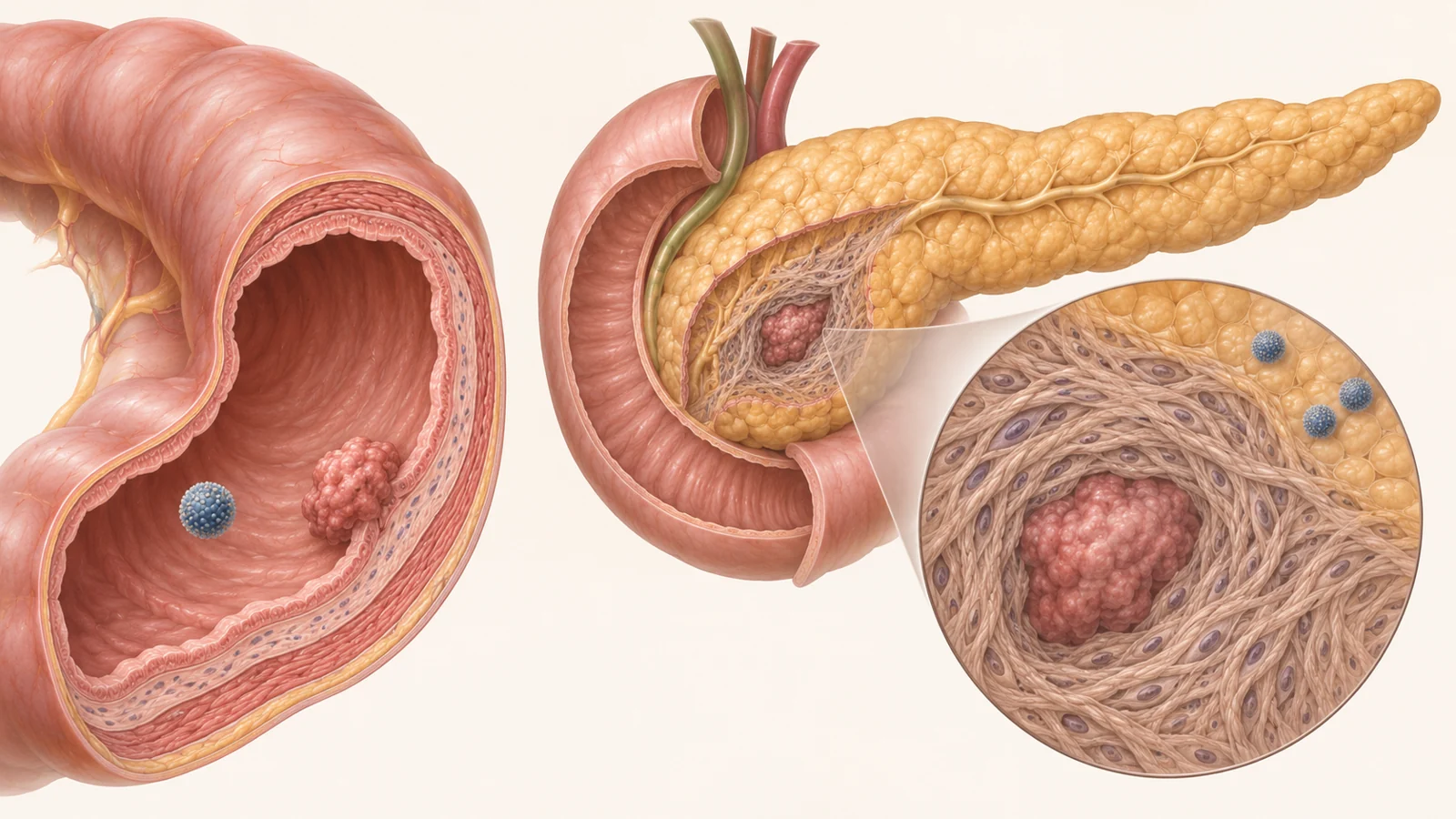
A delivery strategy that seems promising in one tumor may run into a structural obstacle in another. The review describes pancreatic tumors as having dense stroma, the tissue around cancer cells. This dense material can act as a physical barrier between the tumor and the body’s immune system, limiting how far treatments penetrate. The pancreas is also deep in the body, making light-based approaches harder to use there than at more accessible sites.
One proposed response is to let a carrier change size. The reviewed pH-responsive design, called iCluster, was intended to travel through tumor blood vessels and then release smaller particles in the acidic environment around a tumor. Those smaller particles could penetrate farther into tissue, carrying a drug that reduces PD-L1 signaling, while another component targets a signal involved in maintaining the stromal barrier. This is a proposed delivery solution in experimental work, not evidence that the design overcomes pancreatic cancer’s barriers in patients.
The physical challenge also shapes attempts to use heat or light to damage tumor cells and trigger immune attention. The review notes that limited light penetration makes photothermal therapy difficult to apply broadly, especially for a deep pancreatic tumor with dense surrounding tissue. An approach designed around this obstacle cannot simply assume that a strategy used in a more accessible tumor will reach the same target.
What the experiments can and cannot tell us
The review also describes several nanoparticle medicines already used in clinical practice. Their existence shows that some nanoparticle-based drugs can be developed for clinical use; it does not validate the experimental immune combinations discussed here. A carrier’s success with one drug, cancer or delivery route cannot by itself establish that a different carrier will reach the right cells, activate the intended immune response or avoid harmful effects elsewhere.
Interpreting combination experiments brings another challenge: a treatment may damage cancer cells directly while also being designed to activate immunity. If a tumor shrinks, that outcome alone cannot show how much came from immune activity and how much from direct toxicity. The review’s authors caution against assuming that combining multiple cell-damaging agents necessarily strengthens the immune effect. Clearer evidence about both mechanism and outcomes would help show what a treatment is doing.
The examples span different cancers, carriers, immune targets and experimental settings. Their common lesson is a research question: can a delivery system address the obstacle that matters in a particular tumor, and can the resulting immune activity be shown to contribute to a meaningful clinical benefit? The reviewed mouse outcomes help motivate that question but do not answer it for patients.
How this could shape the future
If these strategies can be made safe and effective in people, a person whose bowel cancer responds poorly to checkpoint treatment might someday be offered a clinically validated combination that keeps an immune stimulant near the tumor. Someone with another digestive cancer could need a different approach, one designed around that tumor’s own immune or physical barrier. The review supports the underlying idea of matching delivery and immune mechanism to the tumor; it does not show that these patient treatments are available or effective.
A useful nearer milestone would be a comparative human study measuring whether the drug reaches the tumor, whether immune activity changes there, what clinical outcomes follow, and what adverse effects occur. Such a study could test the bridge between local delivery and patient benefit. It would be a step toward the future described above, not evidence that the envisioned care has already been demonstrated. Existing nanoparticle medicines and experimental immune combinations remain distinct in what has been established about them.
Key Sources
- Primary source: Immunotherapy-based novel nanoparticles in the treatment of gastrointestinal cancer: Trends and challenges.
DOI or Journal Page · Review or Meta-Analysis · 2022-10-07
Keep exploring