
Research Signal – Source date 2022-10-04
Two weeks after receiving one dose of atezolizumab, a man with progressive lung cancer arrived at the emergency department with a high fever, severe difficulty breathing, muscle pain and profound weakness. The symptoms could fit an infection or a complication of cancer treatment. But bruising, enlarged liver and spleen, and falling blood counts raised concern for a rare, dangerous immune overreaction called hemophagocytic lymphohistiocytosis, or HLH.
The 2022 case report describes how clinicians investigated that possibility and treated the patient as his condition worsened. He died a week after presentation. One case cannot establish how often HLH occurs with atezolizumab, prove the drug was the sole cause, or show that a different treatment would have changed the outcome. It does show why recognizing this syndrome can be difficult when several serious explanations initially look plausible.
A treatment meant to release an immune restraint
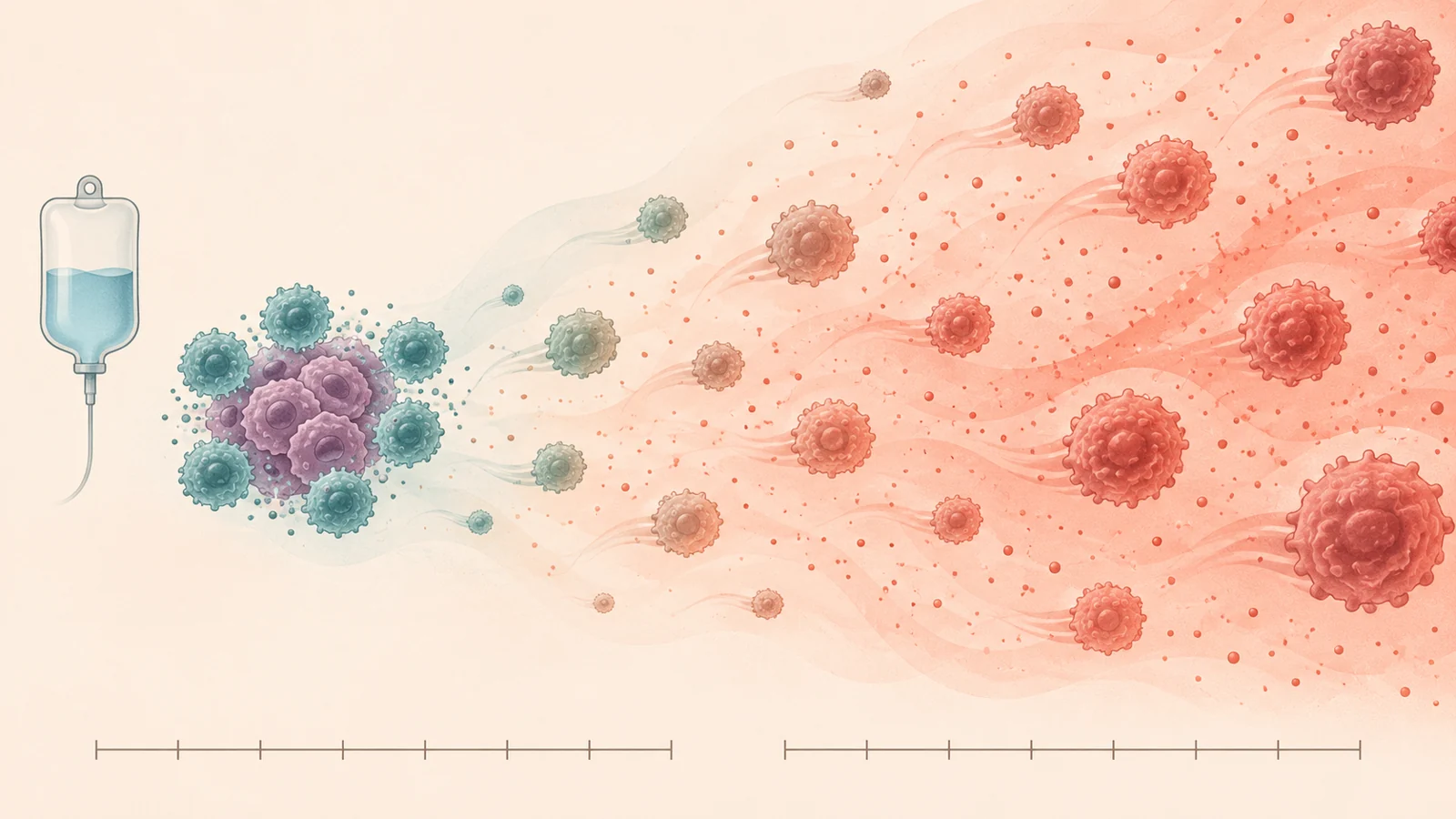
Atezolizumab is an immune checkpoint inhibitor. It blocks a signal that can restrain T cells, a type of immune cell, allowing them to mount a stronger attack against a tumor. The same broad immune activation can also harm healthy tissue. In some patients, the response becomes systemic, affecting multiple organs rather than staying focused on a tumor.
HLH is one such severe inflammatory syndrome. Overactivated immune cells drive an escalating release of inflammatory signals, sometimes called a cytokine storm. The resulting tissue injury can disrupt several organs. HLH can arise in connection with cancer, infections, autoimmune disease or medicines; in this report, the authors considered it a possible treatment-related adverse effect.
The patient’s cancer had progressed after earlier treatment, and clinicians had started atezolizumab as a later line of therapy. The report’s abstract and case narrative differ on the tumor’s precise type and stage, so those details do not provide a reliable basis for a more specific description. The timing was clearer: he presented to the emergency department two weeks after the infusion.
Several explanations fit the first signs
At presentation, a fever of 39 °C, breathlessness, weakness and muscle pain did not point to HLH alone. Infection was a serious possibility during the COVID-19 pandemic, and the team initially assessed for it. Atezolizumab could also cause other immune-related complications. In their discussion, the authors also describe cytokine release syndrome, an inflammatory reaction to immune-activating treatment that can include fever, breathing changes, muscle pain and neurological symptoms. Its features can overlap with HLH.
The examination and tests added reasons to investigate a broader inflammatory process. The patient had bruises on both arms, an enlarged liver and spleen, and moderate pancytopenia: reduced counts across several types of blood cells. Ferritin, an inflammation-related blood marker, was elevated, and kidney function had worsened from its previous normal level. Imaging found no pulmonary clot or lung infiltrates to explain the breathing difficulty.
Over the next day, tests showed persistent pancytopenia, elevated bilirubin and liver enzymes. Infection remained part of the workup, while the team considered other immune complications alongside HLH. Tests for several viruses were negative. The combination of worsening blood counts, organ involvement and inflammation made HLH an urgent possibility, even though no single early symptom could settle the diagnosis.
Scores and marrow findings strengthened suspicion
Doctors use diagnostic criteria and scoring tools to organize evidence for HLH. In this case, the clinicians calculated an H-score of 256, which the report says corresponded to a probability above 99 percent. The score supported strong suspicion; it was not, by itself, a standalone test that could distinguish HLH from every competing cause in a person with cancer.
That distinction matters in oncology. Cancer and its treatments can already affect blood counts, liver tests and organ size, which are among the findings used in HLH assessment. The authors note that conventional criteria may become positive only after a patient is seriously ill, while a score can be harder to interpret when similar abnormalities have other explanations. Clinicians therefore may need to act on a strong, evolving suspicion before every traditional threshold is reached.
A bone marrow biopsy later showed increased reactive cell activity and hemophagocytosis, in which immune cells engulf blood cells. Those findings supported the diagnosis in this case. Hemophagocytosis is not unique to HLH, though, and the report emphasizes that it is neither required for diagnosis nor always visible early. The biopsy added evidence to a wider clinical picture rather than serving as a perfect yes-or-no answer.
Treatment escalated as neurological injury advanced
Neurological deterioration led to intensive care admission and intubation before clinicians calculated the H-score and began high-dose corticosteroids for suspected HLH. Severe low blood counts continued despite transfusions, so the clinicians added tocilizumab, then anakinra, followed by mycophenolate mofetil and, several days after admission, etoposide. The report describes this sequence as an effort to control the suspected hyperinflammation; it does not compare these medicines in a way that can establish which approach works best.
Despite treatment, his neurological condition worsened. Brain imaging showed extensive white matter damage, and an electroencephalogram indicated severe, diffuse brain involvement. The team limited further therapeutic efforts, and the patient died one week after he first came to the emergency department.
The outcome illustrates how rapidly this episode progressed. It cannot show whether earlier recognition would have prevented death, or whether any particular medicine or sequence would have changed the result. The authors describe the case as a warning about a fast-moving complication, not a test of treatment effectiveness.
Earlier reports show a varied picture
The paper also reviews earlier published case reports of HLH associated with checkpoint inhibitors. Its table includes different cancer types and drugs, including pembrolizumab and a combination of ipilimumab with nivolumab. Reported treatments vary as well, from steroids and other immune-directed medicines to combinations that include etoposide. The table records both deaths and improvement.
These reports help show that similar syndromes had been described across more than one checkpoint drug and cancer setting. But a collection of individual cases has no reliable denominator: it cannot tell how many people received each drug without developing HLH. Differences in the patients, clinical circumstances and treatments also make the outcomes unsuitable for ranking therapies or estimating a comparative benefit.
The authors describe their report as the first they knew of involving atezolizumab used alone for cancer therapy. They also discuss another report involving atezolizumab with chemotherapy. Those accounts can raise awareness of a possible association, but they do not independently prove that atezolizumab caused HLH in this patient. Cancer, infection and other factors can also contribute to severe inflammation.
Where this research could lead
A dependable way to distinguish emerging HLH from infection and other immune complications could give clinicians a clearer basis for acting earlier when a person receiving checkpoint treatment becomes seriously ill. The patient in this report moved from fever and breathlessness to severe neurological involvement within days, while several explanations initially overlapped. A validated assessment pathway might help clarify which evidence points toward HLH before conventional thresholds are reached, while still recognizing that treatment decisions belong in clinical care.
That capability remains a possibility, not something established by this case. A meaningful nearer milestone would be a prospective study testing a proposed marker or assessment pathway in checkpoint-treated patients, showing whether it separates HLH from competing conditions sooner and more reliably, and measuring whether that changes time to recognition and patient outcomes. If such a pathway proves useful, it could make early assessment less dependent on an ambiguous pattern of symptoms and tests. Whether that would improve outcomes would still need to be demonstrated.
Key Sources
- Primary source: Treatment-related hemophagocytic lymphohistiocytosis due to atezolizumab: a case report and review of the literature.
DOI or Journal Page · Review or Meta-Analysis · 2022-10-04
Keep exploring