
Research Signal – Source date 2022-10-01
A liver tumor found late in India may be too advanced for surgery, ablation, or transplantation. But timing is only part of the decision: doctors must also consider how much of the liver is affected, whether cancer has entered blood vessels, and whether the remaining liver can support treatment. A 2022 review of published evidence describes why two people with the same tumor size may not have the same options—and why size alone does not always rule out surgery.
The review searched PubMed and MEDLINE for studies published from January 2000 through June 2022. It brings together research on hepatocellular carcinoma (HCC), the most common primary cancer of the liver, along with Indian guidance and treatment findings. It is a synthesis of existing evidence, not a new trial or a representative national survey.
The risk picture is changing, but remains incomplete
The review identifies chronic hepatitis B and C, cirrhosis, alcohol use, and nonalcoholic fatty liver disease (NAFLD) among the important risk factors for HCC in India. These risks can overlap. The authors cite reports in which viral hepatitis combined with alcohol was a frequent risk pattern, alongside signs that hepatitis B was declining while alcohol-related disease and fatty liver disease were becoming more prominent.
One three-year study at an Indian tertiary-care center found that 51% of its patients with HCC had NAFLD or an unexplained cause of disease; hepatitis B accounted for 17.4% and hepatitis C for 5.8%. Those figures describe that center’s patients, not the country as a whole. The review notes that cancer registries are primarily urban and that the available information on HCC in India is limited. Its estimates and changing-risk observations therefore cannot establish a nationwide breakdown of causes.
This matters for interpreting prevention and early detection. A national picture of risk would help clarify who is most affected and where surveillance resources could be useful, but the review cannot supply that picture from the studies it summarizes.
Surveillance targets people already at higher risk
Finding HCC before it grows or spreads can preserve more treatment possibilities. Child-Pugh classes describe increasing severity of liver disease from A to C. The Indian National Association for the Study of the Liver (INASL) guidance cited in the review recommends abdominal ultrasound every six months for specified higher-risk groups: people with Child-Pugh A or B cirrhosis of any cause; people with Child-Pugh C cirrhosis who are listed for liver transplantation; some people with chronic hepatitis B whose risk scores indicate elevated risk; and people with chronic hepatitis C and advanced liver scarring. The guidance also recommends checking alpha-fetoprotein, a blood marker, alongside ultrasound.
This is surveillance of defined groups with chronic liver disease or elevated risk, not a recommendation to screen everyone in the population. Its purpose is to find tumors early enough to consider treatment options that may no longer be feasible after substantial growth or spread. The review describes the guidance; it does not test whether extending surveillance across India would change stage at diagnosis or survival.
A stage label cannot make the decision by itself
The Barcelona Clinic Liver Cancer (BCLC) system groups HCC by disease stage and links those groups to treatment approaches. It is widely used, but the review describes concern that people grouped at the same stage can have different disease features and treatment possibilities. It also notes that surgical techniques and evidence have expanded the range of cases in which resection may be considered.
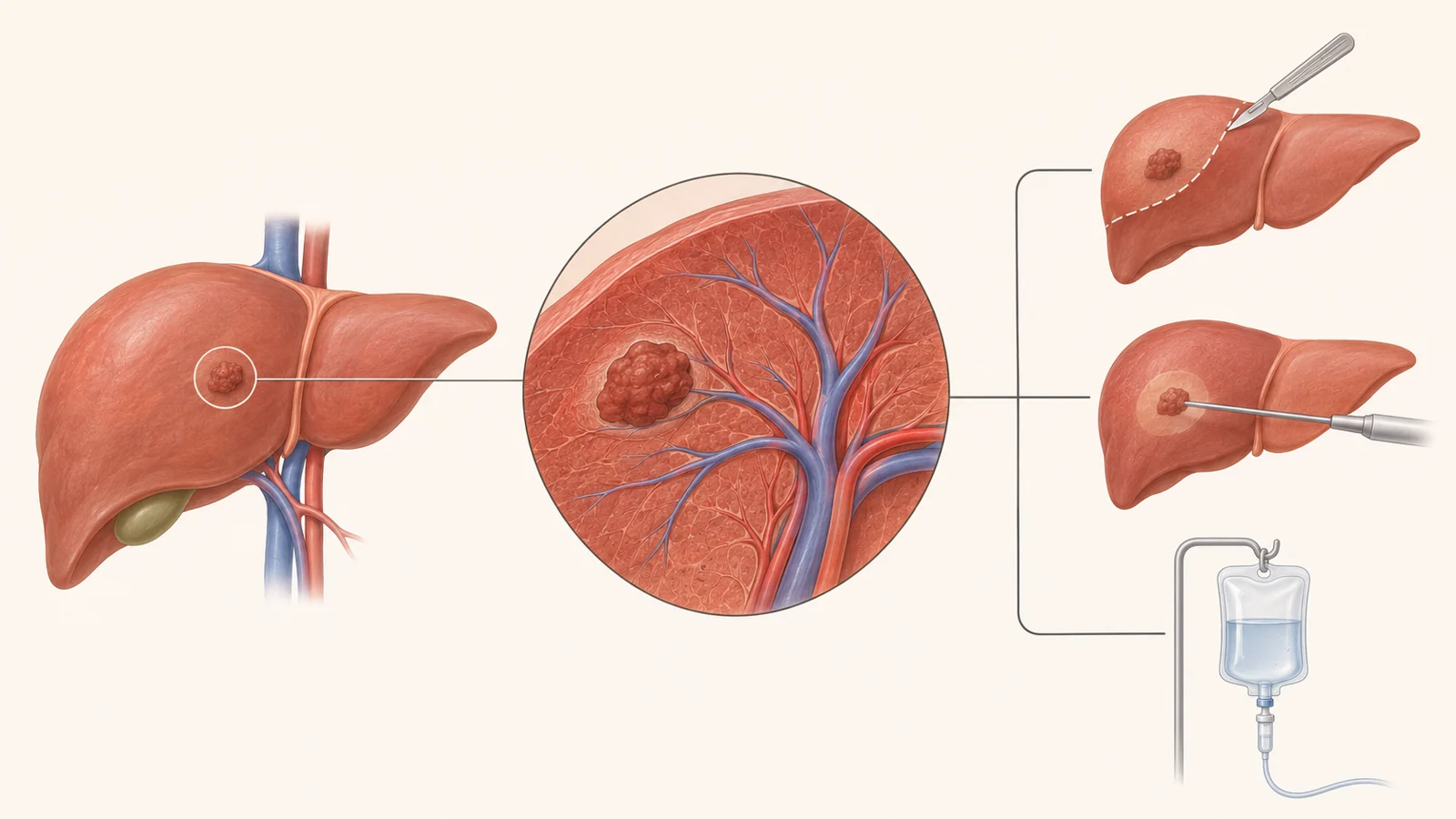
For surgery, clinicians weigh the number and location of tumors, whether cancer has entered blood vessels, liver function, portal hypertension (high pressure in the vein bringing blood to the liver), and how much healthy liver would remain after removing the tumor. A large tumor can make an operation more difficult, but it is not an automatic exclusion. The review cites findings that selected patients with large tumors may undergo resection, particularly when there is no gross vascular invasion, liver function and general condition are suitable, and careful planning is possible. By contrast, clinically significant portal hypertension or inadequate liver reserve can make surgery unsafe even when the tumor itself appears removable.
The INASL approach discussed in the review also allows consideration of transplantation in some patients with severely impaired liver function when tumor size remains within specified criteria. The authors describe these differences as a reason to refine how staging connects a patient’s tumor and liver condition to treatment.
If the treatment usually suggested for a stage cannot be used because of another illness, a technical constraint, treatment failure, or disease progression, clinicians may move to an option associated with the next stage. This is called stage migration. It describes a change in treatment choice when the initial option is not feasible; it does not mean the cancer has necessarily changed stage.
Local treatment and whole-body treatment serve different roles
When surgery, ablation, or transplantation is not suitable, treatment may still aim to control disease or slow its growth. Transarterial chemoembolization (TACE) delivers chemotherapy through an artery supplying the tumor and restricts its blood supply. The review describes it as a commonly used option for selected people with unresectable, intermediate-stage HCC. Indian studies summarized there found TACE could be tolerated in selected patients, while factors such as poorer liver function, larger tumors, portal vein thrombosis, metastasis, and high alpha-fetoprotein were associated with worse survival.
Systemic treatments circulate through the body. The review describes lenvatinib, a targeted drug, as an alternative first-line option for advanced HCC. In a multinational phase III trial summarized by the authors, median survival was 13.6 months with lenvatinib and 12.3 months with sorafenib. The trial found lenvatinib was not worse than sorafenib by more than a preset margin; it did not establish that lenvatinib was better. That comparison informs the treatment option described in the review; it does not show that every patient in India would have the same outcome.
These approaches are not interchangeable. TACE is delivered to the tumor’s blood supply and is used for selected cases; a systemic drug acts throughout the body and has its own eligibility and risks. Liver function and cancer extent remain central to whether either is appropriate.
Pairing immune and blood-vessel targeting
The review also discusses combining atezolizumab, an immune checkpoint drug, with bevacizumab, which targets a pathway involved in forming blood vessels. Checkpoint drugs aim to release some of the brakes that tumors can place on immune cells. The rationale for pairing the two is that blocking blood-vessel signaling may also reduce signals and cells that suppress immune activity inside a tumor, potentially allowing atezolizumab to work more effectively.
In the cited IMbrave150 trial, 67.2% of people receiving the combination were alive at 12 months; the median time before cancer worsened or death was 6.8 months. The review describes a better safety profile than sorafenib on the trial’s reported measures, but serious high blood pressure (grade 3 or 4) occurred in 15.2% of people receiving the combination. These results come from a multinational trial and do not, by themselves, establish identical outcomes in Indian care settings.
How this could shape the future
If India can improve access to timely detection for people at elevated risk, and clinicians can match each tumor to the person’s remaining liver function, more patients may reach care while a wider range of treatments is still feasible. That could make surgery, ablation, or transplantation possible for some who would otherwise be considered only for treatments aimed at controlling later-stage disease. The evidence bridge is practical: the review describes surveillance guidance, the limits of stage-based choices, and treatment findings that make selection matter. A meaningful milestone would be reliable evidence across Indian regions on stage at diagnosis and outcomes after risk-based surveillance, alongside treatment access. Until then, the review supports careful individualized decisions, not a national forecast of how many people could benefit.
Key Sources
- Primary source: Comprehensive Review of Hepatocellular Carcinoma in India: Current Challenges and Future Directions.
DOI or Journal Page · Review or Meta-Analysis · 2022-10-01
Keep exploring