
Research Signal – Source date 2022-09-29
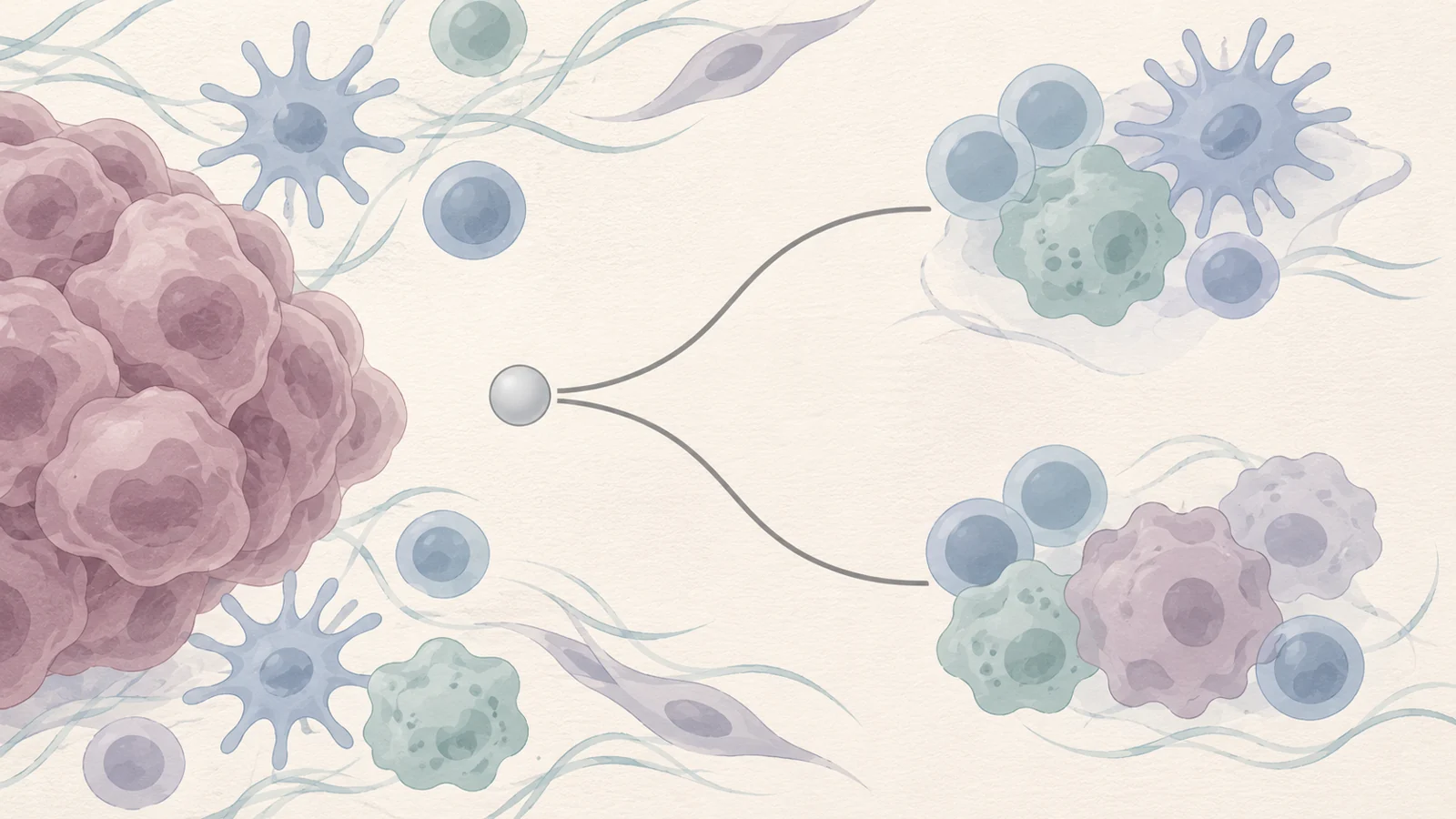
IL-10 is an immune messenger with reported links to both tumor-promoting and tumor-fighting effects. That tension is the central reason it resists a simple label as either helpful or harmful in cancer. A 2022 literature review examines IL-10 in the tumor microenvironment, its relationship to patient outcomes, and possible ways to use it in cancer treatment.
The review’s message is not that both effects occur equally, or that one applies to every cancer. Its abstract describes a broad body of literature but supplies no study-level results or comparisons that would establish which effect dominates in a particular tumor or patient group. The useful point for readers is narrower: IL-10’s role depends on context, so finding it in a tumor is not, by itself, a verdict on what will happen.
A message whose effects depend on context
Cytokines are proteins that cells use to communicate and regulate immune and inflammatory responses. IL-10 is discussed in this review as part of the tumor microenvironment, the setting formed by a tumor and the surrounding cells and signals. Within that setting, the review describes both pro- and antitumor effects attributed to IL-10.
A message between cells can matter differently depending on the surrounding biological conditions and on which response is being considered. The review’s account therefore makes the tumor microenvironment important to interpretation: IL-10’s presence alone cannot tell a reader whether its overall effect in a particular tumor is promoting or opposing cancer growth. Those possibilities help explain the apparent contradiction, but the supplied summary does not identify a dominant pathway or effect for a named cancer.
This is also why a measured amount or presence of IL-10 should not be confused with a direct measure of what it is doing. The review surveys its varied effects in cancer; it does not reduce those effects to one universal direction.
A patient correlation is not a prognosis by itself
The review considers reported correlations between IL-10 and cancer patient outcomes, while describing its prognostic utility as controversial. A correlation means that a feature and an outcome are observed together. It does not, by itself, show that the feature caused the outcome or explain the biological process behind the association.
For prognosis, the practical question is whether an IL-10 measurement can reliably help anticipate how a patient’s cancer will behave. The review’s characterization signals that this relationship is unsettled in the literature it considers. The opposing effects discussed in tumors are one reason a single measurement may be difficult to interpret, but the available abstract does not provide the patient groups, effect estimates, or comparisons needed to judge when an association might be useful.
So IL-10’s presence should not be treated as a stand-alone forecast. A marker can be biologically interesting and still fall short of a dependable guide to an individual patient’s outlook. The review raises the prognostic question; it does not establish a clinical decision tool.
Turning a cytokine into treatment has tradeoffs
Because cytokines regulate immune responses, changing their activity is an attractive idea for cancer immunotherapy. The challenge is controlling a signal that can have multiple effects and that operates among other overlapping signals. Adjusting one cytokine may not produce a simple, isolated response.
The review lists practical hurdles for cytokine-based therapies: a narrow therapeutic window, systemic toxicity, short half-life, and limited efficacy. A narrow window means the desired effect may be difficult to separate from harmful effects. Systemic toxicity is harm that can arise beyond the intended tumor setting; a short half-life means a treatment may not remain active for long. Together with overlapping signals and multiple effects, these constraints make it difficult to assume that boosting or blocking IL-10 would be beneficial across contexts.
The review assesses possible strategies using preclinical and clinical evidence. That scope makes it an assessment of research progress, not evidence that a new IL-10 intervention has completed a trial or is ready for routine care. The supplied summary gives no treatment outcomes or effect sizes to support a claim of patient benefit. Its contribution here is to explain why the therapeutic idea is being explored and why its promise is not straightforward.
What this could make possible
Imagine a future cancer consultation where validated knowledge of a tumor’s IL-10 context helps clinicians decide whether an IL-10-directed approach is worth considering. That would require both dependable guidance about when the signal matters and an intervention that can change it safely and effectively. The review’s account of opposing effects and treatment constraints explains why those advances would need to come together; it does not show that they have already arrived.
A meaningful step toward that capability would be human studies that specify the expected tumor context in advance and report both patient outcomes and adverse effects. Such evidence could help clarify whether a defined setting makes IL-10 useful to target, and at what cost. Until then, the prospect is conditional: the same immune message may matter in more than one direction, and treatment decisions would need evidence that can distinguish those contexts.
Key Sources
- Primary source: IL-10 in cancer: an essential thermostatic regulator between homeostatic immunity and inflammation – a comprehensive review.
DOI or Journal Page · Review or Meta-Analysis · 2022-09-29
Keep exploring