
Research Signal – Source date 2022-09-09
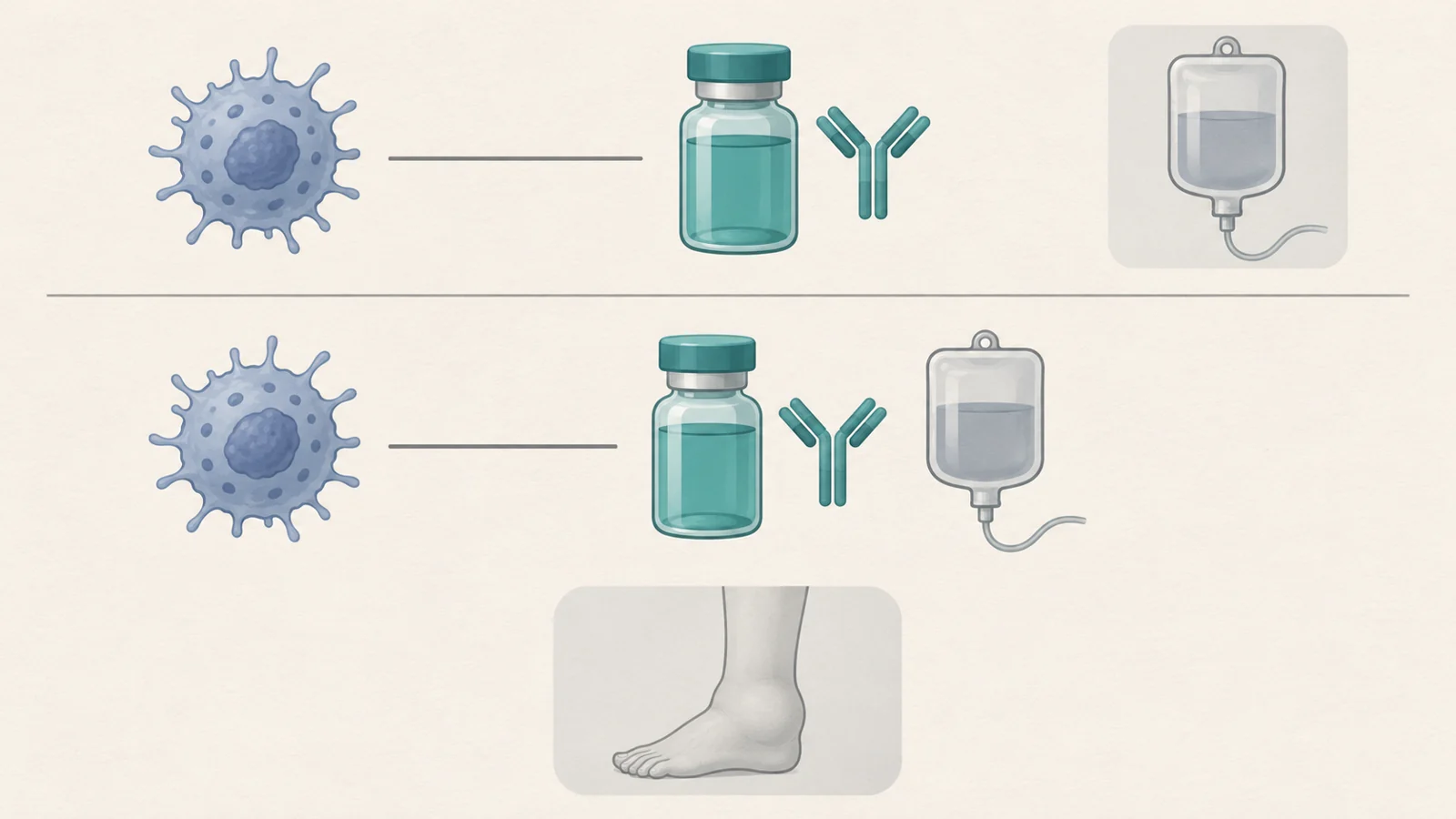
A cancer drug can be compared with chemotherapy as a replacement, or added on top of chemotherapy. For peripheral edema—swelling in the limbs—the reported trial results looked different in those two situations. A 2022 analysis found lower odds of any-grade edema when PD-1/PD-L1 immune checkpoint drugs were used instead of chemotherapy. When the drugs were added to chemotherapy, the pooled comparison did not establish a change.
That difference matters when interpreting trial averages. Neither result can tell what caused one person’s swelling, and the replacement finding is specific to this side effect, not a verdict on overall treatment safety.
The comparison depends on what the drug replaces
PD-1/PD-L1 inhibitors are immune checkpoint drugs: they act on proteins involved in regulating the immune response to cancer. The paper combined results from controlled cancer trials that reported peripheral edema. The eligible trials involved solid tumors; trials of blood cancers were excluded.
The authors selected 27 trial articles for the synthesis, but fewer contributed to each pooled estimate. For any-grade edema, 16 trials entered the final pooled analysis across the treatment comparisons. The pooled odds ratio was 0.36 (95% confidence interval 0.23–0.56). In other words, the odds of reported edema were lower in the inhibitor groups than in the chemotherapy groups in these trials. This is a relative comparison of odds, not an estimate of any individual patient’s absolute chance of swelling.
The result also varied considerably across trials: I² was 65%, which the authors classified as high heterogeneity. Their subgroup analyses pointed to differences among tumor types, with two lung cancer trials identified as possible contributors to the variation. The pooled finding is therefore a summary across different studies, not a uniform pattern demonstrated in every cancer setting.
Adding the drug gave a different answer
The add-on comparison asked a separate question: did regimens combining a PD-1/PD-L1 inhibitor with chemotherapy differ from chemotherapy alone? For any-grade edema, the pooled odds ratio was 1.15, with a 95% confidence interval of 0.93–1.44 and P = .20.
The point estimate sits slightly above 1, but the interval includes values below and above 1. That means the results were compatible with either somewhat lower or somewhat higher odds, and the analysis did not establish that adding an inhibitor changed the frequency of any-grade edema. It does not show that the combination increased swelling.
Here, the treatment context matters: chemotherapy was present in both groups, so the comparison estimates the difference associated with adding the immune checkpoint drug within the studied regimens. The finding should not be read as a general answer for every combination or cancer type.
More severe swelling was less certain
Any-grade edema includes events across the severity range. It cannot stand in for the more serious outcome. For grade 3–5 edema, 10 trials entered the final analyses, fewer than in the any-grade assessment.
In the inhibitor-alone comparison, the odds ratio was 0.53 (95% CI 0.17–1.63). For inhibitor plus chemotherapy versus chemotherapy alone, it was 0.55 (95% CI 0.19–1.61). Neither analysis established a difference. Both intervals are wide and include the possibility of lower or higher odds, so these results also do not demonstrate equal risk between the groups.
A trial average cannot identify one person’s cause
Peripheral edema can have several possible contributors in cancer care. The paper names chemotherapy and other cancer treatments, malnutrition, and liver or kidney disease among them. When swelling occurs, a pooled comparison cannot separate those possibilities for an individual or diagnose the cause.
The analysis summarizes adverse-event reports from groups in prior trials. It does not validate a rule for deciding why a particular person’s limb is swollen or what treatment should follow. The replacement and add-on estimates describe different comparisons, and neither turns an observed symptom into an individual causal diagnosis.
What this could make possible
If future evidence confirms treatment-specific patterns, a person who develops limb swelling while receiving a cancer drug combination could have that symptom interpreted against more dependable evidence for the particular regimen and cancer setting, alongside other possible causes. The paper’s different estimates for replacing chemotherapy and adding an inhibitor show why those comparisons need to remain distinct. Better reporting and independent validation would be needed before such comparisons could reliably support that more specific interpretation.
A nearer milestone would be for controlled studies to report edema consistently by severity and treatment regimen, with enough comparable data to test whether the different patterns persist across cancer types. That would make future pooled estimates more useful for understanding which treatment contexts are associated with different rates of reported swelling, while leaving individual assessment grounded in the full clinical picture.
Key Sources
- Primary source: Incidence risk of peripheral edema in cancer patients treated with PD-1/PD-L1 inhibitors: A PRISMA guideline systematic review and meta-analysis.
DOI or Journal Page · Review or Meta-Analysis · 2022-09-09
Keep exploring