
Research Signal – Source date 2022-09-05
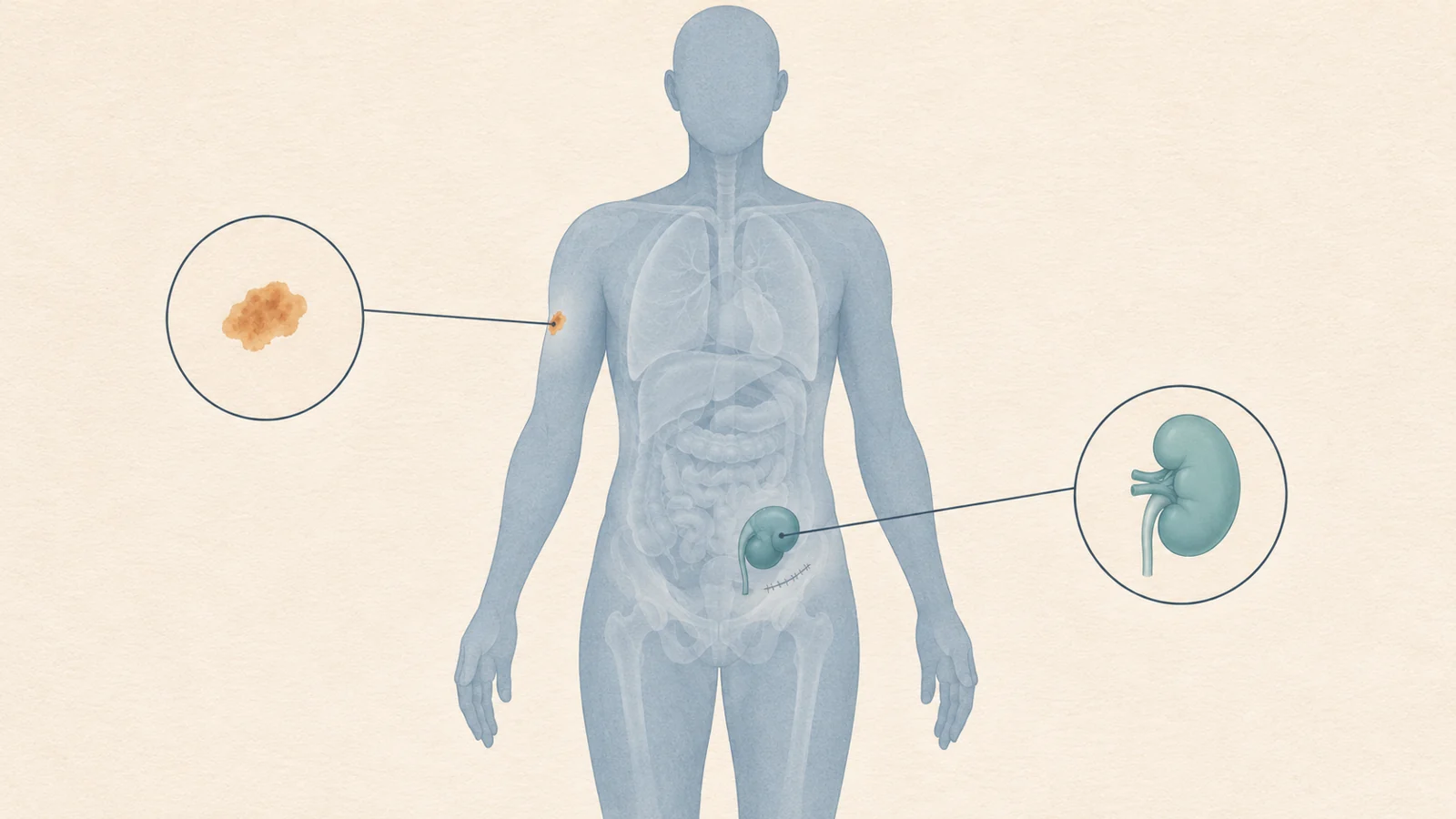
For someone with advanced skin cancer and a transplanted organ, a treatment that helps control the cancer may also put that organ at risk. A 2022 systematic review gathered reports of 33 solid-organ transplant recipients with advanced cutaneous squamous cell carcinoma who received programmed cell death-1 (PD-1) inhibitors. PD-1 is a target of these immune treatments. Across the reported cases, 21 patients had a tumor response, and 11 experienced rejection of their transplanted organ.
Those figures put the central trade-off in view, but they do not settle what would happen to a particular patient. The cases came from 21 articles, and the review did not compare PD-1 treatment with another treatment or with no treatment in transplant recipients.
Responses and rejection in the reported cases
The review counted a tumor response in 21 of the 33 recipients, including cases without a standardized response score. Separately, 11 of 33 experienced allograft rejection: the immune system attacked the transplanted organ. These are outcomes reported among people who received treatment, not a controlled comparison showing how much the treatment changed either risk.
For 25 recipients, the reports included response scores using iRECIST, a system for classifying how tumors respond to immune-based cancer treatment. Twelve of those 25 were scored as complete responses and eight as partial responses; three had progressive disease, and two had stable disease. The complete and partial responses together account for 20 of those 25 scored cases. They should not be added to the 21 responses among all 33 patients: the figures use different groups and reporting criteria.
A response does not establish that someone was cured or show what another patient is likely to experience. The review describes a notable possibility of tumor control alongside a substantial number of reported rejections, without providing a dependable individual prediction.
A small collection across four organ types
The 33 recipients were reported across 21 articles, rather than enrolled and followed as one uniform prospective trial. Twenty-six had kidney transplants, four had liver transplants, two had lung transplants, and one had a heart transplant. With so few cases overall—and only one or two for some organ types—the combined results cannot provide reliable response or rejection estimates for each kind of transplanted organ.
The uneven mix also matters when interpreting the overall percentages. A figure calculated across all 33 recipients summarizes these assembled cases; it is not a stable estimate that can be applied separately to kidney, liver, lung, or heart transplant recipients. Nor does the review establish how these patients would have fared under a different cancer treatment.
Risk management remains a proposal
The review identifies use of mTOR inhibitors, preventive steroids, and monitoring for donor-derived cell-free DNA as approaches that might help reduce or detect rejection risk if PD-1 treatment is pursued. Donor-derived cell-free DNA monitoring looks for fragments of genetic material from the transplanted organ in the recipient’s blood. In this review’s abstract, these approaches are suggestions, not demonstrated guarantees: the reported evidence does not establish that any one prevents rejection.
That distinction is consequential for a patient weighing treatment. A possible way to watch for or manage graft injury is not the same as proof that the risk has been removed. The cases support careful weighing of cancer outcomes and transplant risks, not a one-size-fits-all treatment rule.
Deaths show the stakes without resolving the choice
Eleven of the 33 recipients died. The review attributed six of those deaths to tumor progression. One was attributed to rejection after the patient forwent dialysis. These details show that both uncontrolled cancer and graft rejection can have serious consequences in the reported cases.
The death counts do not show whether PD-1 treatment improved or worsened survival. They also cannot tell a reader what would happen to an individual: the review assembled reports of different patients, and the available abstract does not provide a controlled survival comparison. The findings are best read as a record of outcomes that make the treatment decision difficult, not as a calculation of the right choice for every transplant recipient.
How this could shape the future
For a person living with a transplanted organ and advanced skin cancer, more dependable evidence could make a difficult treatment discussion more concrete. A clinical team and patient could weigh a better-supported chance of tumor control against a better-supported chance of graft injury for people like them. The review contributes an early paired account of those outcomes; it does not yet make either estimate dependable for an individual.
The nearer milestone is prospective reporting that follows cancer response and graft health consistently across transplant types. If future evidence can build on this small collection with more complete, comparable outcomes, it could give patients and clinicians a stronger basis for decisions they already have to make. The practical gain would be clearer estimates for the person facing both risks, rather than a promise that one treatment choice is safe for everyone.
Key Sources
- Primary source: Systematic review of programmed cell death-1 inhibitor therapy for advanced-stage cutaneous squamous cell carcinoma in solid-organ transplant recipients.
DOI or Journal Page · Review or Meta-Analysis · 2022-09-05
Keep exploring