
Research Signal – Source date 2022-09-02
Two people receiving cancer immunotherapy developed severe liver injury that progressed to liver failure. Both later recovered liver function during combined treatment that included a non-biological “artificial liver”—a temporary treatment that processes blood or plasma outside the body. Their cases show how this support was used alongside care aimed at the immune injury. They cannot tell us how much the plasma treatments contributed to recovery on their own.
The report, published September 2, 2022, describes two patients with advanced gastrointestinal cancers. Their liver problems appeared after treatment with immune checkpoint inhibitors, medicines that help the immune system recognize and attack cancer. The same immune activation can sometimes injure healthy organs, including the liver. The paper also reviews prior literature, but its patient-level evidence here comes from these two cases.
When liver injury became urgent
Immune-related liver injury can first appear in blood tests as raised liver enzymes, sometimes without obvious symptoms. More severe cases may involve jaundice—yellowing of the skin or eyes—and impaired blood clotting. In rare cases, the authors note, the injury can progress to liver failure.
The first patient developed widespread skin rashes 12 days after starting checkpoint-inhibitor treatment. The authors considered this an earlier immune-related problem. Later, the patient developed fatigue, loss of appetite, jaundice and abnormal clotting, with very high liver enzyme levels. Tests and imaging were used to assess other possible causes, including viral, autoimmune and other liver diseases, as well as a blockage in the bile ducts. The report says these alternatives were excluded. A liver biopsy was not performed because the clotting problem made the procedure too risky.
The second patient’s course unfolded differently. After about 14 weeks of checkpoint-inhibitor treatment, she developed fatigue and loss of appetite. Blood tests showed high liver enzymes. Those levels later fell while bilirubin—the substance that can build up and cause jaundice—rose, and clotting worsened. She had a history of hepatitis B, but the report says the virus was suppressed on long-term antiviral treatment. The team also considered other liver causes; imaging showed no bile-duct blockage, and the cancer lesions had become smaller. A biopsy was recommended but declined by her family.
In both cases, clinicians judged the pattern and timing, alongside tests for other possible causes, to be consistent with immune-related liver injury. The patients’ cancer and treatment histories made that assessment consequential: the teams were managing severe liver dysfunction while also treating advanced malignancy.
Blood treatment outside the body
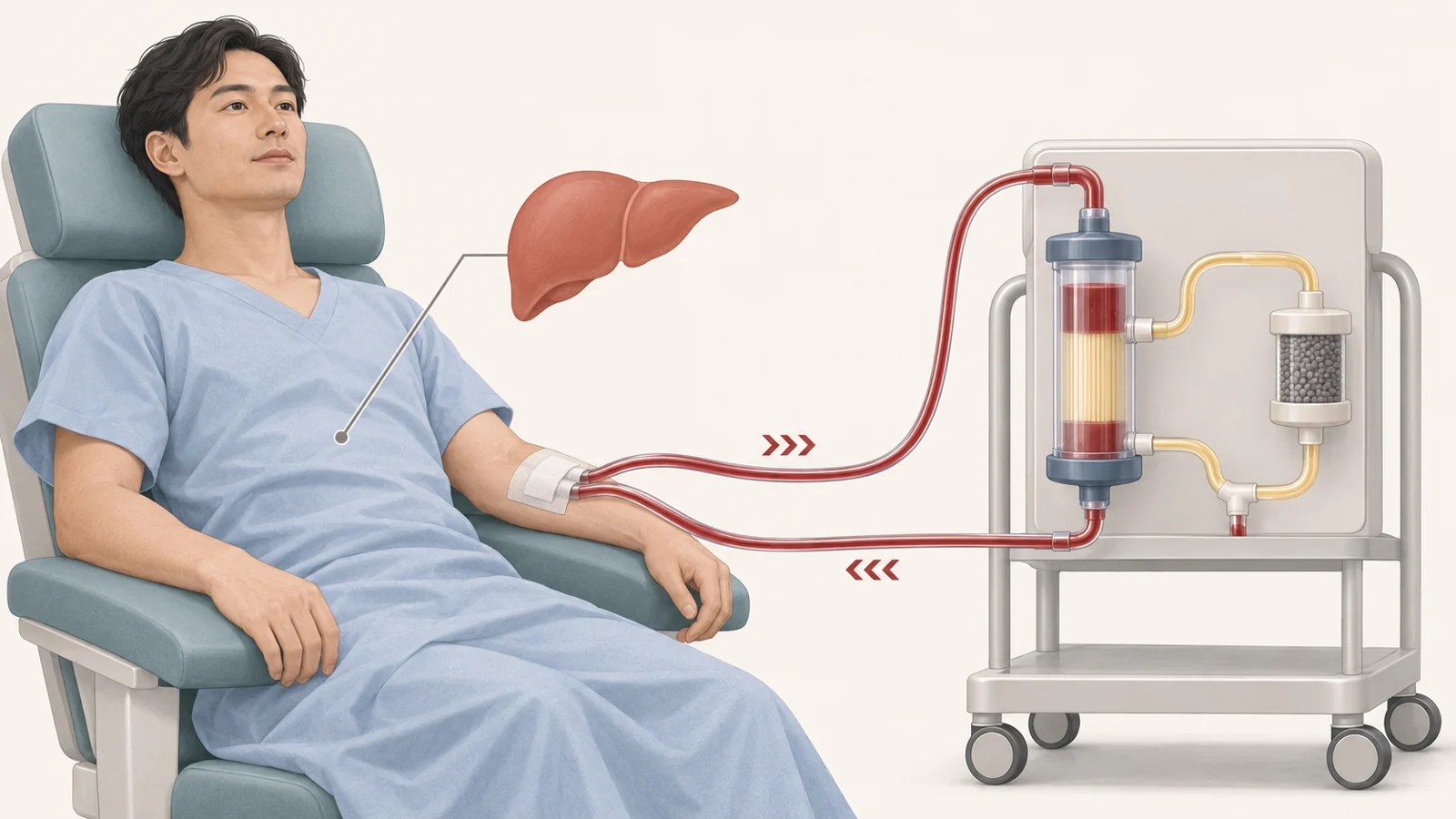
The term “artificial liver” can suggest an implanted replacement organ. That is not what the report describes. The patients received non-biological support in which blood or plasma was treated outside the body and returned. The procedures could temporarily take on parts of the work a failing liver normally performs, while other treatment addressed the suspected immune attack and supported the patients.
The first patient’s checkpoint inhibitor, sintilimab, was stopped. Treatment included glucocorticoids, which suppress immune activity, and other liver-supportive care. The patient then received three plasma-exchange sessions, each using two liters of fresh frozen plasma. In plasma exchange, a portion of the patient’s plasma is removed and replaced with donor plasma. The authors describe the approach as removing harmful substances while supplying plasma components, including substances that support functions such as clotting.
The second patient received a different sequence. After liver-supportive care, she was treated with glucocorticoids and mycophenolate mofetil, another medicine that suppresses immune activity. Her care then included double plasma molecular adsorption, plasma exchange, and a session combining adsorption with exchange. Adsorption uses a treatment material to capture substances from circulating plasma; the report describes these methods as part of temporary support for liver failure.
These were not matching treatment schedules. Each patient received several therapies, and the report does not establish a single standard protocol for this complication. The plasma treatments were used as a bridge during severe illness, alongside efforts to control immune injury and maintain the body’s internal conditions while liver function recovered.
Two recoveries, with different cancer courses
The authors report that liver function and clotting improved after treatment in the first case. Sintilimab was discontinued. The patient later received three cycles of systemic chemotherapy, during which liver function remained normal. Follow-up imaging showed the pancreatic-area tumor had shrunk, and the authors assessed the cancer response as a partial remission. They reported that the patient was undergoing surgery. This was chemotherapy after checkpoint-inhibitor discontinuation, not a return to checkpoint-inhibitor treatment.
In the second case, the authors report that liver function returned to normal after the adsorption and plasma-exchange treatments. Follow-up imaging showed substantial shrinkage of the liver lesions, also assessed as a partial remission. Those cancer findings occurred during the patients’ broader care; the cases do not show that plasma support caused the tumors to shrink or that it improved cancer control.
What the cases can tell us
The report gives a concrete account of two patients with severe immune-related liver injury who recovered liver function during combined care that included artificial liver support. It also describes the clinical reasoning behind attributing the injury to checkpoint inhibitors, and the different plasma-based procedures used as the patients’ liver function deteriorated.
But the treatment sequence is not a test of which part of care made recovery possible. Both patients received immunosuppressive and supportive treatments as well as plasma-based procedures. There was no comparison group, and neither case had liver-biopsy confirmation. With only two patients, the report cannot isolate the contribution of plasma exchange or adsorption, establish an effect on survival, or show that the same approach would work for other patients.
What this could change
For a hospitalized patient whose cancer treatment is interrupted by severe liver failure, temporary plasma support could become a more dependable bridge if future evidence shows which patients are likely to benefit and how best to combine it with treatment for the immune injury. Preserving liver function long enough for recovery could give an oncology team room to consider further cancer care. These two recoveries make that bridge clinically imaginable; they do not establish that the support itself caused recovery or enabled later treatment.
A meaningful nearer milestone would be prospective records of comparable severe cases, documenting immunosuppression alongside liver recovery, survival and the cancer-treatment options patients were able to pursue afterward. That would help show whether this temporary support can reliably create time for liver recovery and a next oncology decision.
Key Sources
- Primary source: Application of artificial liver in immune-related liver injury induced by immune checkpoint inhibitor: Case reports and review of the literature.
DOI or Journal Page · Review or Meta-Analysis · 2022-09-02
Keep exploring