
Research Signal – Source date 2022-08-29
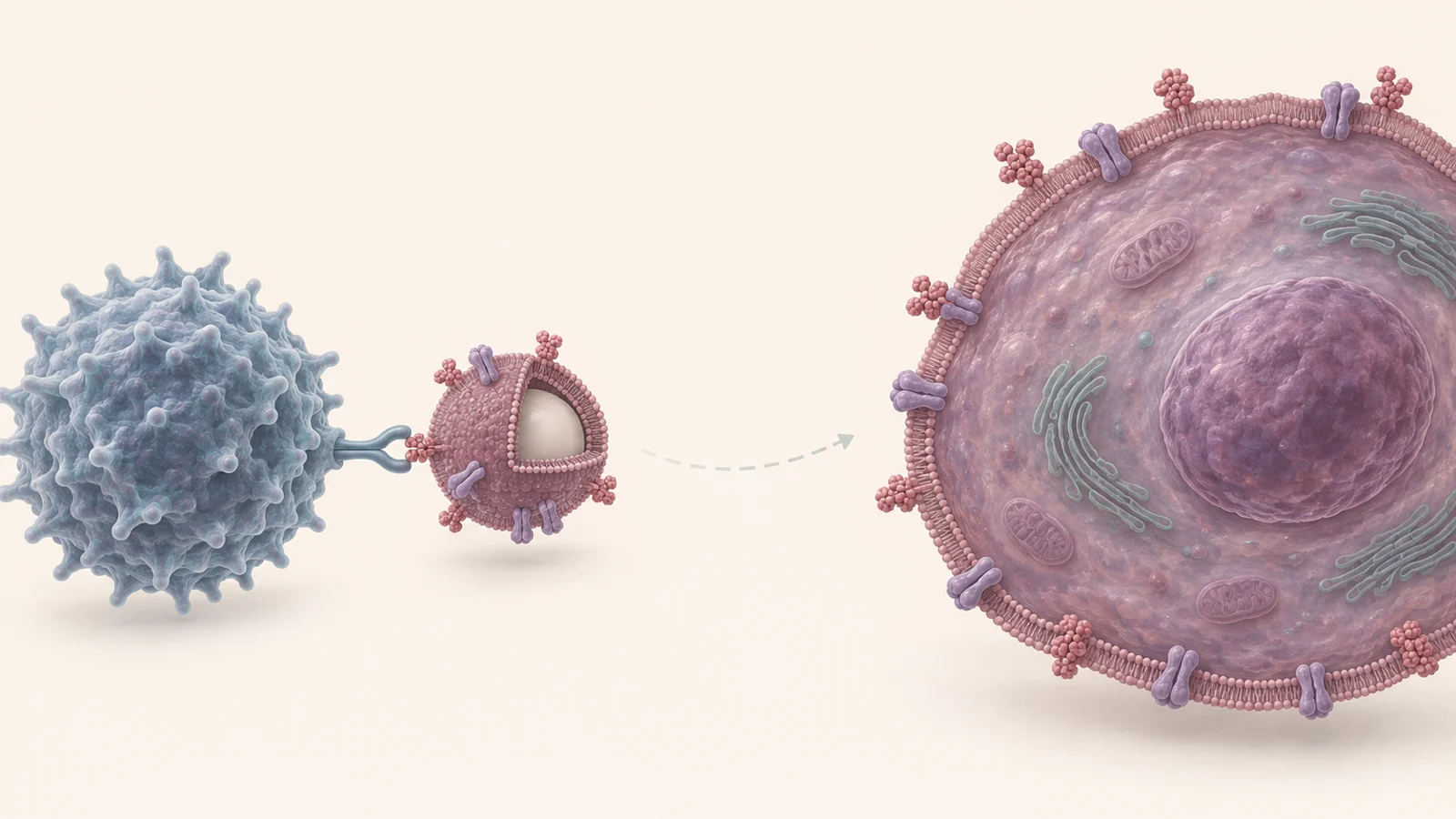
Cancer-cell membranes carry surface features that may help a coated carrier interact with similar tumor cells. Researchers have explored turning that familiar surface into a covering for tiny treatment carriers, hoping the carriers will both home toward similar tumors and bring tumor material into view for the immune system. It is an unusual strategy: the same biological coating may help a carrier approach a tumor while also supplying features the immune system could learn to recognize.
A review published on August 29, 2022, gathers experimental approaches using these cancer-cell membrane-wrapped nanoparticles, or CCNPs. The work it describes spans drug delivery, changes to the tumor’s immune environment, checkpoint-drug combinations, and vaccine designs. The examples offer a rationale for pairing delivery with immune recognition, while remaining mostly laboratory and mouse research rather than evidence of a validated treatment for people.
A familiar surface changes the carrier
A nanoparticle in this setting is a very small carrier designed to transport or present treatment components. Researchers can build a carrier from materials such as polymers, silica, or other engineered substances, then wrap it in a membrane taken from cancer cells. The underlying particle carries the payload; the borrowed membrane changes what is presented at its surface.
Cancer-cell membranes retain a mix of surface molecules. The review discusses features including adhesion molecules, integrins, and cadherins, along with tumor antigens. Some of these surface traits may help a coated carrier interact with a tumor of the same type, a proposed form of “homotypic” targeting. The review also describes membrane coatings as potentially helping carriers circulate longer or evade some immune clearance. Those are design advantages reported across experimental work, not a guarantee that a carrier will find a human tumor reliably.
This approach tries to address a practical problem with synthetic carriers: the body can recognize and remove foreign materials, while particle size and other design limits can affect where carriers accumulate. The review notes that larger nanomaterials may remain in spaces outside cells, while very small ones can be filtered through the kidneys. A cell-derived coating may alter how a carrier is encountered, but it does not make the engineering and biological obstacles disappear.
Reaching a tumor is only one part of immunity
For an immune response against cancer to begin and continue, the review identifies three broad ingredients: an antigen, an adjuvant, and a supportive tumor immune environment. An antigen is material the immune system can recognize. An adjuvant helps stimulate that response. The tumor immune environment is the local mix of cells and signals that can either permit immune attack or suppress it.
A carrier that accumulates near a tumor has not necessarily solved the other two problems. A tumor may present few recognizable targets, have too few immune cells entering it, or create suppressive conditions that blunt those cells. The review describes CCNP strategies aimed at changing this local environment as well as carrying tumor antigens. In one mouse example, membrane-coated polymer particles were linked to less cancer-cell movement toward neighboring fibroblasts and to more cytotoxic T cells, immune cells that can kill cancer cells. Another experimental magnetic-particle design displayed tumor-specific antigens and stimulated natural killer cells, another type of immune cell.
These examples point to different steps in the immune process. A carrier may deliver something or alter local conditions, while immune cells still need to recognize a target and sustain an effective response. Results in cells or mice help researchers examine those steps, but they do not show that the same effects will be safe, dependable, or durable in people.
Pairing delivery with released immune restraints
Checkpoint medicines are an established class of cancer immunotherapy. Drugs that block PD-1, PD-L1, or CTLA-4 can release certain restraints on immune cells, and the review names medicines in these classes that were already in clinical use by the time it was published. Yet checkpoint treatment does not work for everyone. The review describes barriers such as weak tumor recognition, limited immune-cell entry, and suppressive conditions around tumors.
The experimental logic of combination treatment is to address more than one barrier at once. A membrane-coated carrier might deliver a drug or create a local tumor effect, while a checkpoint medicine helps immune cells act with fewer restraints. The review summarizes combinations involving chemotherapy, light-activated treatments, and checkpoint drugs. For example, one experimental strategy used membrane-coated silica particles carrying an enzyme in a tumor-starvation approach, alongside anti-PD-1 treatment. Other reported mouse strategies combined membrane-coated carriers with anti-CTLA-4 or anti-PD-1/PD-L1 treatment.
These are experimental combinations discussed by the review, not evidence that a CCNP has become part of routine checkpoint treatment. Combining components can make the intended chain of effects more ambitious, but each component and the way they interact would need to be assessed. A stronger immune response in a model does not by itself answer whether the approach would improve outcomes or avoid unwanted effects in people.
Vaccines give the membrane another job
In a cancer vaccine, the purpose is to present tumor-associated material in a way that encourages the immune system to build a targeted response. Here the membrane is not only a proposed delivery surface: it can also carry a collection of antigens from the source cancer cells. Researchers have paired that material with adjuvants, which provide immune stimulation, with the goal of helping antigen-presenting cells teach T cells what to recognize.
The review describes a vaccine made by reconstructing a cancer-cell membrane with an immune-stimulating ingredient. It reports stronger immune responses and immune memory against a later challenge with the same tumor-cell line. In separate experiments with tumor-bearing mice after surgery, the review reports improved survival when a membrane-coated vaccine was combined with anti-PD-1 treatment and near-infrared light.
A vaccine result in mice is evidence about that experimental model, not a demonstrated preventive or therapeutic vaccine for patients. The review also raises a practical concern: using material derived from cancer cells requires rigorous procedures to ensure the coating is pure and does not contain components that could promote cancer growth. That concern is especially relevant to any idea of using such material in people who do not already have a cancer diagnosis.
Translation depends on simpler, dependable designs
The membrane can bring useful biological features, but adding more membrane types, payloads, or treatment methods also adds complexity. Hybrid coatings made from different cell membranes might combine functions, as the review discusses, yet more elaborate designs could bring greater toxicity or unwanted immune responses. A tailored carrier would also depend on obtaining appropriate tumor material and preparing it consistently.
Before these strategies could support patient care, researchers would need to establish how to manufacture membrane-coated carriers in standardized, measurable ways and which simpler designs merit further testing. Well-designed human trials would need to evaluate safety and whether the intended immune response occurs. The review’s central translational challenge is the gap between effects seen in laboratory or animal studies and a reliable approach for human tumors. It does not establish a standardized patient-specific product or show improved outcomes in people.
What this could change
If researchers can make these carriers consistently, establish their safety, and show that they help immune treatment recognize tumors in clinical studies, a person with a solid tumor might one day have material from that tumor used to make a tailored carrier. The hoped-for benefit would be a more dependable way to direct tumor-matching features and antigens toward an existing immune treatment, helping it recognize that person’s cancer more effectively. Checkpoint medicines already exist; the new capability would be a reliable, patient-matched membrane carrier that adds a tumor-specific delivery and recognition element. The review’s rationale comes from the proposed targeting features and antigen repertoire of cancer-cell membranes, but that future use would require advances in manufacturing, safety, and clinical treatment.
A nearer milestone would be a standardized formulation tested in a well-designed human trial for safety and immune response. If that evidence eventually supported the approach, patients might gain a treatment component prepared around the features of their own tumor. That possibility is a future-facing implication of the review’s experimental rationale, not a patient benefit demonstrated in the studies it summarizes.
Key Sources
- Primary source: Cancer cell membrane-wrapped nanoparticles for cancer immunotherapy: A review of current developments.
DOI or Journal Page · Review or Meta-Analysis · 2022-08-29
Keep exploring