
Research Signal – Source date 2022-08-24
A lung tumor can carry a mutation that gives doctors a target for a specific drug and still respond poorly to treatment that helps immune cells attack cancer. These are different clues: a mutation may help a cancer cell grow, while immune recognition depends on whether the immune system can identify the tumor and act inside its surroundings.
A 2022 review of lung cancer in people who have never smoked brings these clues together. It describes a varied group of cancers, possible reasons immune checkpoint drugs—which release some of the immune system’s brakes—may work less reliably for some patients, mixed clinical results, and safety concerns when immunotherapy is followed by certain mutation-targeted drugs. The review synthesizes earlier studies; it does not test a new treatment or establish one best approach.
A broad group with different tumor biology
The review estimates that lung cancer in never-smokers accounts for 10–25% of lung cancer cases. The group is not a single biological subtype. These cancers are more often adenocarcinomas and are more common in women, but age at diagnosis varies by region. The review also describes differences in tumor genetics and immune surroundings within the group.
One cited comparison of 160 never-smokers and 299 smokers found clinically actionable genomic alterations in 65% of never-smokers’ tumors versus 35% of smokers’ tumors. “Actionable” means a doctor may be able to match a particular alteration to a targeted drug. The result came from that study’s patient samples and analyses; it does not mean that every person who never smoked has a targetable mutation.
A small sequencing study illustrates another difference. Among 17 patients whose tumors and normal tissue were analyzed, five were never-smokers. Their tumors had about 0.6 mutations per megabase, compared with 10.5 per megabase in tumors from smokers. That is a striking contrast in this small sample, not a universal count for either group.
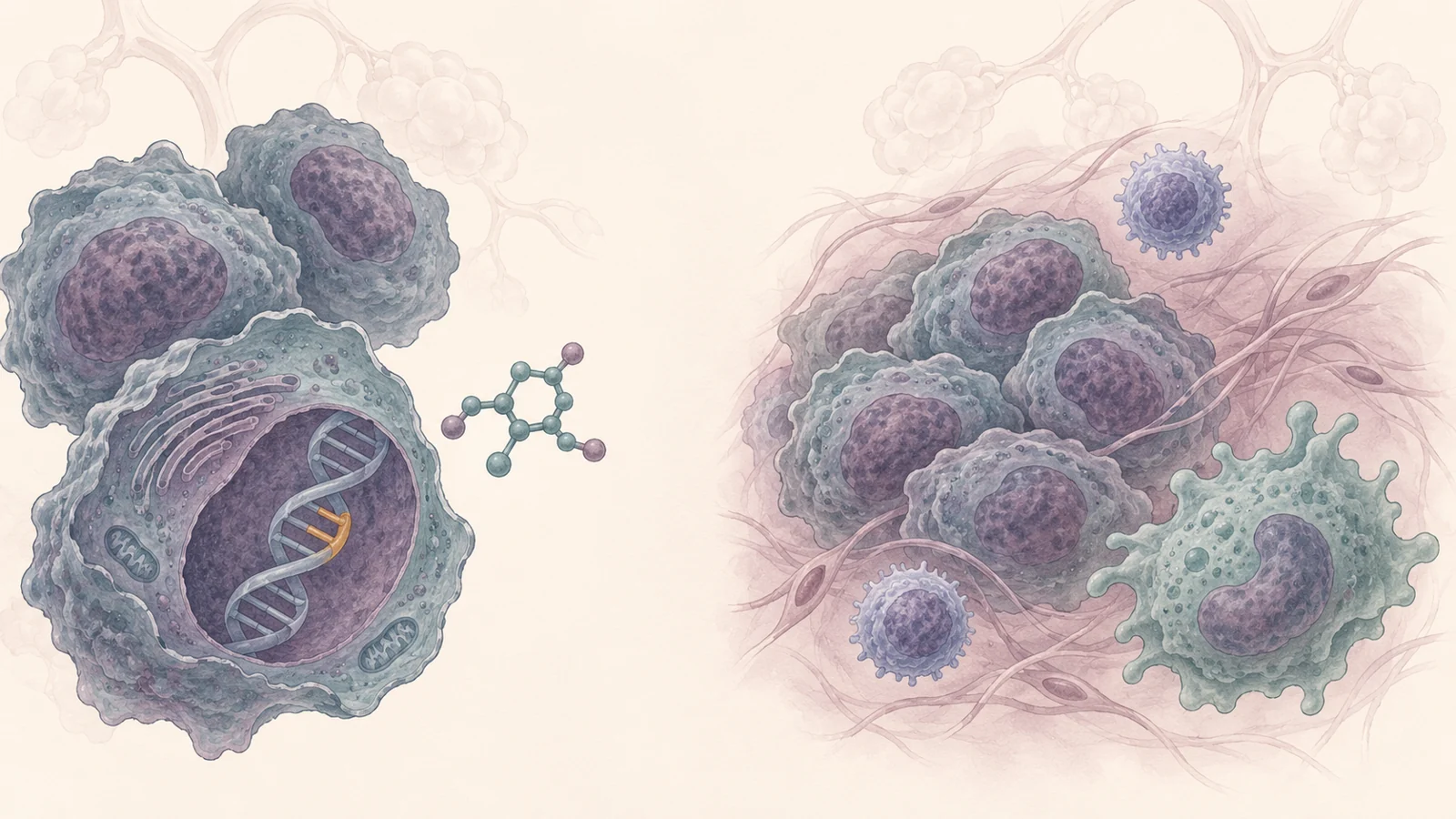
Mutation count matters to immune recognition because some tumor mutations can produce altered proteins, called neoantigens, that immune cells may recognize as foreign. A driver mutation, by contrast, is important because it helps a cancer grow and may be vulnerable to a matched drug. A tumor can therefore have a useful drug target without presenting many mutation-derived signals for immune cells to detect. The review proposes low mutation burden and a lower load of mutation-associated neoantigens as one reason checkpoint treatment may be less effective in some never-smoker tumors.
An immune brake is only one part of the problem
Checkpoint drugs act on signals that can restrain immune cells. One such signal involves PD-L1, a protein that can appear on tumor cells and dampen an immune attack. But blocking a brake may not be enough if the tumor microenvironment—the cells and conditions surrounding a tumor—also discourages immune activity.
The review describes several possible barriers. Tumor cells may produce immunosuppressive factors such as TGF-beta and CD39. The surrounding tissue may contain more regulatory T cells and M2 macrophages, which can limit or redirect immune responses, and fewer activated immune cells. Tumors may also interfere with antigen presentation, the process that displays recognizable tumor fragments to immune cells. Differences in metabolism and in the organization of tertiary lymphoid structures—local arrangements of immune cells—are additional proposed factors.
PD-L1 levels alone may not capture this whole environment. The review notes that some never-smoker tumors can express PD-L1 yet still fail to show durable responses to checkpoint drugs. A marker on tumor cells does not by itself tell the full story of immune recognition, the cells present nearby, or whether those cells can sustain an attack. These mechanisms are plausible explanations discussed in the review; the cited associations do not identify the cause of an individual patient’s response.
Patient results point in different directions
Clinical studies reviewed in the paper do not give a single answer about checkpoint treatment in never-smokers. Their patient groups, treatment settings and analyses differ, which matters when comparing their findings.
In one prospective real-world cohort, 268 people with advanced non-small cell lung cancer received anti-PD-1 treatment; 78 were never-smokers. The reported response rate was 14% for never-smokers, compared with 26% for former smokers and 36% for current smokers. Even among patients whose tumors had high PD-L1 levels, the response rate was 19% in never-smokers and 58% in current smokers. Most people in the cohort received immunotherapy in the second line or later, and the never-smoker group included tumors with EGFR mutations and ALK fusions. The finding describes that cohort, not every patient with similar smoking history or PD-L1 levels.
A separate retrospective study examined 962 people with advanced disease and high PD-L1 levels who received pembrolizumab as first treatment. Never-smokers had a higher risk of progression and death than smokers in the initial analysis. After matching patients on selected characteristics, the higher progression risk remained, while the difference in overall survival was no longer statistically significant. This analysis raises a concern but cannot settle how treatment should be chosen for an individual.
Another study of people with high PD-L1 levels did not find statistically significant differences among smokers, light smokers and never-smokers. Some outcome measures numerically differed, but the analysis did not establish a reliable separation between the groups. Across these reports, smoking history alone does not neatly predict who will respond; tumor alterations, treatment line and study design all shape what a result can show.
Treatment order may carry its own risk
The potential for a matched drug to help does not make treatment order irrelevant. The review describes retrospective safety signals in patients who received an immune checkpoint inhibitor before certain targeted drugs. These reports are small or observational, so they identify risks worth investigating rather than proving a universal rule.
In one analysis of people with EGFR-mutated lung cancer, 6 of 41 patients who received the targeted drug osimertinib after an immune checkpoint inhibitor developed severe adverse events requiring corticosteroids; some were hospitalized. These events were more frequent when osimertinib began within three months of the prior immunotherapy. In the same report, no severe adverse events were observed among patients treated in the reverse order. The observation does not establish that the reverse order is safest for every patient, but it makes the sequence a clinically important question.
A separate report found severe, grade 3 or 4 increases in liver enzymes in 5 of 11 patients with ALK, ROS or MET alterations who received crizotinib after checkpoint treatment. The reported liver effects were reversible and nonfatal. Together, these retrospective findings suggest that a treatment sequence can affect safety as well as expected cancer response. They do not quantify the risk for every drug combination or patient.
Combination results are promising but incomplete
The review also discusses evidence for combining chemotherapy with immunotherapy. In a subgroup of never-smokers in the KEYNOTE-189 trial, pembrolizumab plus platinum-based chemotherapy was associated with better overall survival than chemotherapy alone; the reported hazard ratio was 0.23, indicating a lower estimated rate of death during follow-up for the combination group. In IMPOWER150, never-smokers receiving a combination that included atezolizumab, bevacizumab and chemotherapy had median overall survival of 22.3 months, compared with 18.2 months in the comparison group. The estimated hazard ratio was 0.75, with a confidence interval that included no difference, so the result was a trend rather than a conclusive benefit in that subgroup.
A pooled analysis of first-line treatment among people with high PD-L1 levels also found better outcomes for never-smokers receiving immunotherapy with chemotherapy than for those receiving immunotherapy alone. These subgroup findings make combination treatment a worthwhile question. They do not establish the best regimen for all never-smokers: the studies were not all designed to answer that specific question, and never-smokers may have different driver mutations and treatment histories.
By June 2022, the review identified one recruiting phase II trial that included non-smokers. Its eligibility combined people with an EGFR mutation and people who had never smoked, so it was not a study of never-smokers alone. That mixed group illustrates why results need to be reported separately by both smoking history and actionable driver status.
What this could change
For a person with advanced lung cancer who never smoked, the future value of this research would be a more dependable way to distinguish when a mutation-matched drug, an immune-containing regimen, or a particular treatment sequence is likely to help—and when it may carry added risk. Mutation-matched treatments already exist. The prospective advance would be better evidence for selecting immune treatment in this diverse population, where a targetable driver, lower mutation burden and a suppressive immune environment can coexist.
The path to that capability runs through the biology described in the review, the mixed results for treatment combinations, and the sequence-related safety signals. A nearer milestone would be a prospective comparison that reports outcomes separately for never-smokers with and without actionable driver alterations. If that and further clinical validation show which treatment choices work for which patients, teams could make more informed choices about both the drug and its timing. The review points toward that possibility; it does not yet provide a validated treatment-selection rule.
Key Sources
- Primary source: Lung cancer in never smokers: Tumor immunology and challenges for immunotherapy.
DOI or Journal Page · Review or Meta-Analysis · 2022-08-24
Keep exploring