
Research Signal – Source date 2022-08-19
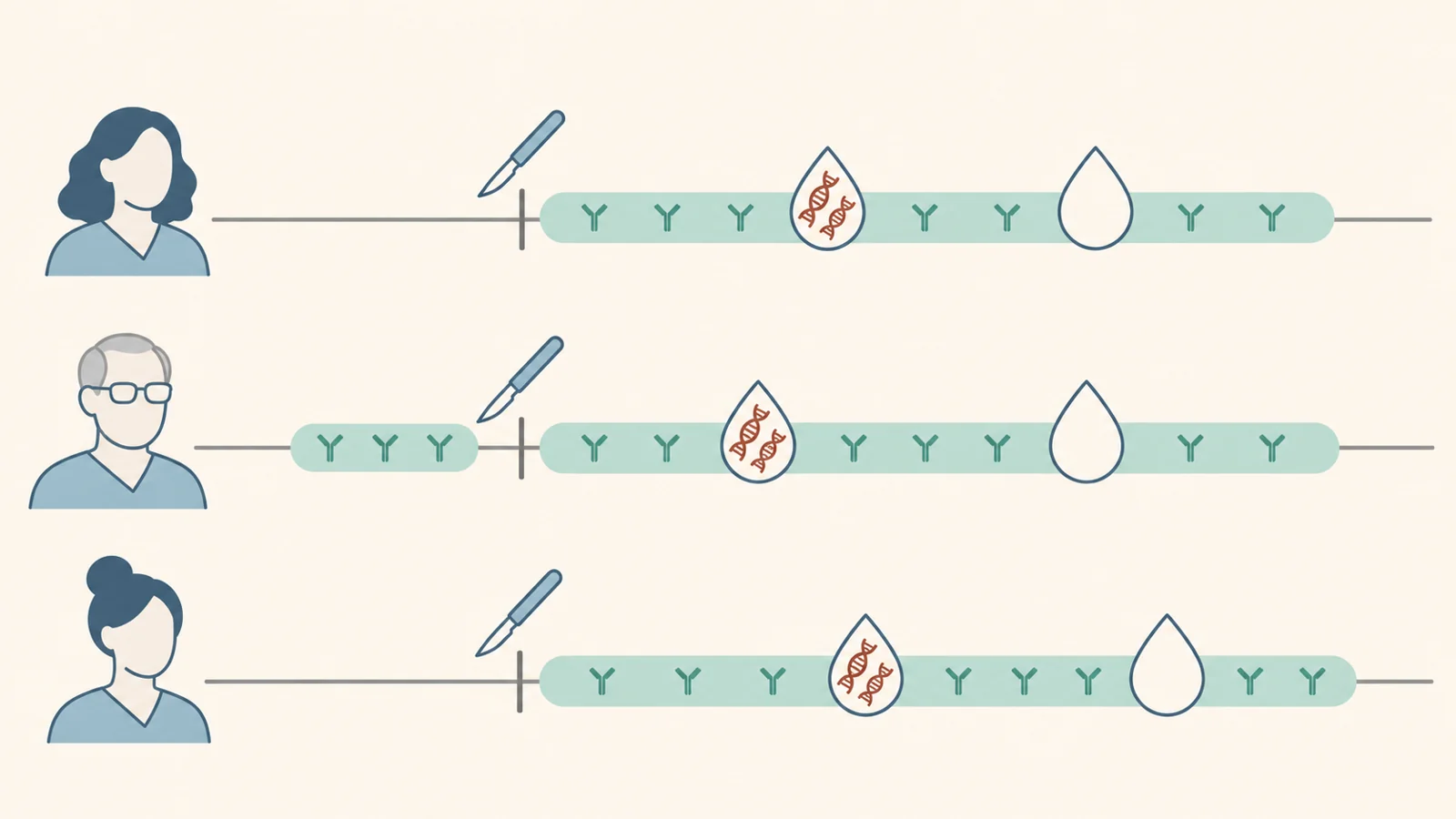
After surgery to remove colon cancer, blood tests still detected tumor DNA in each of three patients. During immunotherapy given after surgery, that signal later cleared. The change is striking, but it leaves an important question: what can a disappearing blood signal tell us about a person’s disease and treatment?
The report, published on August 19, 2022, follows three people with colon cancer whose tumors had features associated with immunotherapy treatment. Each had serial measurements of circulating tumor DNA, or ctDNA: a tumor-DNA signal measured in blood. A single result captures one moment. Repeated results show whether the signal remains detectable or changes over time.
Here, detection after surgery and later clearance during treatment are observations from the blood tests. They are not, by themselves, proof that cancer remained in the body, that immunotherapy caused the signal to disappear, or that the disappearance predicts what will happen next. The patients’ clinical condition is a separate part of the picture.
Three different treatment paths
The cases span different stages and tumor characteristics. One patient had stage IV colon cancer that had returned and was diagnosed with Lynch syndrome, an inherited condition associated with increased cancer risk. This patient received adjuvant sintilimab, an immunotherapy drug given after surgery. The report says this patient had more than 16 months without recorded cancer progression, the measure reported as progression-free survival.
A second patient had stage IIIc cancer with high microsatellite instability, a marker of faulty DNA repair, and a high number of tumor mutations. The patient received toripalimab before surgery. Before surgery, the patient was assessed as having a clinical complete response: no cancer was apparent on clinical assessment at that point. After surgery, the patient continued with adjuvant sintilimab. The report gives progression-free survival of more than 17 months.
The third patient had stage II colon cancer with a reported POLE P286R mutation—a specific genetic change in the tumor—and received adjuvant sintilimab. The report also gives this patient more than 17 months of progression-free survival.
The stage IIIc case is the only one described as receiving immunotherapy both before and after surgery. The other two treatment paths reported here center on immunotherapy after surgery. Despite those differences, all three had detectable ctDNA after radical surgery and later clearance during adjuvant immunotherapy.
What the follow-up can show
At the time of the report, all three patients were described as free of tumor disease. Their reported progression-free periods—more than 16 months for one person and more than 17 months for the other two—provide an early account of how these patients were doing after treatment.
The small series cannot show whether ctDNA clearance predicted those outcomes. The patients differed in stage, tumor features and treatment sequence, and three cases cannot establish how well the blood test forecasts recurrence across people with colon cancer. Nor can they show whether using serial results to guide care improves decisions or patient outcomes.
The shared pattern is a reason to study the test further, not a validated rule for interpreting an individual result. In these cases, blood-test changes, treatment histories and clinical status appear together in time. The report does not establish which caused or predicted which.
How this could shape the future
For someone receiving immunotherapy after colon-cancer surgery, repeated blood results could one day help clinicians decide when a possible return of cancer needs closer investigation, if the pattern is shown to predict later clinical outcomes. The three reported detection-to-clearance sequences show the kind of changing pattern that future work could evaluate. Making that pattern useful in care would require independent validation so clinicians and patients could understand what persistent or cleared ctDNA reliably indicates across relevant groups.
A nearer milestone would be a prospective study that sets sampling times in advance and follows people across relevant patient groups. It could test whether ctDNA clearance or persistence predicts later clinical outcomes. That evidence would help determine whether a changing blood result can become a reliable part of follow-up.
Key Sources
- Primary source: Serial Circulating Tumor DNA in Monitoring the Effect of Neoadjuvant and Adjuvant Immunotherapy in Patients With Colon Cancer: Case Series and Review of the Literature.
DOI or Journal Page · Review or Meta-Analysis · 2022-08-19
Keep exploring