
Research Signal – Source date 2022-08-01
Sunlight can leave many genetic changes in skin cells. Some cancers that develop from these damaged cells respond to drugs that help immune cells attack tumors, yet apparently similar cancers may not. A 2022 review of squamous cell carcinoma (SCC)—a cancer arising from the skin’s flat surface cells—describes both the biological reasons for this treatment and the difficulty of predicting who will benefit.
The distinction matters most in advanced cutaneous SCC. Many early lesions can be treated directly, while surgery or radiotherapy remains central for many tumors. For some cancers that are advanced, recurrent, or have spread, those approaches may not be suitable. The review describes immune checkpoint drugs as an option for some of these patients and examines why the treatment can work without reliably working for everyone.
From early lesions to advanced disease
SCC spans a range of conditions, from precancerous lesions and in-situ disease to locally advanced tumors and, less commonly, cancer that has spread to distant sites. Treatment depends on where a cancer sits along that range. Early lesions may be treated by targeting an individual spot or a broader area of affected skin. For locally advanced or metastatic disease, surgery—including Mohs surgery, which examines tissue edges during removal—or radiotherapy may be considered. A person’s health or the tumor’s location can make surgery difficult or unsuitable.
When advanced, recurrent, or metastatic SCC cannot be treated with surgery or radiotherapy, treatment that works throughout the body may become relevant. The review describes immunotherapy as one such option. In the United States, it reports that three PD-1 checkpoint inhibitors—cemiplimab, pembrolizumab, and nivolumab—were approved for advanced, recurrent, or metastatic SCC by the review’s 2022 publication era.
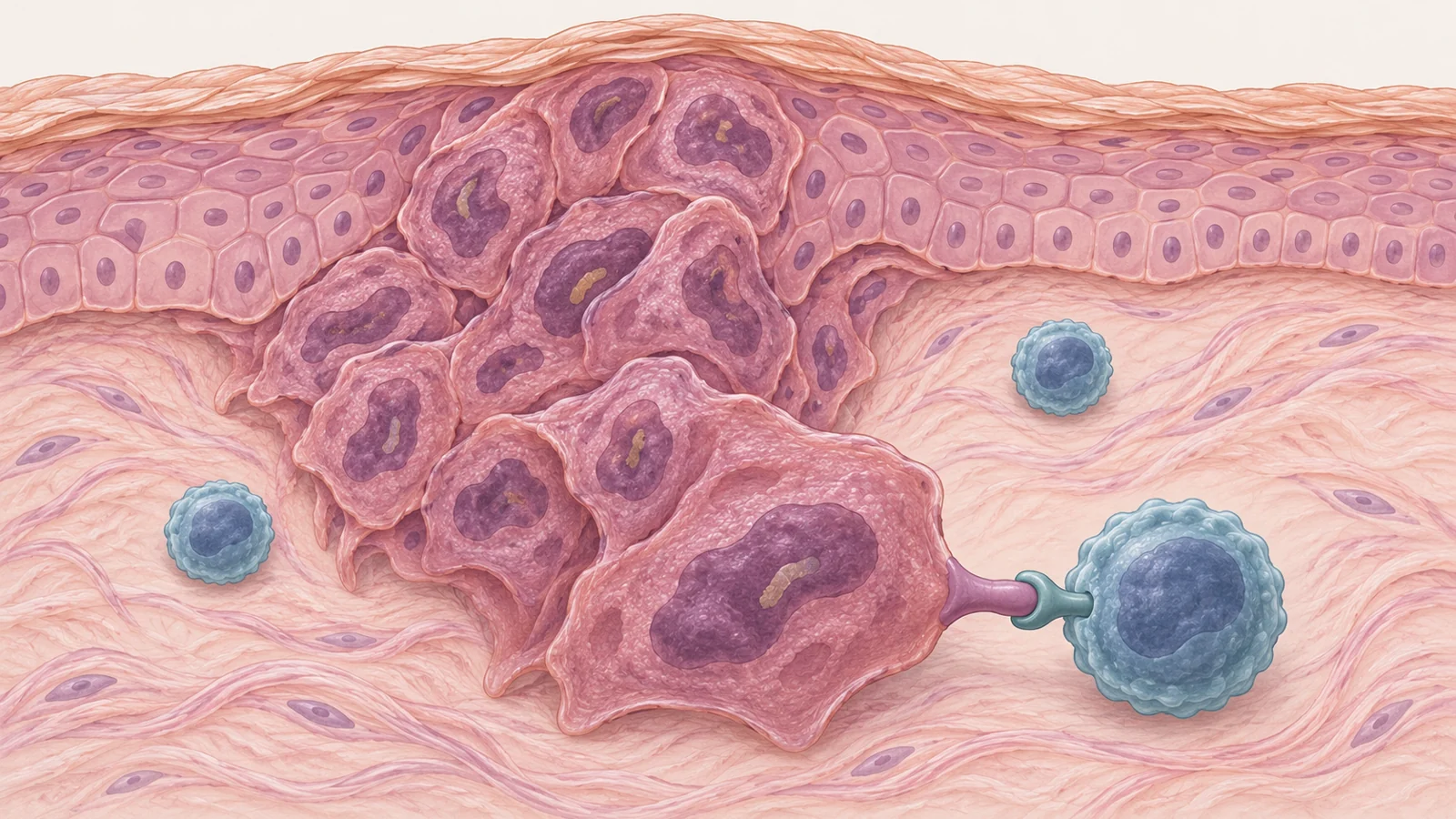
Their shared target helps explain the appeal. PD-1 is a checkpoint: a control mechanism that can turn down T-cell activity. T cells are immune cells that can recognize and attack abnormal cells. When PD-1 on an immune cell binds to its partner, PD-L1 or PD-L2, the interaction can dampen that attack. Tumors can use this pathway to weaken the immune response around them. A PD-1-blocking drug interrupts the interaction, making it possible for immune cells to act against the tumor again.
Sun damage can create targets, but a brake can still hold
Ultraviolet radiation damages DNA in skin cells. As those cells divide, damage can become mutations: changes in the genetic instructions that help control how cells grow. The review describes a high tumor mutational burden in cutaneous SCC—many mutations across the tumor’s DNA—and notes that mutations associated with ultraviolet exposure are common in these cancers.
A tumor with many mutations may produce more altered proteins for the immune system to notice. The review presents that as part of the rationale for checkpoint treatment: an immune system may have targets to recognize, but its T cells can still be restrained by the PD-1 pathway. Blocking that checkpoint may therefore help some immune cells mount an attack against a mutation-rich tumor.
The immune environment around the cancer also matters. Tumors can contain infiltrating immune cells, including T cells that are associated with antitumor activity. The review describes these cells and checkpoint activity as features that may help explain why SCC can respond to immunotherapy. But a tumor’s mutation count alone cannot tell the whole story. Signals in its surroundings can encourage immune attack or suppress it, and different tumors can have different combinations of those signals.
The clinical figures offer a concrete sense of the treatment’s potential. The review cites objective response rates of about 50% in a phase I cemiplimab study and 47% in a phase II study of advanced SCC. An objective response rate describes the share of participants whose tumors met the study’s criteria for a measurable response, such as shrinking. It is not the same measure as durable disease control, which the review discusses separately. Nor does either figure mean that every patient benefited: in the cited studies, many participants did not have an objective response.
These percentages are findings from earlier clinical studies discussed by the review’s authors. The review itself did not run a new trial. The results support a treatment possibility for some people with advanced disease, not a guarantee for an individual patient.
Tumor clues offer pieces of a prediction
Researchers would like to know in advance which tumors are more likely to respond. The review discusses three types of clues: tumor mutational burden, PD-L1 staining, and immune-cell infiltration. Each offers a different view of a tumor, and none is presented as a dependable stand-alone answer for every person with cutaneous SCC.
Tumor mutational burden (TMB) counts mutations in a tumor’s DNA. Cutaneous SCC is associated with high TMB, and the review cites studies in which high TMB was linked to better outcomes with PD-1 or PD-L1 treatment. But the predictive value of TMB varies. Some of the review’s discussion of combined mutation measures and outcomes concerns recurrent or metastatic head and neck SCC, which arises at a different anatomical site. Those findings cannot simply be treated as proof of how a skin tumor will respond.
PD-L1 staining looks for a protein involved in the checkpoint pathway. Its interpretation is complicated by where the protein is found: on tumor cells or on immune cells within the tumor. Studies described in the review report mixed associations between PD-L1 and treatment outcomes. For example, a nivolumab study discussed by the authors found an overall-survival improvement that was not associated with PD-L1 expression, while other findings varied by the cells examined and the outcome measured. A marker that is informative in one setting may not reliably sort responders from nonresponders in another.
Immune-cell infiltration provides another clue. The review describes studies in squamous cancers where CD4 and CD8 T cells were associated with favorable outcomes, and also evidence that some SCC tumors have relatively low CD8 T-cell infiltration. The details vary by cancer site and study. Findings in oral or head and neck SCC can suggest questions for skin cancer research, but they are not direct evidence that a marker predicts response in cutaneous disease.
Together, these observations make the prediction problem more specific than simply asking whether a tumor has many mutations or expresses PD-L1. A useful assessment may need to account for tumor features, the types and locations of immune cells, and the treatment outcome being predicted. The review brings these clues together as a research rationale, not as a validated test for choosing every patient.
Resistance can emerge even when the immune brake is released
Prediction asks who might respond before treatment begins. Resistance is a separate problem: a tumor may fail to respond, or may become less sensitive, because other biological processes keep immune attack from succeeding. Blocking PD-1 can release one restraint, but it does not switch off every pathway that shapes a tumor’s environment.
The review describes interferon-gamma, a signaling molecule produced by activated immune cells, as one example. It can be linked to changes in PD-L1 and other processes associated with resistance to checkpoint treatment. The review also discusses ADAR1, an RNA-editing enzyme, whose increased expression in SCC may contribute to resistance. These are proposed biological links synthesized from earlier studies; they do not establish a single resistance pathway that explains every patient’s outcome.
Other pathways may suppress immune activity as well. The review describes TGF-beta signaling as a possible influence on immune-cell function and infiltration, and Wnt signaling as a possible contributor to resistance, while noting that further research is needed to confirm the relationship in SCC treatment. The practical point is that an immune response depends on more than whether a drug blocks one checkpoint. A tumor can carry recognizable mutations and still have ways to limit the cells that might attack it.
The tradeoff includes immune-related effects
Checkpoint treatment changes immune activity, so its potential benefit comes with the possibility of unwanted effects. The review lists diarrhea, fatigue, nausea, itching, rash, reduced appetite, constipation, and asthenia among commonly observed adverse effects associated with the approved PD-1 antibodies it discusses. Asthenia refers to a feeling of weakness or lack of energy.
The review notes that immune-related adverse events can vary with treatment factors, a person’s prior autoimmune conditions, and other individual characteristics. This makes tolerability part of the treatment decision alongside the possibility of tumor response. The response percentages describe outcomes in groups of study participants; they do not erase the possibility of side effects or show what any one person will experience.
How this could shape the future
For someone with advanced skin cancer that cannot be fully removed, checkpoint drugs were already a treatment option by the review’s 2022 publication. A future, more dependable way to identify likely responders could help clinicians make a better-informed choice and recognize sooner when another approach may be needed. That capability would need to bring together the mutation burden and immune-cell clues that may make a tumor visible to the immune system with the resistance processes that can still blunt an attack.
A nearer milestone is prospective validation in advanced cutaneous SCC: test a response-prediction approach against patients’ actual treatment outcomes and harms, rather than relying on associations alone. The review’s evidence points toward mutation, immune-cell, and resistance features as candidates to study, but developing a useful tool requires further work beyond this review. If such a tool proves reliable, it could make treatment selection more informative while keeping both likely benefit and potential harm in view.
Key Sources
- Primary source: Immunotherapy for the Treatment of Squamous Cell Carcinoma: Potential Benefits and Challenges.
DOI or Journal Page · Review or Meta-Analysis · 2022-08-01
Keep exploring