
Research Signal – Source date 2022-07-30
Tumors can contain immune cells, and researchers have asked whether their presence might help identify people more likely to benefit from checkpoint blockers, a type of cancer immunotherapy. A systematic review of 1,193 records found reported associations between tumor-infiltrating lymphocytes and outcomes mainly in melanoma and breast cancer. But the authors could not draw a definitive conclusion about whether these cells predict response to the treatment.
That difference matters. An association can make TILs worth studying; a dependable way to choose treatment would need to show that the measurement identifies who benefits specifically from checkpoint blockers.
The reported associations clustered in two cancers
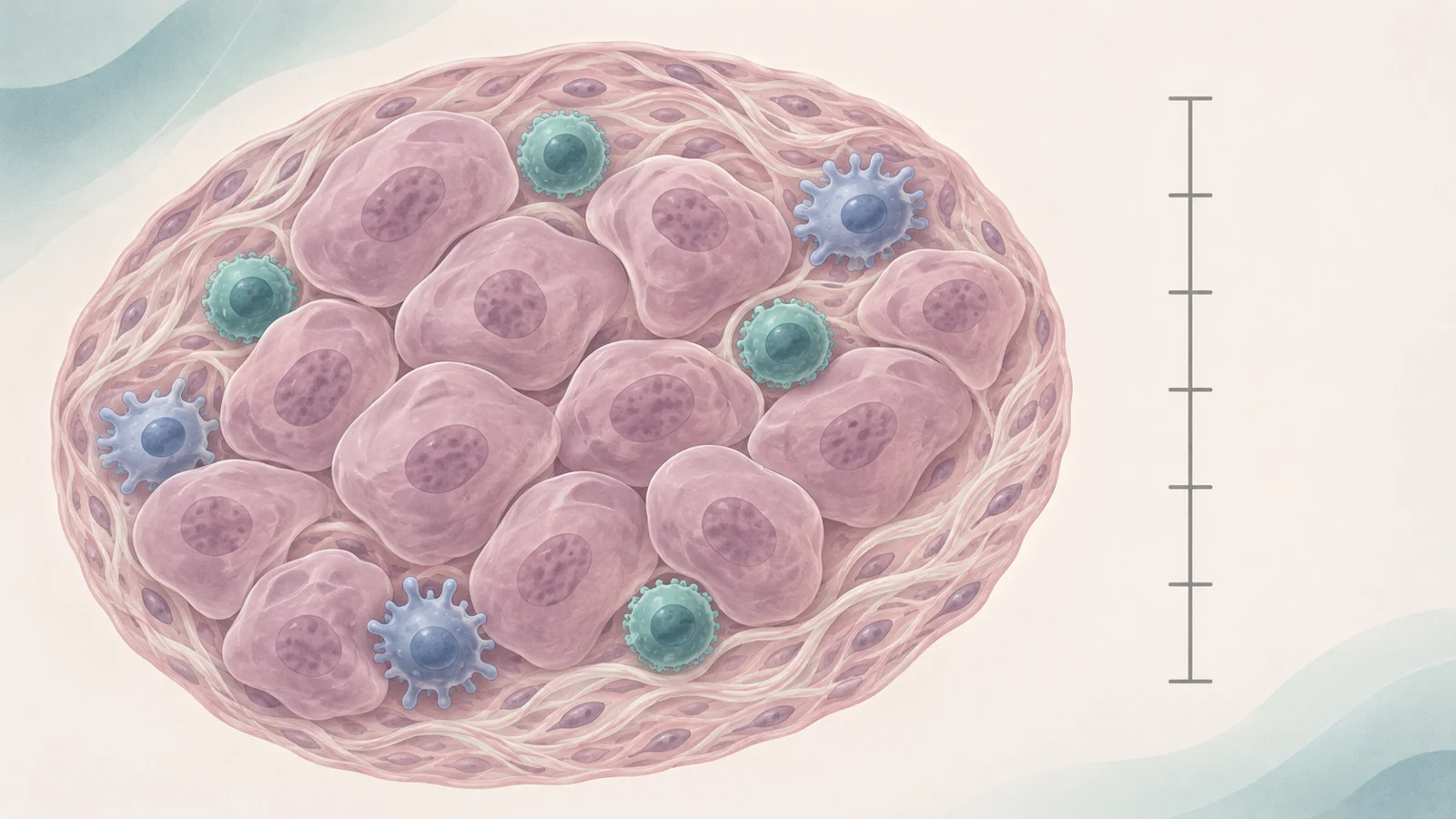
Tumor-infiltrating lymphocytes, often shortened to TILs, are immune cells found within a tumor. Their presence has attracted interest because many people with solid tumors gain limited benefit from checkpoint blockers. If TIL levels tracked treatment outcomes, they might eventually help researchers understand which patients are more likely to respond.
The review examined records published from January 2010 through December 2021. Its abstract says associations between TILs and outcomes appeared mainly in melanoma and breast cancer. This describes where the reviewed evidence most often showed a relationship. It does not establish that TILs perform equally well in other solid tumors, or that the pattern has one explanation across these cancers.
The concentration in melanoma and breast cancer is a useful guide to where the research signal appeared. It is not, by itself, a reason to apply the same interpretation to every tumor type. A marker observed in one group of cancers needs evidence in other groups before it can be treated as a general guide to checkpoint treatment.
Different outcomes answer different questions
The studies most commonly assessed overall survival and overall response rate in advanced disease, and pathological complete response in earlier-phase tumors. These measures describe different kinds of benefit.
Overall survival tracks how long people live over a defined period. Overall response rate counts how often treatment produces a tumor response, such as shrinkage. Pathological complete response refers to an assessment of whether cancer remains in tissue examined after treatment. One measure cannot stand in for the others: a relationship with tumor shrinkage, for example, does not automatically show a relationship with longer survival or with complete response in earlier disease.
The review therefore brings together outcomes that are related to treatment benefit but are not interchangeable. A TIL association tied to one endpoint would need to be understood in that context rather than read as a single, universal measure of success.
A treatment marker must do more than track good outcomes
A biomarker is predictive when it helps identify who benefits from a particular treatment. Finding that people with more TILs had better outcomes in a group receiving checkpoint blockers would be encouraging, but that relationship alone would not show that the blockers caused the difference or that TIL levels distinguish who gains more from those drugs.
For example, TIL levels might be associated with better outcomes for reasons that also matter under another treatment. To establish treatment-specific prediction, researchers need evidence that outcomes differ in relation to TIL levels between treatment groups. The review calls for further evaluation using prospective, randomized clinical-trial data, which can help address that treatment-selection question.
The authors’ conclusion was measured: they could not draw a definitive conclusion about TILs’ predictive role. The reviewed associations justify continued study, but they do not validate a test for choosing checkpoint blockers for an individual patient.
A shared cutoff would make readings easier to compare
Even if TIL levels prove useful, researchers and clinicians would need a consistent way to distinguish a “high” reading from a “low” one. The review calls for a standard cutoff for that distinction. Without an agreed threshold, the same tissue measurement could be classified differently across studies, making results harder to compare and a future test harder to reproduce.
A cutoff would not establish predictive value on its own. It would make the measurement more consistent so that researchers could test whether it predicts treatment-specific benefit. The abstract supplies no validated threshold, so a number cannot yet be treated as a clinical dividing line on the evidence summarized here.
Where this research could lead
A dependable TIL reading could eventually give a person and their oncologist one more piece of information when weighing checkpoint treatment. That possibility rests on a specific bridge: the review found outcome associations, mainly in melanoma and breast cancer, while leaving unresolved whether TILs identify benefit from the blockers themselves and how high or low should be defined. Independent validation and consideration alongside other treatment factors would also be needed before such a reading could guide care.
A nearer sign of progress would be prospective analyses of randomized trials that test whether TIL levels predict benefit from checkpoint blockers specifically, using a cutoff set in advance and applied consistently. If those results hold up across validation, a tumor-tissue measurement might become a useful decision aid alongside the other information a care team considers. Checkpoint treatment is already used in many solid tumors; this proposed role for TILs would be an additional way to inform decisions, not evidence that the marker is ready to select treatment today.
Key Sources
- Primary source: Tumor infiltrating lymphocytes (TILs) as a predictive biomarker of response to checkpoint blockers in solid tumors: A systematic review.
DOI or Journal Page · Review or Meta-Analysis · 2022-07-30
Keep exploring