
Research Signal – Source date 2022-07-28
In uveal melanoma, a drug that directs immune cells toward cancer improved overall survival compared with investigators’ choice, even though the proportion of patients with a tumor response on scans was modest. The result, discussed in a 2022 review, offered evidence that a T-cell-engaging treatment could work against a solid tumor. It also raised a harder question: what made this case possible, and why might the same approach be difficult to use elsewhere?
The drug, tebentafusp, was approved for uveal melanoma in January 2022. Its result stood out because the RECIST response rate—the proportion of patients whose tumors shrank enough on scans to count as a response—was modest, while the overall-survival comparison favored tebentafusp. These measurements answer different questions: one counts patients whose tumors met a defined shrinkage threshold on scans; the other compares how long people lived. The review does not establish that this pattern will hold for other cancers or other targets.
A temporary bridge that turns T cells toward cancer
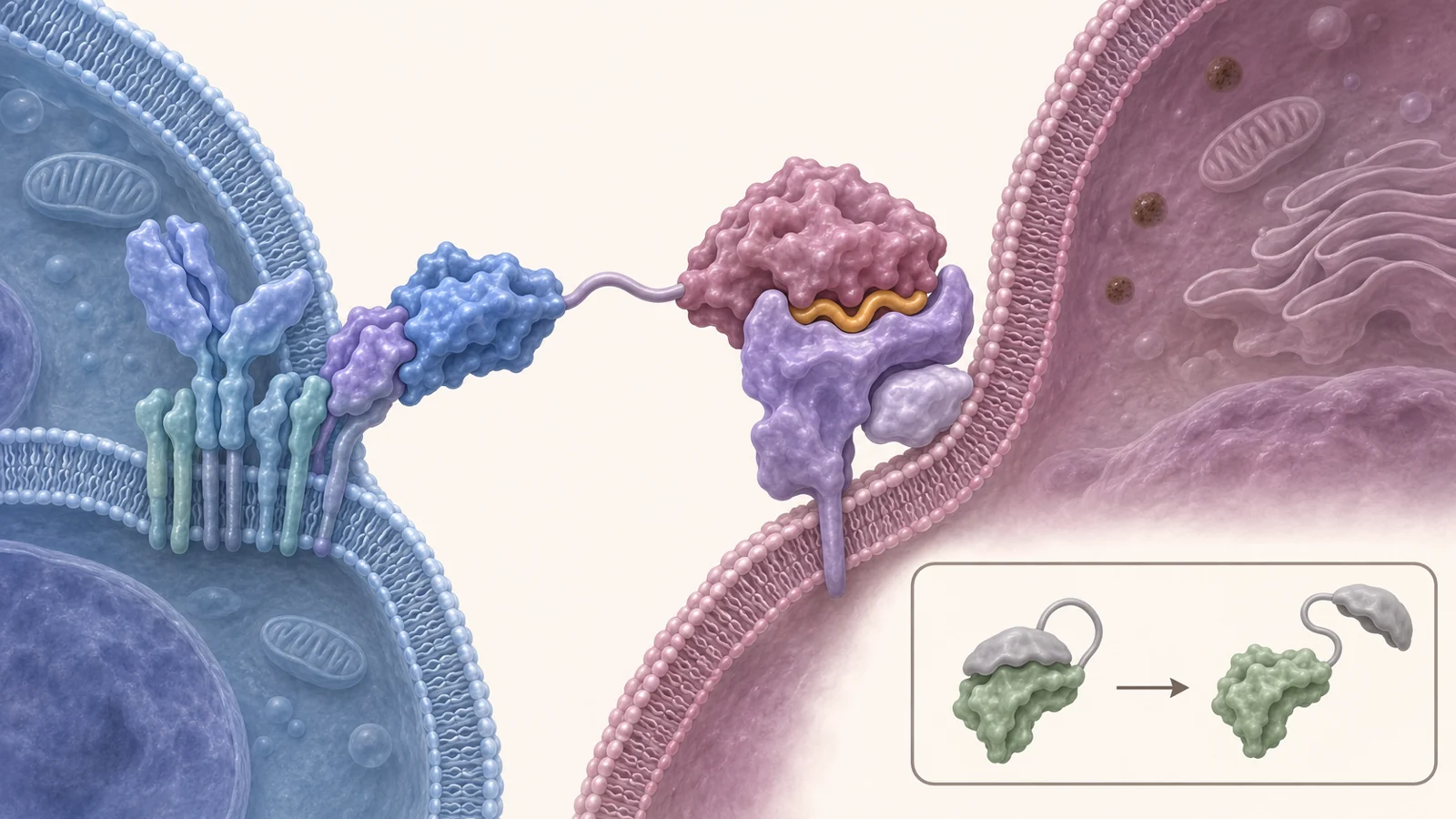
A T-cell engager is designed to bring a T cell close to a cancer cell. One part of the drug binds a marker on the cancer-cell surface; another binds CD3, a component of the T cell’s receptor complex. When both connections form, the T cell can make close contact with its target and release proteins that damage the cancer cell and trigger its death.
This can redirect T cells without relying on each cell’s own receptor to recognize a particular cancer fragment. The review describes T-cell engagers as capable of recruiting several kinds of cytotoxic T cells—the immune cells able to kill other cells—and prompting them to attack in sequence. That potency helps explain their strong single-agent activity in some blood cancers.
The comparison with blood cancers also highlights a delivery challenge. Cancer cells in the blood or marrow are more accessible to a circulating drug than cells packed within solid tumor tissue. To achieve effective concentrations inside a solid tumor, a T-cell engager may need higher exposure throughout the body. More exposure can increase the chance of unwanted effects, so a drug must reach the tumor while keeping activity elsewhere under control.
Tebentafusp reaches beyond surface proteins
Most surface-targeting engagers recognize a marker displayed directly on a cancer cell. Tebentafusp uses a different route: it binds a small fragment of gp100, a protein, when that fragment is displayed at the cell surface by an MHC molecule. MHC proteins act like display platforms for protein fragments made inside cells.
That feature matters because many cancer-associated proteins are inside cells, where a conventional surface-targeting drug cannot reach them. If a fragment from one of those proteins is displayed by MHC, it may become visible to a T-cell engager. The review describes this as a way to investigate targets drawn from a much broader portion of the cancer-cell protein supply, including altered proteins such as mutant Ras and p53 in preclinical research.
Tebentafusp therefore offered a clinical example of a peptide–MHC target working against a solid tumor, even though the target was present at low levels. But the same sensitivity that helps a drug recognize scarce target can make selectivity crucial. If a target also appears on healthy tissue that cannot safely be injured, redirected T cells may damage that tissue. The review cites toxicity concerns associated with other targets, including CEA and EpCAM in clinical trials and EGFR in nonhuman-primate studies.
Keeping activity where it is needed
Unwanted immune activation can also occur without the intended cancer-cell connection. The review describes aggregation and binding to Fc-gamma receptors on other immune cells as possible routes to off-target activation. One serious consequence can be cytokine release syndrome, a reaction in which extensive immune activation causes the release of inflammatory signals and can become life-threatening. These risks can limit dosing and, in turn, the amount of drug available to act in the tumor.
One proposed response is to administer an engager in an inactive form and allow it to become active only under certain conditions. Some investigated designs aim for gradual activation over time; others are intended to activate in the tumor environment, for example where acidity or protease activity can help unmask the drug. The aim is to reduce activity in healthy tissues while retaining it at the tumor.
In preclinical studies, inactive forms of some conditional engagers showed much lower activity in laboratory tests than their activated forms. That difference is a design clue, not proof that patients will have a wider safety margin. Different testing conditions and drug behavior can make the safety and effectiveness of the inactive and active forms difficult to compare. Patient studies must show whether conditional activation can support useful tumor activity at tolerable doses while limiting effects on healthy tissue.
T cells still have to function inside the tumor
Even when an engager brings a T cell to cancer, the surrounding tumor environment can suppress immune activity. The review discusses several strategies intended to help T cells keep working: combining engagers with checkpoint inhibitors such as anti-PD-1, adding medicines that stimulate receptors such as 4-1BB, or using cytokines such as IL-2.
These approaches have different purposes and evidence levels. Checkpoint blockade aims to counter signals associated with T-cell exhaustion. Costimulation can provide an additional activating signal, while cytokines can support T-cell activity. The review describes encouraging preclinical results and reports IL-2 use alongside tebentafusp in a clinical trial, but these strategies do not by themselves establish that a particular combination benefits patients or is acceptably safe.
The possibility of recruiting less-experienced, or naive, T cells could expand the pool available for attack. Yet broader activation may also expand self-reactive cells and intensify inflammatory effects. Increasing immune force therefore has to be balanced against keeping the response focused and manageable.
Where this research could lead
For someone with a solid cancer beyond uveal melanoma, a useful future option would be a T-cell engager matched to a marker on their tumor, with activity controlled well enough to treat the cancer without unacceptable injury to healthy tissue. Recognition of peptide–MHC complexes could make some internal cancer proteins available as targets, while conditional designs could help restrict where or when an engager becomes active. That possibility depends on finding suitable targets and confirming in clinical studies that the drugs work safely in people. Tebentafusp’s approval for uveal melanoma was a specific step; it does not make that wider treatment option established for other solid cancers.
A nearer milestone is clinical evidence for a conditional engager that shows tumor activity alongside tolerable dosing and measured effects on healthy tissue. Such results would help clarify whether the design can control activation in people, not just in preclinical tests. The review’s central promise is that a different way to reach cancer and recruit T cells may widen treatment possibilities; each target and design still has to earn that place in care.
Key Sources
- Primary source: T-cell-engaging antibodies for the treatment of solid tumors: challenges and opportunities.
DOI or Journal Page · Review or Meta-Analysis · 2022-07-28
Keep exploring