
Research Signal – Source date 2022-07-17
For someone with classic Hodgkin lymphoma who receives hemodialysis, chemotherapy planning can involve two opposing risks. A medicine that is not cleared well by the kidneys may remain in the body longer than expected, raising concern about toxicity. A dialysis session may also remove some medicines, potentially leaving too little exposure for treatment. Both risks matter, and the balance can differ from one drug to another.
A 2022 review gathered reported treatment experience in this difficult setting and offered recommendations on drug amounts and scheduling. The authors stressed that pharmacokinetic and pharmacodynamic studies—research on how the body handles a medicine and how the medicine affects the body—are limited for most chemotherapy drugs in people on hemodialysis. Much of the available experience came from case reports and small case series.
Two routes can change drug exposure
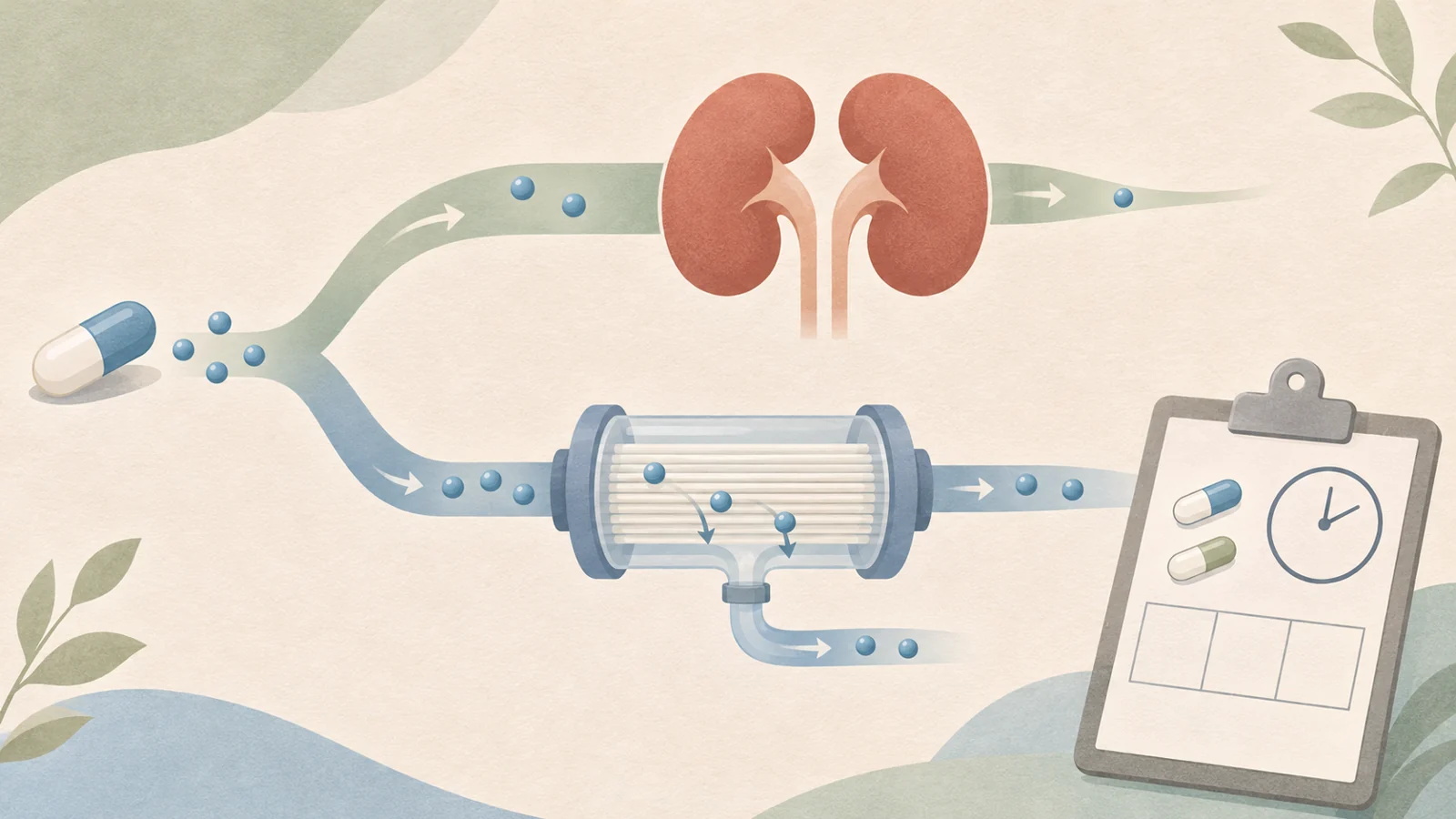
Kidney clearance and removal during dialysis are related to drug exposure, but they are separate processes. If a medicine is usually eliminated significantly by the kidneys, reduced kidney function can change how much remains in the body. Hemodialysis creates another consideration: some medicines can be removed during a session. A treatment plan therefore has to account for both what happens between sessions and what may happen while dialysis is underway.
The direction of concern can differ. Less kidney elimination can raise the risk that a medicine’s effects or toxicities become excessive. Removal during dialysis can raise the opposite concern: treatment may be weaker if too much of a drug is taken out at the wrong point in the schedule. The review’s central practical point is that these are drug-specific questions. The fact that a person receives dialysis does not, by itself, tell a care team how a particular chemotherapy medicine will behave.
The recommendations draw on different kinds of reports
The authors reviewed accounts of chemotherapy actually given to people with classic Hodgkin lymphoma who were on hemodialysis. They also used reports of the same medicines given to dialysis patients being treated for other cancers. Those two evidence sources can inform one another, but they are not interchangeable: experience in another cancer is an extrapolation, rather than direct evidence from Hodgkin lymphoma treatment.
The review covered both multi-drug treatment combinations and individual medicines, including gemcitabine. Covering a wide range does not mean the evidence is equally direct or equally strong for every treatment.
Amount and timing answer different questions
Dose modification concerns how much medicine is given. Scheduling concerns when it is given in relation to a dialysis session. A dose adjustment alone cannot answer whether a session might remove a drug soon after administration; moving treatment in the schedule alone cannot resolve every concern about kidney elimination. The review’s recommendations address both decisions according to the characteristics of each chemotherapeutic.
That distinction is useful for understanding why a single general rule for “chemotherapy on dialysis” would be inadequate. A plan has to consider the particular medicine and its relationship to dialysis. The review offers practical recommendations drawn from the treatment experience available to its authors, rather than a patient-specific regimen. Individual treatment decisions belong with the clinical team familiar with the person’s cancer and dialysis care.
What the evidence can support
Case reports and small series can show how treatment has been administered in particular circumstances, and the review uses them to assemble practical experience. But a collection of such reports cannot, on its own, establish that one dosing approach is safer or more effective across patients. Limited pharmacokinetic and pharmacodynamic research also makes it harder to predict exposure and effects reliably from one person to another.
The recommendations should therefore be read as an effort to manage a real planning problem using sparse evidence, not as proof that the suggested approaches improve clinical outcomes. The authors identify why both excess exposure and drug removal matter, while the available reports leave substantial uncertainty about how dependable any particular plan will be across different patients.
What this could make possible
A future with more direct evidence could let a person receiving dialysis and treatment for Hodgkin lymphoma have a drug-specific plan informed by measured medicine exposure and patient outcomes. That would give care teams firmer grounds for weighing the amount of a drug against its timing around dialysis, with less reliance on scattered case reports and evidence borrowed from other cancers. The 2022 review helps point toward that possibility by identifying the two exposure risks and the decisions they create; dependable planning would still require further direct evidence.
One meaningful milestone would be a study in people with Hodgkin lymphoma on hemodialysis that measures both exposure and clinical outcomes for a specified drug and dialysis schedule. Such a study would add evidence for planning; it would not, by itself, show that treatment outcomes have improved.
Key Sources
- Primary source: Hodgkin Lymphoma on Hemodialysis: A Review of Treatment and Recommendations.
DOI or Journal Page · Review or Meta-Analysis · 2022-07-17
Keep exploring