
Research Signal – Source date 2022-07-16
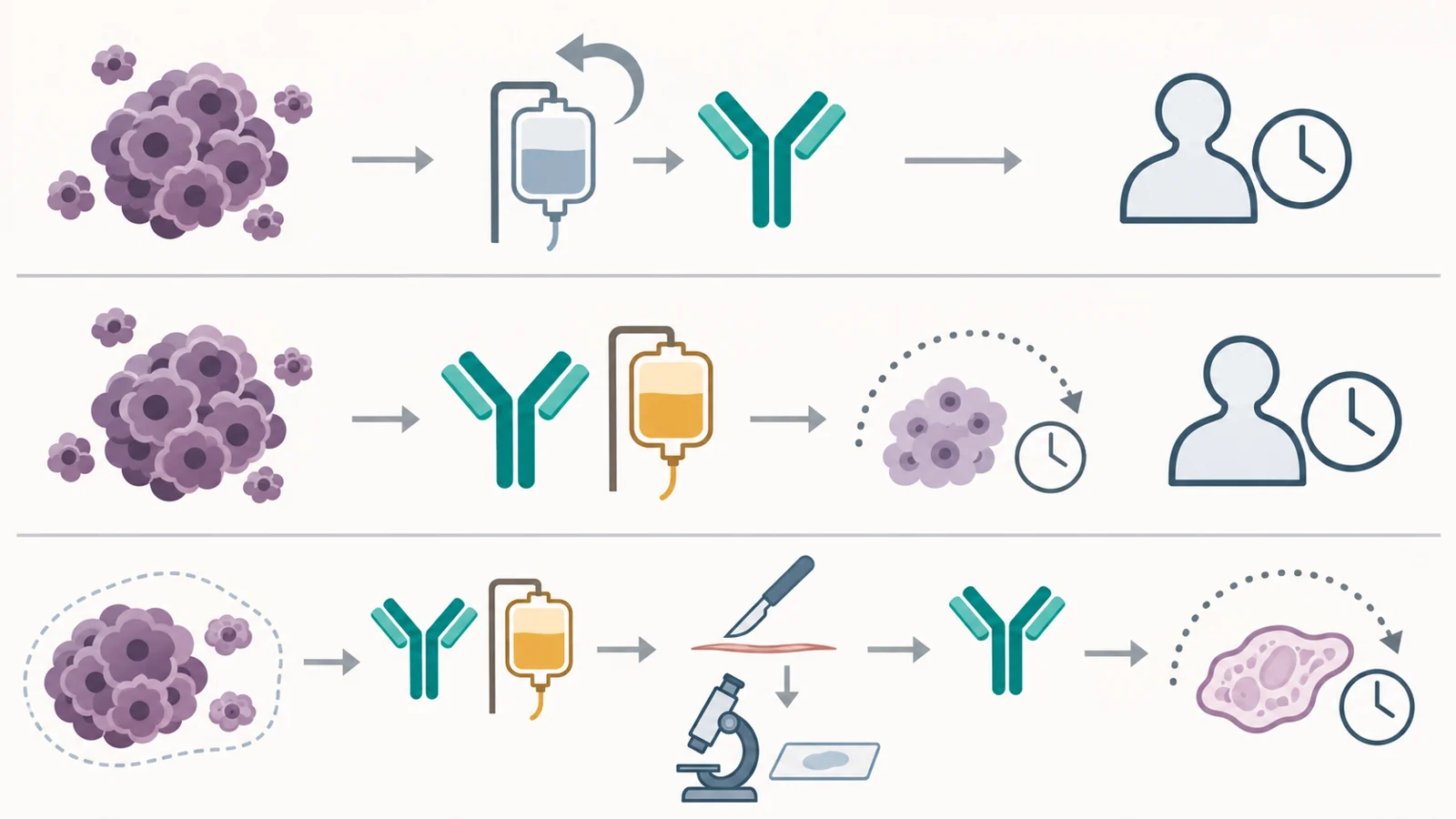
Immunotherapy’s results in triple-negative breast cancer depend on when and how it is used. A review published on July 16, 2022, reports that checkpoint inhibitors alone did not outperform chemotherapy in previously treated advanced triple-negative breast cancer. In other settings, checkpoint inhibitors combined with chemotherapy brought gains for some first-line patients with advanced disease and for patients with stage II–III disease, though the outcomes measured differed.
Triple-negative breast cancer is cancer that lacks three commonly tested receptor markers. The review’s findings do not describe one result that applies to every person with this subtype. Treatment line, chemotherapy combination, disease stage and the outcome being measured all matter.
The advanced-disease results changed with treatment line
For advanced triple-negative breast cancer that had already been treated, checkpoint inhibitor monotherapy did not outperform chemotherapy. The review therefore does not support the idea that immunotherapy by itself was a better option in that setting.
The picture differed for first-line treatment, meaning treatment given before another treatment for advanced disease. When checkpoint inhibitors were combined with chemotherapy, studies showed consistent gains in progression-free survival among patients whose tumors were PD-L1-positive. PD-L1 is a marker assessed in the tumor; here, it identifies the subgroup in which the review describes those progression results.
Progression-free survival measures how long people live before their disease worsens. It is not the same as overall survival, which measures how long people live. The review says that, among these first-line combinations, pembrolizumab was the only checkpoint inhibitor to clearly demonstrate a significant overall-survival benefit. A gain in time before progression should not be read as proof of a longer life, and the review does not describe the same survival result for every combination.
Early treatment brought two different measures of benefit
The review also describes results in stage II–III triple-negative breast cancer, where treatment began before surgery. In the KEYNOTE-522 trial, pembrolizumab was given with chemotherapy before surgery and then continued after surgery. The chemotherapy sequence included carboplatin and paclitaxel followed by anthracyclines.
This course increased the pathological complete response rate and disease-free survival. Pathological complete response, or pCR, refers to an assessment of whether cancer remains in tissue examined after treatment before surgery. Disease-free survival tracks whether patients remain free of disease events over follow-up. One measure captures what is found in tissue after the initial treatment; the other follows patients over time. Both improved in the trial described by the review, but they answer different questions.
These findings made the regimen an important change in early-stage treatment at the time of the review. They do not establish an overall-survival benefit for KEYNOTE-522. Nor do the first-line advanced-disease results and the early-stage results amount to a single effect across all stages, treatment sequences or breast cancer subtypes.
A reassuring safety observation still leaves a hard tradeoff
The review reports no unexpected safety signal with these treatments. It also raises a concern that matters especially in early-stage disease: checkpoint inhibitors may cause toxicities that are definitive, or lasting. When treatment is intended to cure, a lasting harm can weigh heavily alongside a possible improvement in cancer outcomes.
The safety observation is not evidence that lasting harm cannot occur. The review highlights the need to weigh potential benefit against this possibility in curable disease; it does not provide a basis here for predicting an individual person’s risk.
Important choices remain open
The review identifies three unresolved questions. Researchers still need to determine which chemotherapy partners work best with checkpoint inhibitors, which additional markers could help identify people most likely to benefit, and whether the approach can extend to breast cancer subtypes beyond triple-negative disease.
The PD-L1-positive subgroup in the advanced setting is not a validated selection tool for the early-stage regimen. The findings described in the review do not establish a biomarker that can tell an individual with stage II–III disease whether adding pembrolizumab will help them. That distinction matters because a result in a defined group is a starting point for more precise choices, not yet a personal forecast.
Where this research could lead
If independently validated selection tools and clinical evidence build on the combination benefits already seen in defined settings, a person with triple-negative breast cancer and their oncology team could judge more precisely whether adding immunotherapy is likely to help. That could make treatment discussions more specific to the person’s disease and the regimen being considered, while keeping possible lasting toxicity in view. It would not guarantee benefit or spare someone harm.
A nearer milestone would be prospective validation that a proposed marker identifies who gains disease-free-survival benefit when a specified checkpoint inhibitor is added to a specified early-stage regimen. Reaching that point would help connect a marker to a defined treatment and outcome; broader use would still depend on evidence that the selection approach works in practice.
Key Sources
- Primary source: Immunotherapy and breast cancer: an overview.
DOI or Journal Page · Review or Meta-Analysis · 2022-07-16
Keep exploring