
Research Signal – Source date 2022-07-06
A signal meant to strengthen cancer-fighting T cells can leave some of them less able to respond. The explanation is not simply that the immune system needs more stimulation. A 2022 review of research on exhausted CD8-positive T cells describes different cell states: some retain the ability to renew and produce other T-cell types, while others have become more fixed and difficult to redirect.
The review brings together findings from human samples, cell experiments and mouse models. Its central question is how to preserve a renewable pool while still producing T cells that can attack. The examples offer research directions, not a treatment combination shown to improve outcomes for patients.
Exhausted cells can follow different paths
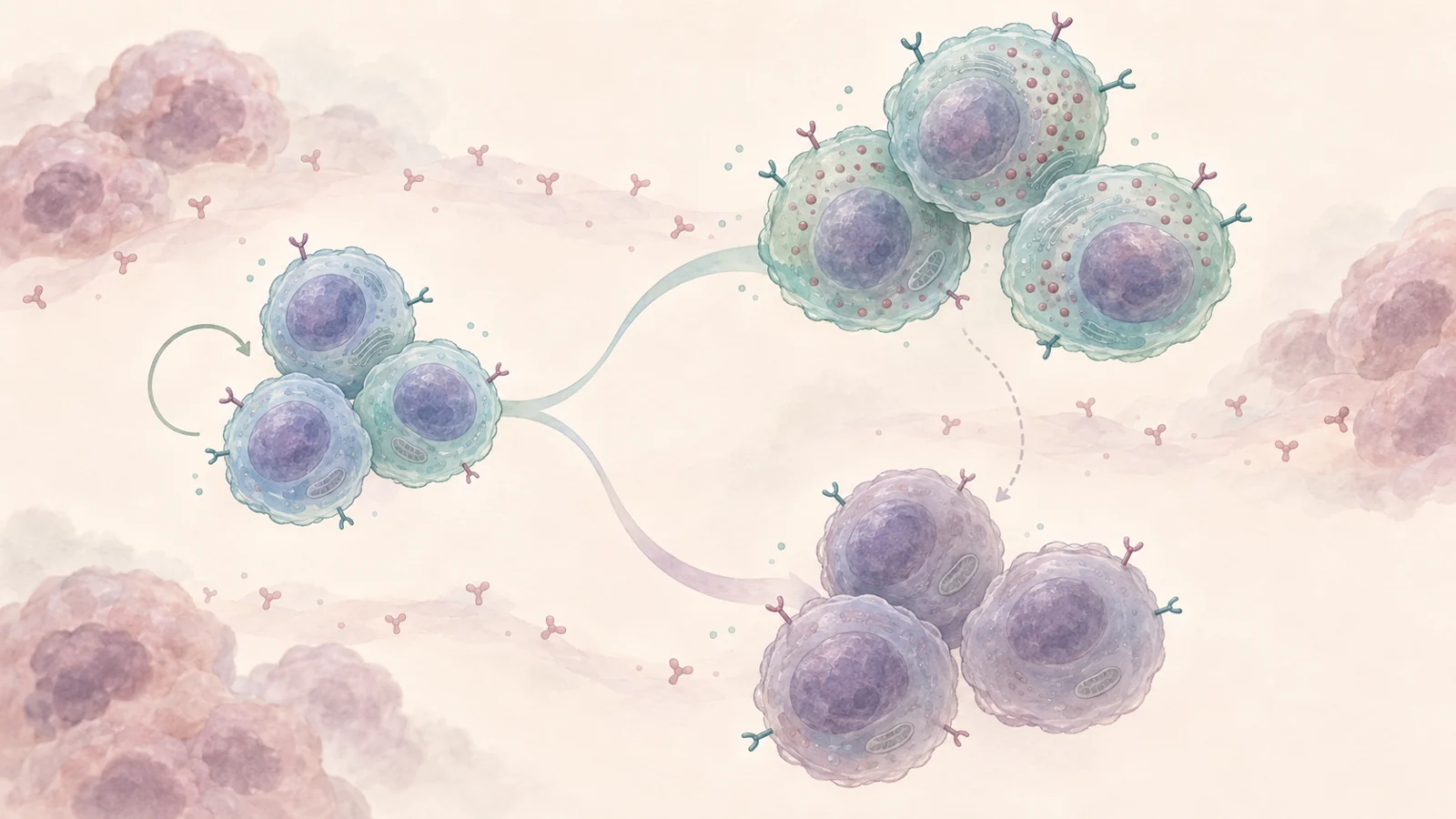
CD8-positive T cells help recognize and attack infected or cancerous cells. When they encounter their target over a long period, as in chronic infection or cancer, they can lose some of their ability to act. This state is called T-cell exhaustion. It involves changes in cell function and gene activity, but it does not leave every T cell in the same condition.
One group, called precursor exhausted cells, retains the protein TCF-1. These cells have some properties of memory T cells: they can renew themselves and give rise to other states, including cells with killing functions and more terminally exhausted cells. The review links this TCF-1-positive reserve to effective responses to immune-checkpoint blockade in the studies it summarizes. Checkpoint-blocking drugs can release inhibitory restraints on immune cells, but the presence of a renewable T-cell population may matter to how well that response can be sustained.
More terminally exhausted cells have a different profile. The review describes gene-regulating changes in these cells as becoming fixed and persisting even after chronic stimulation and inflammation are removed. That makes the earlier, renewable state an appealing focus for research: preserving cells that can still develop may offer more options than trying to redirect cells whose state is deeply established. It does not follow that increasing TCF-1-positive cells alone would improve treatment; their ability to produce useful attacking cells and respond to therapy also matters.
CD226 and CD137 show why stimulation is complicated
CD226 is a receptor that helps CD8-positive T cells respond to activation. Studies summarized in the review, involving human samples and mouse tumor models, associated loss of CD226 with weaker cell function and reduced responsiveness to anti-PD-1 checkpoint blockade. In experiments described by the review, restoring CD226 in cells that lacked it rescued their response to stimulation. Among tumor-infiltrating T cells, higher CD226 expression also tracked with a greater ability to release the effector molecule IFN-γ.
CD137 is another receptor that can encourage T-cell activity. In mouse tumor models, stimulating CD137 increased the killing activity of tumor-infiltrating CD8-positive T cells. Yet anti-CD137 treatment also led to the accumulation of CD8-positive cells lacking CD226 in mice. Those CD226-negative cells were less able to multiply and release inflammatory molecules when stimulated, and they had weaker anti-tumor properties in the reported experiments.
Some CD226-negative cells showed activity in genes associated with precursor exhausted cells, including the gene that produces TCF-1. But that resemblance did not mean they shared the precursor cells’ treatment responsiveness: in a mouse melanoma model, anti-PD-1 did not restore effector function in cells lacking CD226. A stem-like gene pattern, by itself, is not proof that a T cell can respond to checkpoint blockade. The receptor findings make the practical tension clear: activating one route can support attack, while changes in another part of the cell’s response may leave a population less functional.
Cell development has a balancing act
PI3Kδ is part of a signaling pathway that helps shape T-cell development. In experiments on dividing T cells, daughter cells with stronger PI3K activity were more likely to switch off FoxO1, a regulator of TCF-1, and lose TCF-1. Cells with lower PI3K activity were more likely to retain TCF-1 and form a self-renewing memory population. These observations connect the strength of this pathway with the cell states that emerge.
The review then considers a possible therapeutic step: inhibiting PI3Kδ might help maintain TCF-1-positive precursor exhausted cells. That is a proposal based on the cell-development findings, not an established treatment effect. PI3Kδ also contributes to the development of effector T cells, the cells that carry out attacks. Reducing the pathway could therefore help preserve a renewable pool while making it harder to generate enough effective attackers. How to balance those outcomes, including during the preparation of tumor-infiltrating or engineered T cells, remained an open question in the review.
IL-2 variants may favor different cells
IL-2 is a messenger that encourages immune cells to grow and act. In studies summarized by the review, conventional IL-2 promoted cytolytic, or target-killing, CD8-positive cells. In studies of chronic viral infection summarized by the review, IL-2 treatment increased antigen-specific exhausted T cells and improved control of the virus. Combining IL-2 with PD-1 blockade also produced a stronger effect in that setting; the review suggests the interventions may have acted on different T-cell populations.
IL-2 can also expand regulatory T cells, which dampen immune responses, and conventional treatment has been associated with vascular leakage syndrome. Engineered versions are designed to alter which cells receive the strongest growth cue. The review describes THOR-707, a modified IL-2 designed to engage two components of the IL-2 receptor, as reducing tumors in reported experiments without expanding regulatory T cells. It also summarizes findings on H9T, an engineered IL-2 variant that helped CD8-positive cells retain TCF-1; those cells also had greater spare respiratory capacity, a measure of their ability to increase energy production.
The point of these variants is not simply to deliver more of the same messenger. It is to steer growth toward cells that maintain a useful state, while accounting for the other immune cells IL-2 can affect. The results summarized here make that a research direction; they do not establish patient benefit.
Antigen delivery changes the setting
Some approaches change the circumstances in which T cells encounter their target, rather than directly changing a receptor or growth pathway. In a cited study, vaccination through a vein with a compound that activates the immune sensors TLR7 and TLR9, plus a nanoparticle carrying a new tumor antigen, produced a higher proportion of stem-like CD8-positive T cells than vaccination under the skin. The stem-like cells could develop into effector cells and support anti-tumor responses in that model.
The comparison suggests that the route and presentation of an antigen can influence which T-cell states are generated. The review also raises the possibility that how long dendritic cells display a target to T cells in lymph nodes and the spleen could help maintain the TCF-1-positive reserve during persistent exposure. These findings bring the setting of stimulation into the same conversation as the molecular cues: the pattern of exposure may help determine the balance of cells available later.
Where this research could lead
For a patient whose tumor does not respond to existing checkpoint blockade, a future treatment might maintain a renewable pool of T cells that can respond while still producing cells able to attack the tumor. Checkpoint drugs already release an inhibitory brake; the farther goal suggested by this review is a dependable way to balance that renewable reserve with active effectors. The biological bridge is the relationship between TCF-1-positive precursor cells, which can renew and produce other states, and the receptor, signaling and antigen-presentation findings that may influence which states emerge. Developing such a treatment would take further work and clinical testing.
A nearer milestone would be a controlled tumor study showing that one defined intervention preserves the TCF-1-positive pool and functional tumor-directed responses together, including responsiveness to checkpoint blockade. That would show whether the approach maintains both a renewable source and cells capable of acting, rather than changing a marker alone.
Key Sources
- Primary source: The Road Less Taken: Less Appreciated Pathways for Manipulating CD8 + T Cell Exhaustion.
DOI or Journal Page · Review or Meta-Analysis · 2022-07-06
Keep exploring