
Research Signal – Source date 2022-06-01
CAR-T therapy has reached clinical practice for two blood cancers, yet the same approach has proved difficult to apply to solid tumors, and some cancers return after an initial complete response. A 2022 review describes both the promise and the challenges: engineered T cells can be directed to recognize and eliminate tumor cells, but durable benefit depends on more than getting that recognition started.
The review, published June 1, 2022, describes accumulated clinical challenges and surveys approaches used in 2020–2021 trials. It also discusses design strategies intended to improve the therapy. Those strategies point to possible directions; the review’s abstract does not show that a newer design outperformed an existing treatment.
A redirected immune cell, with a specific target
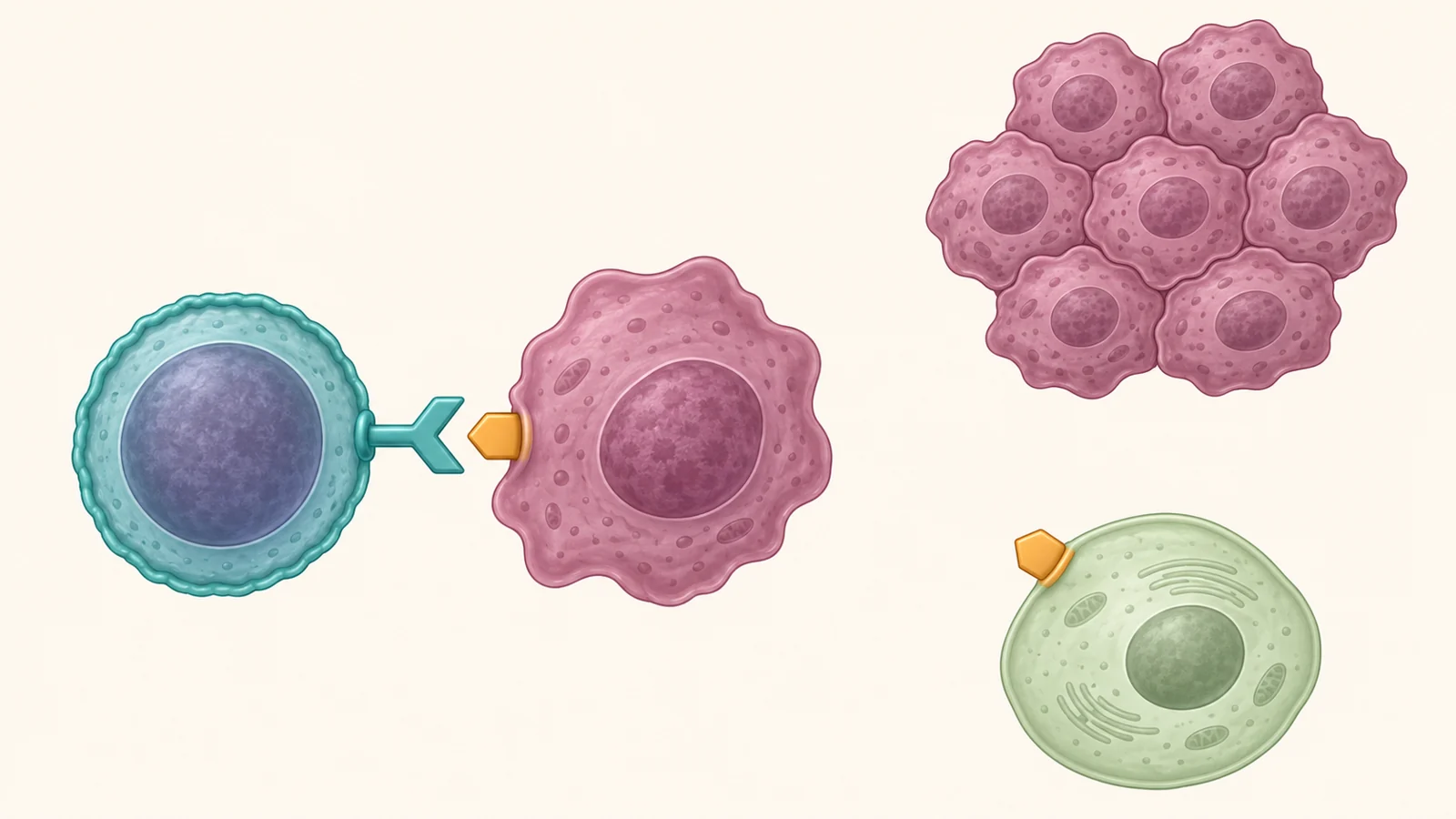
A chimeric antigen receptor, or CAR, is an engineered receptor that redirects a T cell toward a tumor target. The T cell is the immune cell; the receptor gives it a way to recognize the selected target and attack cells carrying it. This makes target choice central: the intended recognition must lead toward tumor cells while avoiding unacceptable effects elsewhere.
By the review’s publication, CAR-T products were commercially available for acute lymphoblastic leukemia and B-cell lymphoma. The review cites roughly 900 CAR-T clinical-trial registrations through 2021. That figure describes the scale of research activity, not the number of successful therapies or the number of patients who benefited. The review surveys the antigens selected as targets, receptor designs, and cell sources represented in trials during 2020–2021.
A response can start, then fade
The review separates poor efficacy in solid tumors from relapse after complete response. Poor efficacy means the approach has struggled to produce a strong effect in that setting. Relapse describes a different course: a complete response occurs, then the cancer returns. One is a problem of initial effectiveness; the other concerns how long a response lasts.
The review also identifies lack of T-cell persistence and tumor resistance as challenges relevant to lasting benefit. Persistence concerns whether engineered T cells remain available over time; resistance describes the tumor’s ability to escape the treatment’s effects. These are distinct concerns, and the abstract does not assign a cause to any particular relapse. It does, however, make clear why an early response alone cannot answer whether the benefit will endure.
Recognition can create a safety trade-off
On-target off-tumor toxicity is a risk in which the treatment acts through its intended recognition target but affects tissue outside the tumor. In other words, accurate recognition of a target does not by itself ensure that every cell carrying that target is part of the cancer. Stronger activity therefore has to be considered alongside where the target is found and what effects follow from recognizing it.
The review discusses efforts to change CAR-T signaling and antigen-recognition designs, engineer T cells, and explore cell resources. It describes modular and programmable approaches, as well as combined genetic and chemical engineering, as ways researchers aim to improve versatility, antitumor activity, persistence, and safety. These are design goals under investigation, not comparative evidence that any one approach has already improved patient outcomes.
What this could change
A dependable engineered T-cell option for a person with a solid tumor would extend the kind of treatment choice represented by the blood-cancer products described in this review. The possible path is clear but conditional: redirecting T cells toward tumor targets is already the underlying idea, while design changes aim to address weak activity, limited persistence, and safety. Development and clinical testing would still need to establish whether those aims can become reliable benefit for people with solid tumors.
A useful milestone would be a defined solid-tumor trial reporting responses that remain sustained, alongside careful monitoring for off-tumor toxicity. Such a result would be evidence about a particular treatment in a particular setting. It would not, by itself, establish a dependable option across solid tumors; it would show whether the proposed bridge from targeted recognition to durable, acceptably safe treatment is beginning to hold.
Key Sources
- Primary source: CAR-T Therapy in Clinical Practice: Technical Advances and Current Challenges.
DOI or Journal Page · Review or Meta-Analysis · 2022-06-01
Keep exploring