
Research Signal – Source date 2022-05-27
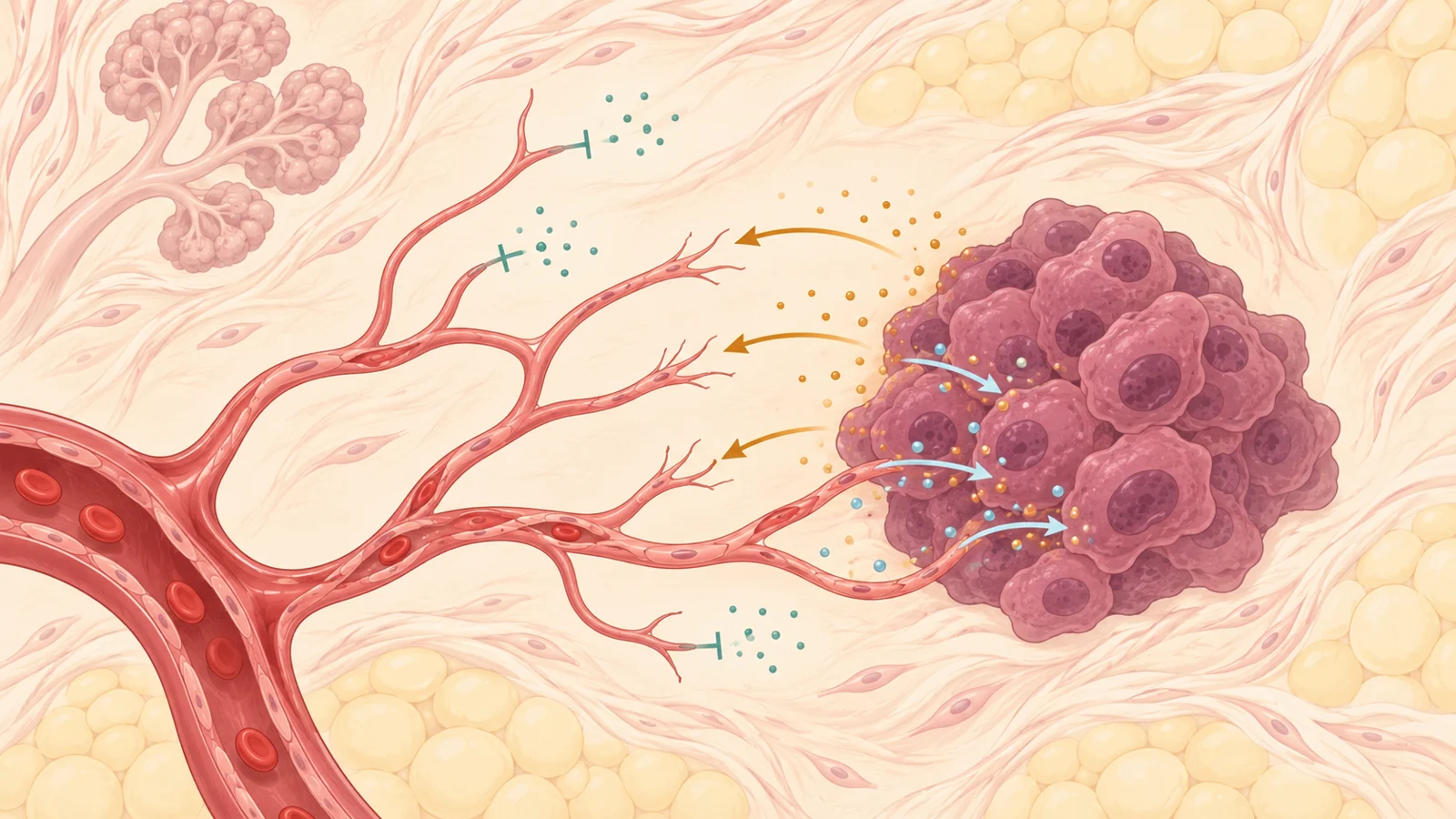
A growing breast tumor needs more than cancer cells: it also needs a supply of oxygen and nutrients. New, tiny blood vessels can provide that supply. A 2022 review describes vessel formation as a balance between signals that encourage it and factors that restrain it, and discusses whether strengthening the restraining side could become a treatment approach.
The idea is biologically understandable, but it is not the same as evidence that a treatment works for patients. The review’s abstract summarizes earlier findings and treatment directions; the material available here does not establish the benefit or risks of a particular approach in people.
A growing tumor needs a supply line
Angiogenesis means the formation of new blood vessels. The review describes angiogenic factors—molecules that promote this process—and anti-angiogenic factors, which inhibit it. In its account, an imbalance between the two can favor the formation of new vessels in and around a breast tumor.
Those small vessels matter because they carry oxygen and nutrients to growing tumor cells. A developing tumor’s surroundings, often called its tumor microenvironment, include these vessels as well as the signals that influence them. The review links vessel growth to changes in that environment that can support tumor development.
This is a supply mechanism, not a claim that blood vessels alone determine whether a tumor grows. It helps explain why researchers study the signals that shape them alongside the cancer cells themselves.
The concern extends beyond the breast
The review also connects angiogenesis with conditions that can facilitate cancer cells’ migration from the breast to other organs, including the lungs, liver, bones and brain. In that account, new vessels are part of a wider setting associated with both tumor growth and spread.
That connection matters because metastasis—cancer spreading from its original site—can involve more than expansion of the breast tumor. The abstract does not describe a measured effect of vessel formation on spread in a particular group of patients. It presents the relationship as part of the biological evidence the review considers.
Restraining vessel growth is a treatment idea
If factors that promote vessel formation help create conditions for a tumor to grow, factors that inhibit it offer a possible point of intervention. The review discusses anti-angiogenic approaches on this basis: they aim to restrain the formation of new blood vessels that supply a tumor.
That is a proposed treatment direction grounded in the biology the review summarizes. The abstract does not identify a specific treatment whose effect on breast cancer outcomes can be assessed from the evidence provided here. A plausible target is a reason to investigate an approach, not proof that targeting it helps patients.
What the review can tell us
Published on May 27, 2022, the paper is a review of the role of anti-angiogenic factors in breast cancer and their therapeutic potential. Its abstract supports a broad account: vessel-promoting and vessel-inhibiting factors both matter to the biology under discussion; an imbalance is linked to new vessel growth; and those vessels supply oxygen and nutrients to growing tumor cells. The review also connects angiogenesis with conditions that facilitate migration and discusses anti-angiogenic treatment approaches.
The supplied evidence does not give a quantitative comparison of treatments, patient outcomes, harms, or a patient group for whom a named approach might be appropriate. It therefore cannot show how well any particular vessel-targeting treatment works for people with breast cancer. Those clinical questions require evidence about treatment and outcomes in people, rather than a biological rationale alone.
What this could make possible
If future evidence shows that a specified approach can safely restrain tumor-supporting vessel growth and improve outcomes, a person with breast cancer could have another treatment option grounded in that biology. The meaningful advance would be an option with demonstrated patient benefit, not simply a way to alter vessel formation.
A nearer milestone would be a human study of a specified anti-angiogenic approach that reports both patient outcomes and harms. Such evidence could help establish whether the review’s treatment direction translates into a dependable clinical option. The 2022 review describes that direction; it does not establish that the option is already available or effective.
Key Sources
- Primary source: Role of anti-angiogenic factors in the pathogenesis of breast cancer: A review of therapeutic potential.
DOI or Journal Page · Review or Meta-Analysis · 2022-05-27
Keep exploring