
Research Signal – Source date 2022-05-16
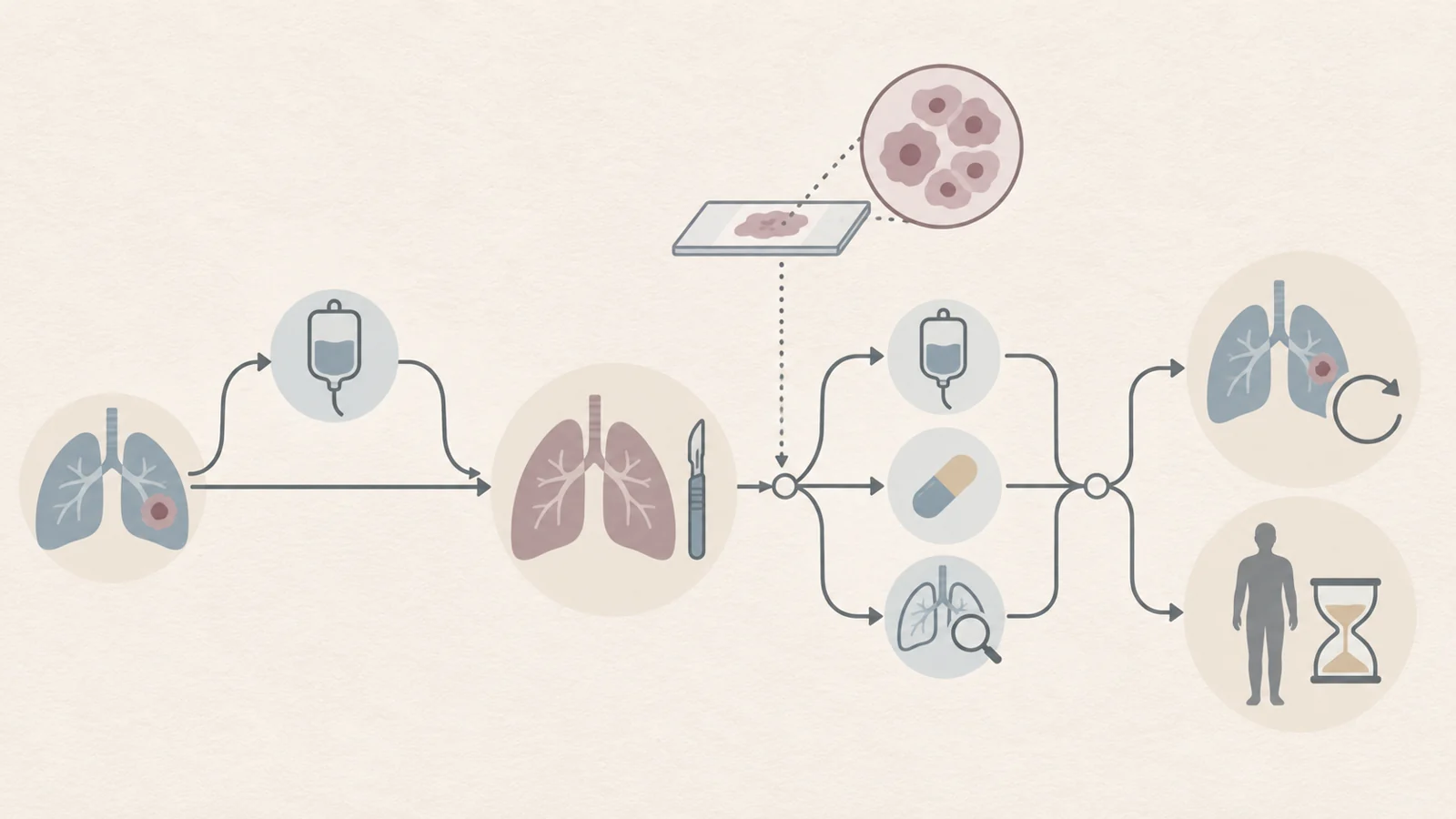
Removing a lung tumor does not always prevent the cancer from returning. For people with non-small-cell lung cancer (NSCLC), treatment after surgery aims to lower that risk. A review published May 16, 2022, interpreted clinical studies discussed as important advances in 2021. Its examples show why tumor tests can help shape treatment choices—and why more time without recurrence does not automatically mean more time alive.
The studies measured different outcomes in different groups of patients. To understand what a result means, it helps to separate disease-free survival, a measure of time before recurrence or another defined disease event, from overall survival, or how long people live.
The recurrence benefit did not settle the survival question
After surgery, the review describes treatment decisions informed by tests for changes in the EGFR gene and measurement of PD-L1, a feature of tumor cells. For some patients whose tumors have an EGFR mutation, an EGFR-targeted drug may be used as postoperative treatment. The review’s account of the ADJUVANT/CTONG1104 trial shows why a favorable result on one measure can leave an important question open.
In that study, people with resected, EGFR-mutated stage II to IIIA NSCLC received gefitinib, an EGFR-targeted drug, or chemotherapy. Median disease-free survival was 30.8 months with gefitinib and 19.8 months with chemotherapy. The difference favored gefitinib, but overall survival did not differ significantly between the groups. Some patients still experienced recurrence.
Longer time before recurrence can matter to patients, but this trial result alone does not show that the treatment extends life. It also raises a further question: could tumor features help distinguish which patients are more likely to benefit from one postoperative treatment than another?
An exploratory analysis examined tumor samples from 171 trial participants across 422 cancer-related genes. The researchers used the findings to develop MINERVA, a score intended to compare the relative benefit of targeted therapy and chemotherapy. It separated EGFR-mutated patients into groups with different outcomes: one had advantages in both disease-free and overall survival with gefitinib, another had a disease-free survival advantage with gefitinib, and a third had a disease-free survival advantage with chemotherapy. The chemotherapy-priority group included patients with RB1 alterations; other gene changes were enriched in the group with the strongest relative advantage on gefitinib.
When applied to data from a separate phase II study, MINERVA again separated patients into groups with different outcomes. That observation supports further study of differences within the EGFR-mutated group, but it does not establish the model as a routine treatment-selection test.
PD-L1 levels added detail to the postoperative result
The IMpower010 trial studied immunotherapy after surgery and chemotherapy. In the review’s account, atezolizumab improved disease-free survival compared with best supportive care among patients with resected stage II to IIIA NSCLC whose tumors had PD-L1 expression of at least 1%. PD-L1 expression is a measured tumor feature; the trial also examined groups based on how much of it was present.
The reported effect varied across those groups. The disease-free survival result was strongest among tumors with PD-L1 expression of at least 50% (hazard ratio 0.43) and more limited among those with expression from 1% to 49% (hazard ratio 0.87, with a confidence interval that included no difference). A hazard ratio compares event rates over time between groups; it does not tell an individual how many months they will gain.
The review cautions that this subgroup analysis followed the main analysis and should be interpreted carefully. The result illustrates why a finding for a broad group may not describe every patient equally well, while leaving the overall-survival question separate from the reported disease-free survival benefit.
Before or after surgery is a separate decision
Immunotherapy can also be given before surgery. The randomized phase III CheckMate 816 study assigned 358 people with operable stage IB to IIIA NSCLC to three treatment groups before surgery. The reported response comparison involved nivolumab plus chemotherapy and chemotherapy alone. The review reports higher rates of complete and major pathological response with the combination. Complete pathological response means no cancer was found in the surgical specimen; major pathological response means only a small amount remained. The study’s event-free survival result was also announced as positive by the end of 2021.
These findings address what was seen in the removed tumor and how long patients went before a defined event. They do not directly compare treatment before surgery with the postoperative approach in IMpower010: the studies examined different treatment schedules and patient groups. The review leaves which timing is better unsettled.
What this could make possible
A pattern of tumor-gene changes could one day help people recovering from lung surgery choose among available treatments, alongside established tumor tests. If such a pattern reliably identified who is more likely to benefit, it could help prevent recurrence while sparing patients treatment unlikely to help. The exploratory MINERVA groups offer an early bridge to that possibility, while the gefitinib results show why a useful choice must be judged by both recurrence and survival.
That future depends on clinical validation. A new study would need to show whether using the gene pattern to choose treatment improves outcomes over current marker-based care, tracking recurrence, survival, and treatment harms. Until then, MINERVA remains exploratory, and the patient-level benefit is a possibility rather than an established capability.
Key Sources
- Primary source: [An Overview and Interpretation of Important Clinical Studies on Non-small Cell Lung Cancer in 2021].
DOI or Journal Page · Review or Meta-Analysis · 2022-05-16
Keep exploring