
Research Signal – Source date 2022-05-04
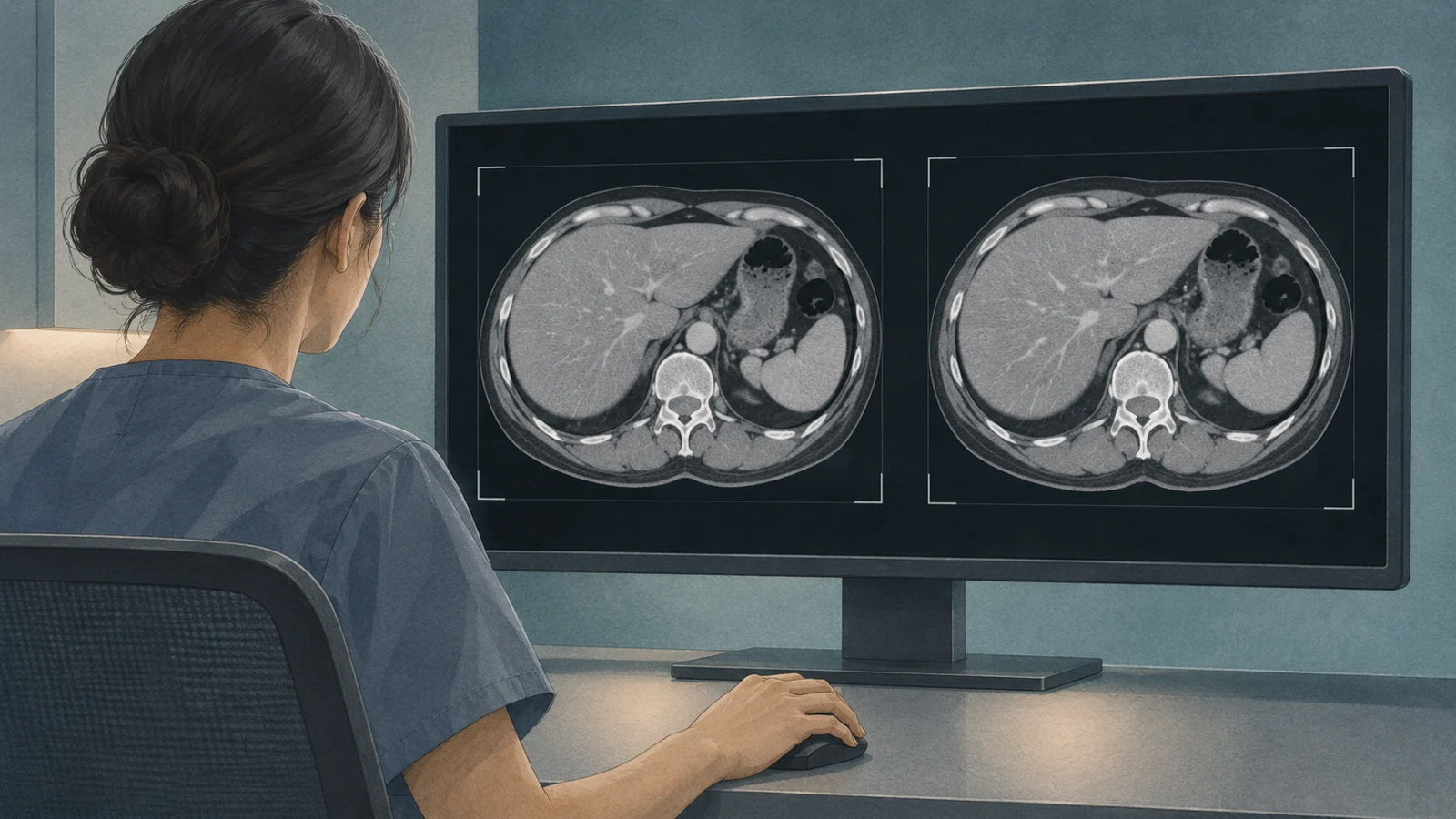
Immune-based treatment has brought a survival benefit for people with advanced hepatocellular carcinoma, a form of liver cancer. Yet improvement in survival and a clear reading of an individual scan are different questions. A CT or MRI may be harder to interpret after treatment, even as immunotherapy changes the outlook for some patients.
That tension is central to a 2022 AJR Expert Panel narrative review. The review summarizes published studies and radiology consensus; it is not a new patient study. It describes how checkpoint-inhibitor treatment can produce imaging patterns that challenge established ways of judging whether a tumor has responded or progressed.
A treatment benefit is not a scan measurement
The review reports that immunotherapy has conferred a survival benefit in advanced liver cancer, a disease setting where prognosis is typically poor. It also says the most pronounced improvements in response documented on CT or MRI occurred when immunotherapy was combined with other systemic treatments or with locoregional treatments directed at the liver or nearby area.
Those are related but distinct observations. Survival describes how long patients live; imaging response criteria classify changes seen on scans. The review’s abstract gives no effect sizes or comparative response rates, so it does not quantify the survival benefit or establish how much better one treatment combination performed than another. Its point is that some of the strongest imaging-response improvements in the studies it discusses came from combinations, not that a particular combination guarantees an individual benefit.
Established rules can struggle with treatment-related patterns
Radiologists use response criteria as consistent rules for comparing scans over time and deciding whether visible disease appears to be shrinking, growing, or otherwise changing. RECIST, modified RECIST, and criteria from the European Association for the Study of the Liver are among the conventional approaches named in the review.
Checkpoint inhibitors can lead to imaging patterns that make those rules difficult to apply. The review identifies that challenge without specifying how often any particular pattern occurs or providing an example that can be generalized to a patient. The practical issue is that a rule designed to classify change must fit the kinds of changes treatment can produce. If it does not, a scan’s appearance may not translate neatly into a judgment about response or progression.
Newer criteria offer a proposal, not a validated answer
Immune-related RECIST, or iRECIST, and immune-modified RECIST, or imRECIST, were developed to assess response or progression in people receiving immunotherapy. They represent attempts to adapt scan interpretation to treatment-related patterns that can strain conventional criteria.
The review states that these newer criteria remained unvalidated. A proposed way to classify scans is not the same as proof that it reliably guides care. The review does not establish that using iRECIST or imRECIST improves treatment decisions. That boundary matters because a scan rule may sound precise while still needing evidence that its classifications correspond meaningfully to what happens to patients.
Bringing treatment evidence into radiology
The panel’s contribution is to bring several strands of the changing treatment landscape together for radiologists: studies of immunotherapeutic agents, the biological rationale for using them, response assessment on imaging, and consensus considerations for practice. That synthesis helps explain why scan interpretation is part of understanding the evidence, rather than a simple visual check detached from how treatment works.
The review is useful as a 2022 account of a rapidly changing field. Its consensus statements are intended to inform radiologists, while its discussion of published studies provides context for reading imaging findings. It does not give patient-specific guidance, and the supplied evidence does not support using its summary to predict how a particular person’s scan or treatment will turn out.
Where this research could lead
At a future follow-up appointment, a person receiving immune-based treatment for liver cancer and their care team could discuss a scan using response rules shown to handle the treatment’s unusual imaging patterns dependably. CT and MRI already provide the images; the possible advance is a more reliably validated way to interpret them. If those classifications prove meaningful against clinical outcomes, they could contribute to clearer treatment discussions.
That possibility follows from the mismatch the review identifies: checkpoint-inhibitor treatment can produce imaging patterns that established rules may not capture well. A nearer milestone would be independent patient-study validation of immunotherapy-specific scan classifications against subsequent outcomes. This is an editorial forecast, not a result reported or promised by the review. Whether better classification would change care depends on evidence that connects the scan interpretation to outcomes that matter to patients.
Key Sources
- Primary source: Immunotherapy-Based Treatments of Hepatocellular Carcinoma: AJR Expert Panel Narrative Review.
DOI or Journal Page · Review or Meta-Analysis · 2022-05-04
Keep exploring