
Research Signal – Source date 2022-04-05
T cells are central to the body’s antitumor response, and treatments that change their activity have already shown that this response can matter in cancer care. Yet tumors can create an environment that suppresses T cells, and many patients do not respond to current treatments. A 2022 review considers whether small interfering RNA, or siRNA, could offer another way to help: temporarily silence a chosen gene that acts as a brake on T-cell activity.
The idea is attractive because it combines a specific target with a temporary effect. But choosing a gene is only part of the problem. The RNA must reach the intended T cells and work inside them. The review examines delivery approaches and the practical questions that stand between that possibility and a useful treatment.
A temporary brake on a chosen gene
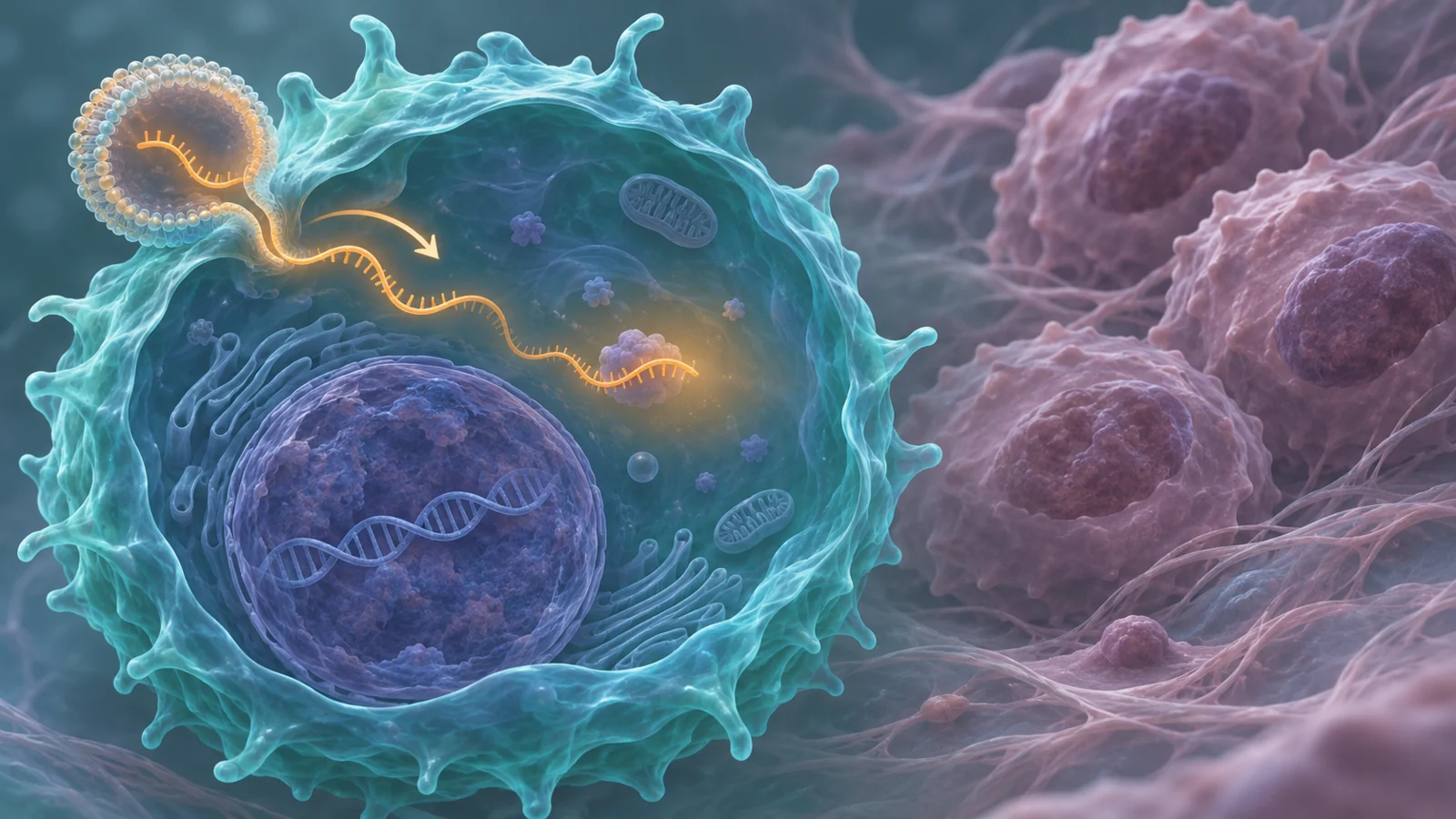
An siRNA is a small RNA sequence designed to match a particular gene’s message. By reducing that message, it can temporarily lower expression of the chosen gene. In this setting, the target would be a negative regulator: a gene whose activity restrains T cells. The aim is to ease that restraint without permanently changing the cell’s genetic instructions.
Some approaches use drugs or antibodies to block immune checkpoints, controls on T-cell activity; others aim to edit genes. The review presents siRNA as another possibility: temporarily reducing a selected gene’s activity. It does not show that siRNA is better or can replace those approaches.
A temporary, sequence-matched intervention could let researchers focus on a selected brake and ask whether reducing it changes T-cell behavior. The hoped-for effects include better proliferation, survival, entry into tumors, or potency. Those are possible goals for the approach, not outcomes established for patients by this review.
Reaching the right cell is part of the treatment
A gene target may be well chosen and still be out of reach. For siRNA to have its intended effect, it has to get to the relevant T cell from outside and then function inside that cell. The review treats these as linked but separate delivery hurdles: reaching the cell is one challenge; getting the RNA to work within it is another.
This matters because T cells are the intended recipients, and delivery methods have to be considered in relation to those cells. A delivery claim alone answers whether an approach can get siRNA to T cells under some conditions. It does not by itself show that the chosen gene was silenced enough to change the cells’ behavior.
Cells can be approached inside or outside the body
The review discusses delivery both ex vivo and in vivo. Ex vivo means working with cells outside the body; in vivo means delivering an approach to cells within the body. Adoptive T-cell therapies have helped drive interest in approaches that can act on cells outside the body, while delivery within the body raises the question of how siRNA can reach T cells in their natural setting.
The review compares delivery technologies with clinical use and manufacturing in mind. Those considerations matter because an approach must do more than work in principle: it has to fit a practical route for preparing or reaching the cells. The supplied evidence does not support ranking particular technologies or assigning them performance figures, so the useful point is the set of questions the comparison raises rather than a platform winner.
What would show that delivery changes T-cell function?
Evidence for delivery and evidence for benefit answer different questions. First, researchers would need to show that siRNA reaches the intended T cells and reduces expression of the selected negative-regulator gene. Then they would need to connect that silencing to a meaningful change in T-cell activity, such as proliferation, survival, tumor infiltration, or potency, in a relevant comparison.
The review’s abstract summarizes the rationale and delivery challenges; it does not establish that siRNA-treated T cells improve cancer outcomes for patients. Nor does the abstract show which delivery route or technology works best. That leaves a clear test for future work: link measured, targeted silencing to a meaningful T-cell change, rather than treating successful delivery as proof of therapeutic effect.
Where this research could lead
For someone whose tumor suppresses T cells, a future immune treatment might temporarily quiet a chosen molecular brake so those cells remain more useful within the tumor. That possibility depends on reliable delivery, evidence that the intended gene is actually silenced, and a demonstrated improvement in T-cell function where suppression limits treatment. Existing T-cell therapies already help some patients; the new capability would be making a chosen T-cell brake temporarily easier to overcome when it matters.
A nearer milestone is reproducible evidence that measured silencing of a selected T-cell brake leads to better T-cell activity or tumor infiltration in a relevant comparison. The review describes why transient, targeted silencing and delivery inside or outside the body are being explored. Whether those pieces can produce clinical benefit requires further development and evidence.
Key Sources
- Primary source: Non-viral siRNA delivery to T cells: Challenges and opportunities in cancer immunotherapy.
DOI or Journal Page · Review or Meta-Analysis · 2022-04-05
Keep exploring