
Research Signal – Source date 2022-04-04
Mushrooms are familiar foods, and researchers also study substances derived from them for possible effects on immune cells. Those are two different claims from saying mushrooms help treat cancer. A 2022 review brings these questions together, but its supplied abstract does not tell us whether eating mushrooms or taking a particular compound improves outcomes for people with cancer.
The immune system is part of the research question
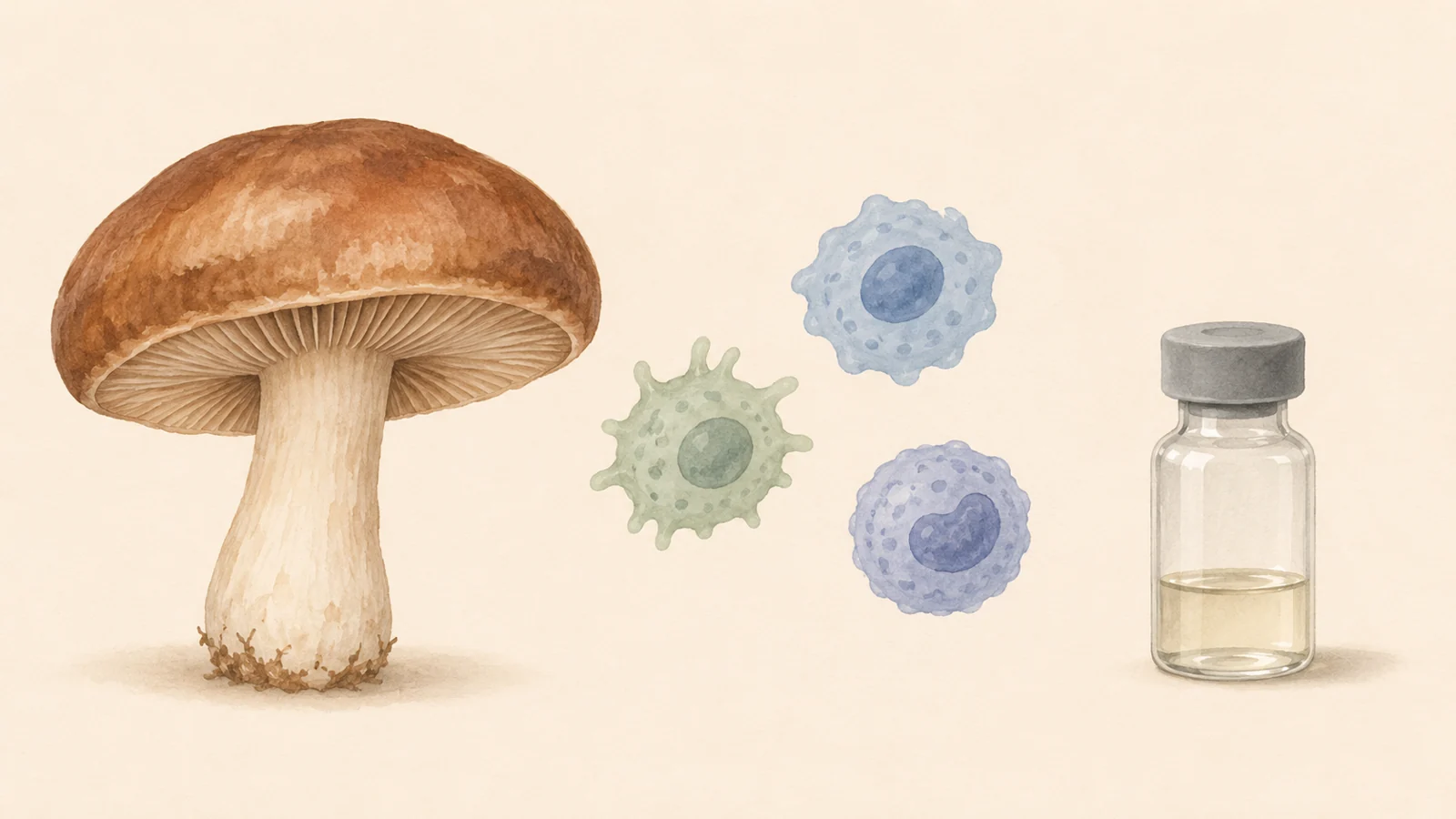
The review frames immune function as relevant to cancer-treatment research. It discusses mushrooms in connection with several kinds of immune cells: hematopoietic stem cells, which give rise to blood and immune cells; lymphocytes, a broad group of immune cells; macrophages, which can take up material in tissues; T cells, which help coordinate or carry out immune responses; dendritic cells, which help present information to other immune cells; and natural killer cells, which are part of the body’s immune defenses.
Naming these cell types makes the research question more specific than asking whether mushrooms “boost immunity.” Researchers can ask about particular cells and their functions. The abstract, however, does not attribute a measured effect to any one cell type. It identifies areas the review covers, rather than giving enough detail to compare findings or determine what happens in a person receiving cancer care.
A food is not the same as an extracted compound
The review describes mushrooms as traditional food and medicine, and also focuses on bioactive compounds derived from them. “Bioactive” means a substance that may interact with biological processes. The abstract connects these topics, but they should not be treated as interchangeable.
A whole mushroom contains a mixture of constituents and is eaten as food. A research question about a defined compound concerns a particular substance, which would need to be identified and studied on its own. Evidence about one would not automatically establish an effect for the other. The abstract does not specify a dose, a treatment role, or a result for a named mushroom species or compound.
That matters for readers because “mushrooms and cancer” can refer to ordinary eating, laboratory investigation of a substance, or a proposed treatment. Each question needs evidence suited to it. A general discussion of immune-cell research cannot by itself answer whether a particular product helps alongside established cancer treatment.
What the review can support
The source is a review published on April 4, 2022. Its abstract supports a broad account of research themes: immune function is relevant to cancer research, multiple immune-cell types are discussed, and mushroom-derived bioactive compounds are among the subjects considered. It also places those topics alongside conventional cancer therapy and other areas of drug development.
The abstract does not provide individual study designs, compound-specific results, effect estimates, or patient outcomes for independent appraisal. On this supplied evidence, there is no verified estimate of patient benefit, comparative safety, or affordability for a particular compound. Nor does the review’s general interest in mushrooms establish that eating them improves cancer outcomes. Those questions remain distinct from the review’s description of what researchers are investigating.
What this could make possible
For someone undergoing cancer care, a useful future answer would be specific: whether a defined mushroom-derived compound has a supported role alongside established treatment, and what evidence supports that role. Reaching that point would require independent work that moves from the review’s broad list of immune-cell types to reproducible, compound-specific findings, followed by clinical evidence that can assess outcomes and safety in people. The review’s abstract does not establish that such a role exists.
A nearer observable milestone would be a reproducible study that names a compound and measures its effect on a specified immune-cell function. That would make the question clearer and easier to test. It would still be an early step toward a dependable patient-facing answer, not proof that the compound treats cancer.
Key Sources
- Primary source: Immunomodulatory effect of mushrooms and their bioactive compounds in cancer: A comprehensive review.
DOI or Journal Page · Review or Meta-Analysis · 2022-04-04
Keep exploring