
Research Signal – Source date 2022-04-01
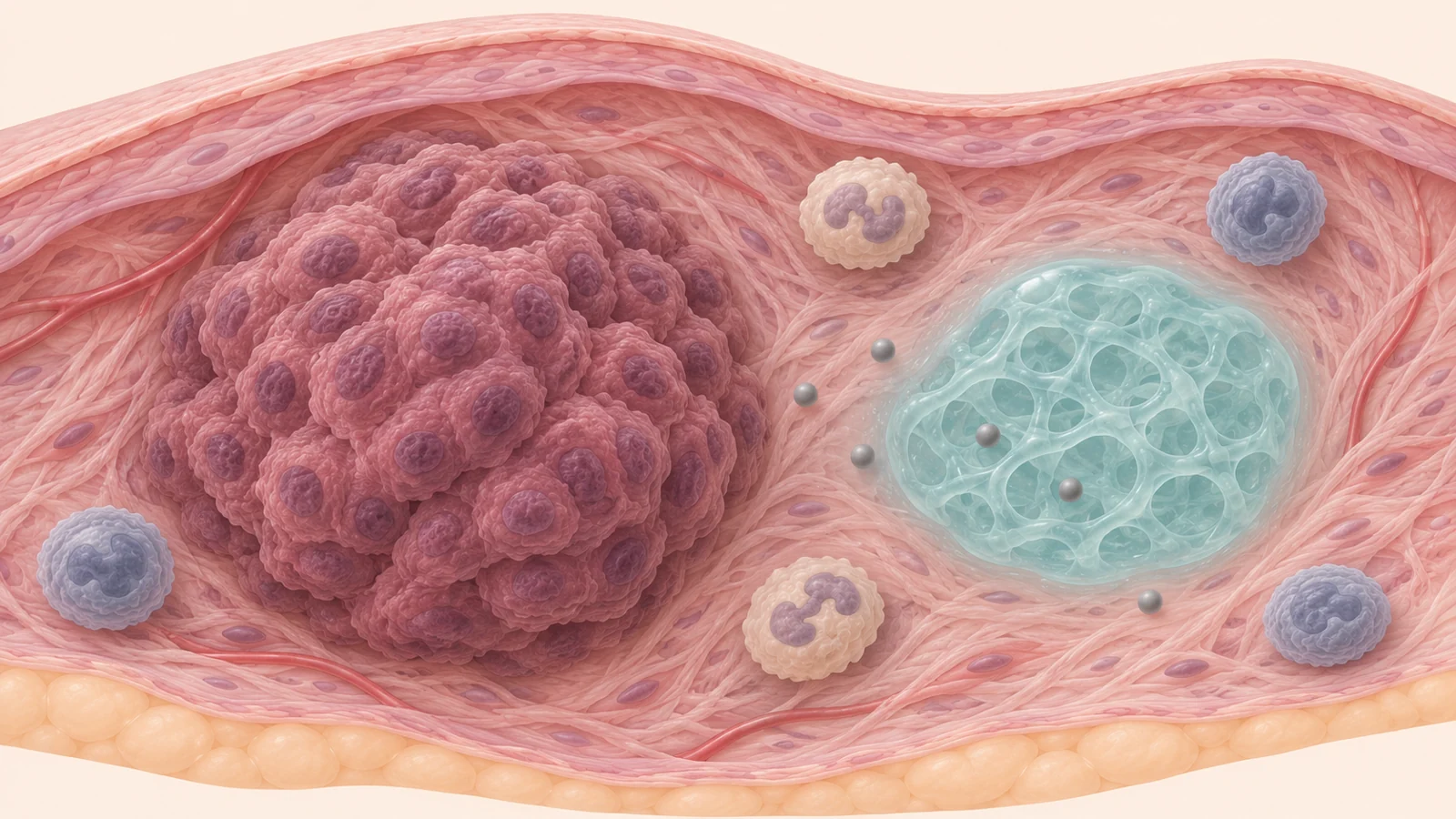
An immune treatment can act beyond the tumor it is meant to fight. That reach can be useful, but broad exposure can also contribute to serious immune-related effects. A review published on April 1, 2022, examines a different delivery question: could a treatment be held near a tumor and released there over time? Its proposed answer is a hydrogel, a water-rich, porous material that can serve as a local depot for immune therapies.
The idea changes where and when a treatment is delivered; it does not change the immune target itself. The review describes several distinct designs for cytokines, cancer vaccines, checkpoint-blocking drugs and engineered T cells. Their cargos and intended actions differ, so the examples are best understood as separate approaches rather than one proven platform.
A local depot changes the delivery problem
Hydrogels contain a network of material with high water content. Their porous structure can resemble aspects of the tissue environment and hold molecules or cells in place. Depending on how a gel is made, it can release its cargo gradually or respond to a condition such as temperature or reactive molecules in a tumor environment.
That makes location and timing part of the design. A drug injected into a tumor may be retained near the tissue for longer than a dose that immediately disperses through the body. A gel may also protect a delicate cargo or control how it is released. These are reasons to investigate the approach, not guarantees that every gel stays put, releases predictably, or reduces side effects in people.
Some of the reviewed materials are injectable in a flowing state and form a gel after reaching body temperature. In that design, the cargo can be mixed throughout the liquid before injection; the change to a gel can then limit an initial burst of release. The material’s chemistry and its transition conditions matter because a depot must be placeable while preserving the activity of whatever it carries.
Short-lived signals need a different schedule
Cytokines are signaling proteins that help coordinate immune activity. Interferons can activate immune cells such as dendritic cells and natural killer cells, while interleukins influence T-cell development and activity. GM-CSF can support T-cell survival and help dendritic cells display tumor-related antigens.
The delivery challenge is that cytokines can have short lifetimes in the body. Maintaining an effect may therefore require frequent or high doses, which can increase the risk of reactions such as cytokine release syndrome or vascular leak syndrome. The review also notes that some cytokines may kill activated T cells or help sustain regulatory T cells, which restrain immune responses.
A temperature-responsive gel is one proposed way to change the schedule. Instead of relying on repeated doses circulating throughout the body, an injectable depot can be designed to release a cytokine and other agents locally over time. This approach aims to make exposure more controlled. Whether a particular formulation achieves a useful balance between local activity, systemic exposure and immune effects depends on the specific cargo and material.
Vaccines have to reach the cells that build a response
A cancer vaccine must do more than stay near a tumor: it must help immune cells recognize tumor markers, called antigens. The review describes gels carrying tumor material or RNA, sometimes with adjuvants that stimulate the immune response. These ingredients can be fragile or difficult to deliver to the cells that start that response, so keeping them intact and getting them to the right place are central design problems.
One animal example shows what the approach can do in a model. Researchers tested a DNA gel carrying immune-stimulating material in mice with colon tumors. The review reports more activity in cells that help start immune responses, more tumor-attacking T cells and fewer T cells that dampen those responses. When tumor cells were later reintroduced, treated mice showed no sign of recurrence. That result belongs to this mouse model; it does not show that the approach prevents cancer recurrence in people.
Another gel in the review carried mRNA, genetic instructions cells can use to make an immune target, alongside an immune stimulant. The researchers reported immune responses targeted to that antigen in mice. The example shows why a vaccine depot cannot be judged only by how long it holds its contents: the cargo must remain usable and reach cells that can start the desired response.
Checkpoint blockers meet the tumor environment
Checkpoint inhibitors work by blocking signals that can restrain T cells. Drugs targeting PD-1, PD-L1 or CTLA-4 are discussed in the review as established immunotherapies, but their systemic use can produce immune-related adverse effects, and not every tumor responds. A hydrogel formulation is a separate delivery proposal: it seeks to alter where a checkpoint-blocking drug is released, not to make the drug effective for every tumor.
Some reviewed gels also respond to features of the tumor environment. For example, a reactive-oxygen-sensitive material can degrade in response to reactive oxygen species, molecules involved in local tumor biology. One approach combined such a gel with a PD-L1 blocker and gemcitabine in mouse tumor models. The gel was designed both to release the agents and to react with local oxidative conditions. The reported immune activity and tumor-model effects are specific to those experiments; they do not show that the same material or combination will work across cancers.
Here, the material is part of the proposed treatment mechanism. Its behavior in the tumor environment may shape both cargo release and local conditions. That creates a more complex design question than simply placing a drug in a reservoir: the response of the gel, the drug and the tumor all have to align.
Living T cells need a place to remain active
CAR-T therapy uses a patient’s T cells, engineered to recognize a chosen target, and returns them to the body. Unlike a soluble drug, these are living cells. They must remain viable and active after delivery, and many solid tumors create a difficult environment for them. The review notes that CAR-T therapy has had limited effectiveness against most solid tumors, alongside risks such as targeting healthy cells that share the recognized antigen.
A gel that carries CAR-T cells therefore has a different job from one that releases a small molecule. It may need to support cell survival and activity in the tumor environment, potentially alongside signals that help sustain the cells. For example, the review describes a gel carrying engineered T cells and an immune signal that supports them in mice with retinoblastoma, an eye cancer. In that mouse experiment, the review reports elimination of retinoblastoma cells without impaired vision; the result cannot establish effectiveness or safety in patients.
What the examples can tell us
The review brings together varied hydrogel designs and experimental examples. Some report immune-cell changes; others report tumor control in mice. Those outcomes answer different questions. A rise in a particular immune-cell population does not by itself show that a tumor will shrink, and tumor control in one model does not establish a patient benefit. Nor can results from a vaccine gel be treated as evidence for a cytokine, checkpoint-blocker or CAR-T formulation.
A human comparison would need to examine several outcomes together. Does the material retain the treatment near the intended tumor, and how much reaches the rest of the body? Does the treatment produce a meaningful tumor response? What immune-related adverse events occur? The answers could vary with the tumor, the cargo and the properties of the gel. The review supports local retention and controlled release as research goals; it does not establish improved survival or reduced immune-related harm in patients.
How this could shape the future
For someone with a reachable solid tumor, a dependable local option could eventually pair the placement of an immune treatment with a release pattern suited to that treatment. Such a depot might reduce reliance on repeated whole-body exposure while keeping a useful agent near the tumor. The review’s examples provide an early evidence bridge for that possibility: local materials have carried several kinds of immune cargo, with activity reported in animal models. A patient option would still depend on finding suitable tumors and effective agents, and on clinical studies showing that the formulation works reliably.
A nearer milestone would be a controlled human comparison that measures local retention, systemic exposure, tumor response and immune-related adverse events. That test would ask whether a particular gel and cargo combination behaves as intended in people. It is distinct from the future option itself, and from immunotherapies already available without these hydrogel formulations.
Key Sources
- Primary source: Short Review on Advances in Hydrogel-Based Drug Delivery Strategies for Cancer Immunotherapy.
DOI or Journal Page · Review or Meta-Analysis · 2022-04-01
Keep exploring