
Research Signal – Source date 2022-03-11
Among the small studies of adoptive T-cell therapy for advanced colorectal cancer, three of five articles reporting overall survival found median estimates above 14 months. Seven articles reported median progression-free survival above 4.5 months. Those figures sound encouraging, especially in a disease where many patients had already received other treatments. But the studies did not compare these patients fairly against similar patients receiving another treatment, so the figures cannot show that the transferred cells extended survival.
The 2022 systematic review gathered results from 15 clinical studies involving 108 enrolled patients. It found a wide range of tumor responses and one treatment-related death. The findings explain why researchers were exploring ways to put cancer-targeting immune cells into patients, and why the approach’s effects could depend on the specific cells and target.
The search for another option
Most people in the review had stage IV colorectal cancer, meaning their cancer had spread beyond its original site. Standard care often combined chemotherapy with a biologic drug. These treatments could control disease, but were not curative, and many patients in the reviewed studies had already received at least one treatment line.
Immune checkpoint drugs offered another route for a small subgroup: people whose tumors have many DNA changes and are more likely to attract immune cells. This pattern is called microsatellite instability-high, or MSI-H. The review notes that this subgroup made up about 5% of people with advanced colorectal cancer; checkpoint treatment had established benefit for them, while most patients did not have that option outside clinical trials.
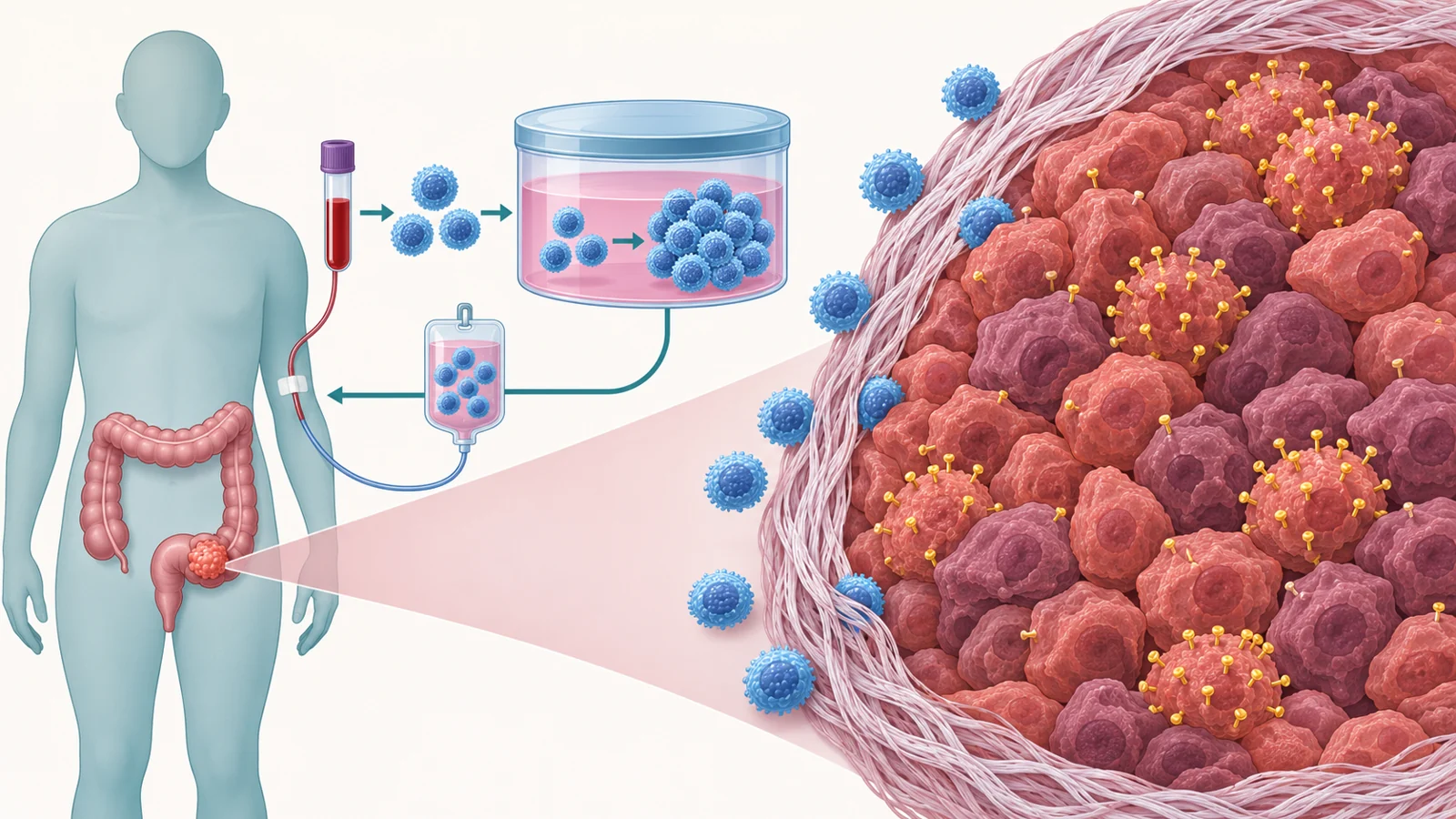
Adoptive T-cell therapy takes a different approach. Instead of mainly releasing the brakes on immune cells already in a tumor, it collects T cells, grows or modifies them outside the body, and returns them to the patient. The hope is to provide cells that can recognize cancer more effectively. But a cell capable of recognizing a target still has to reach the tumor, remain active there, and find the cancer cells carrying that target.
From a tumor sample or a blood draw
Some approaches start with T cells taken from a tumor removed during surgery. These tumor-infiltrating lymphocytes, or TILs, already came from the tumor. They can be reactivated and expanded in the lab before being infused back into the patient.
Other approaches collect T cells from blood and modify them to recognize a chosen cancer target. In T-cell receptor therapy, the modified cells recognize a target presented by a molecule on the cancer cell. Chimeric antigen receptor T cells, known as CAR-T cells, are designed to bind directly to a target on the cell surface. These different routes matter because a treatment is only as useful as its ability to find an appropriate target on cancer cells without causing serious harm elsewhere.
Success in blood cancers does not automatically carry over to colorectal cancer. A solid tumor can be difficult for immune cells to enter. Cells that get inside may be suppressed, and different cancer cells within the same tumor can carry different targets. A treatment could therefore miss some cancer cells even if it recognizes others. The review describes these obstacles as reasons that immune therapies with striking results in blood cancers had produced much less response in solid tumors.
Fifteen studies, with very different cells and patients
The review searched four research databases for English-language studies published from 2010 onward. From 226 records, it removed duplicates, screened the remaining reports, and assessed 24 full texts. Fifteen studies met its criteria. Together, they enrolled 108 patients, most of whom had stage IV disease; 72% had received adoptive cell therapy as a second-line treatment or later.
The studies did not all test the same product. They included tumor-derived TILs, CAR-T cells, T-cell receptor therapy, cytokine-induced killer cells, and other T-cell approaches. Groups were small: the average study enrolled seven participants, and sizes ranged from one to 21. Most were early-phase trials, and three were retrospective studies. None were randomized trials. Some also combined cell treatment with other interventions, making it harder to attribute an outcome to the cell product alone.
That mix is crucial when reading the survival estimates. Overall survival counts time until death from any cause; progression-free survival counts time until the cancer worsens or the patient dies. Seven articles reported progression-free survival, with median estimates from 5.5 to 17.5 months. Five reported overall survival, with medians from 4.5 to 16.5 months; three of those five were above 14 months.
These are results from separate, nonrandomized studies, not a comparison between matched groups. The review placed them alongside results from other trials of standard treatments, including later-line studies, to give readers context. Those separate trials were not control groups for the cell-therapy studies. Differences in patients, treatment history, cell products, and other care can all affect survival. The figures are a reason to investigate further, not proof that adoptive T-cell therapy caused longer lives.
Tumors often stayed stable, but responses varied
Survival and tumor response describe different things. A tumor can remain stable for a time without shrinking, and a response rate measures the share of patients whose tumors met criteria for shrinking. Among the 11 articles that reported response, stable disease was common. Reported disease-control rates—the share with stable disease or a better response—ranged from 17% to 100%.
Two articles reported high overall response rates of 80% and 83% using αβ T cells, a subtype of T cell. Both were published by the same author and used a similar treatment schedule; these small studies do not show whether the high response rates would hold in a broader patient group. Other results were less striking: one study using γδ T cells, another T-cell subtype, reported a disease-control rate of 0%, and a T-cell receptor study reported 33%. A few patients had complete responses in reports involving TIL or cytokine-induced killer cells, but these small studies cannot establish which approach works best.
The review could not combine the results into a pooled statistical estimate because the studies were small and varied. It did not report how many included patients had MSI-H tumors, leaving outcome differences by that subtype unknown. The spread in response results is therefore more informative than a single label such as “T-cell therapy works” or “does not work”: each product, target, and study group may tell a different story.
A generally tolerable treatment had a serious exception
The review described adoptive T-cell therapy as generally well tolerated. Across the studies with relevant reporting, about 30% of patients receiving treatment on protocol had a severe adverse event, graded 3 or higher. The authors compared that figure with a 53% rate in a separate chemotherapy-based trial. The groups were not matched or part of the same safety study, so this comparison offers context rather than a direct test that cell therapy is safer.
One case makes the safety question concrete. A patient with colorectal cancer received CAR-T cells aimed at ERBB2, also called HER2, after several chemotherapy regimens. Within hours of the first infusion, she developed severe breathing and blood-pressure problems, followed by other serious complications, and died. The review describes the treatment as having caused a fatal reaction. Its discussion says the cells also recognized ERBB2 on normal lung tissue, provoking a severe inflammatory response. The trial was terminated after this first and only patient received the investigational treatment.
That event does not describe every cell product in the review. It does show why a target’s presence on cancer cells is not enough: researchers must also consider where else it appears and what could happen when highly active cells recognize it there.
Where this research could lead
If researchers can identify T cells that reach colorectal tumors, recognize targets shared across enough cancer cells, and avoid dangerous activity in healthy tissue, adoptive therapy could eventually give some patients another personalized treatment option after standard care stops working. For patients whose tumors do not benefit from checkpoint drugs, the potential value would be a way to bring a selected immune response directly to a solid tumor. The bridge to that future is evidence from larger, comparable trials that can show whether particular cell products improve outcomes and define their risks. In this review’s era, the survival estimates and varied responses made that possibility worth testing, while the fatal case showed how much target selection matters.
Key Sources
- Primary source: Adoptive T-Cell Therapy in Advanced Colorectal Cancer: A Systematic Review.
DOI or Journal Page · Review or Meta-Analysis · 2022-03-11
Keep exploring