
Research Signal – Source date 2022-03-09
Acute myeloid leukemia (AML) presents a targeting problem for engineered immune cells: a suitable marker on the leukemia cell surface has been hard to identify. A different approach looks for evidence of proteins from inside the cell. T-cell receptor engineered cells can recognize short protein fragments displayed on a cell’s surface, opening a wider search for leukemia targets.
A review published March 9, 2022, describes this approach and early studies of cells directed at WT1, a protein often found at high levels in AML. Some small patient reports recorded encouraging observations, including lower leukemia blast counts or transferred cells that persisted. But these measures answer different questions, and the reports do not establish dependable survival benefit across people with AML.
A protein from inside can leave a visible clue
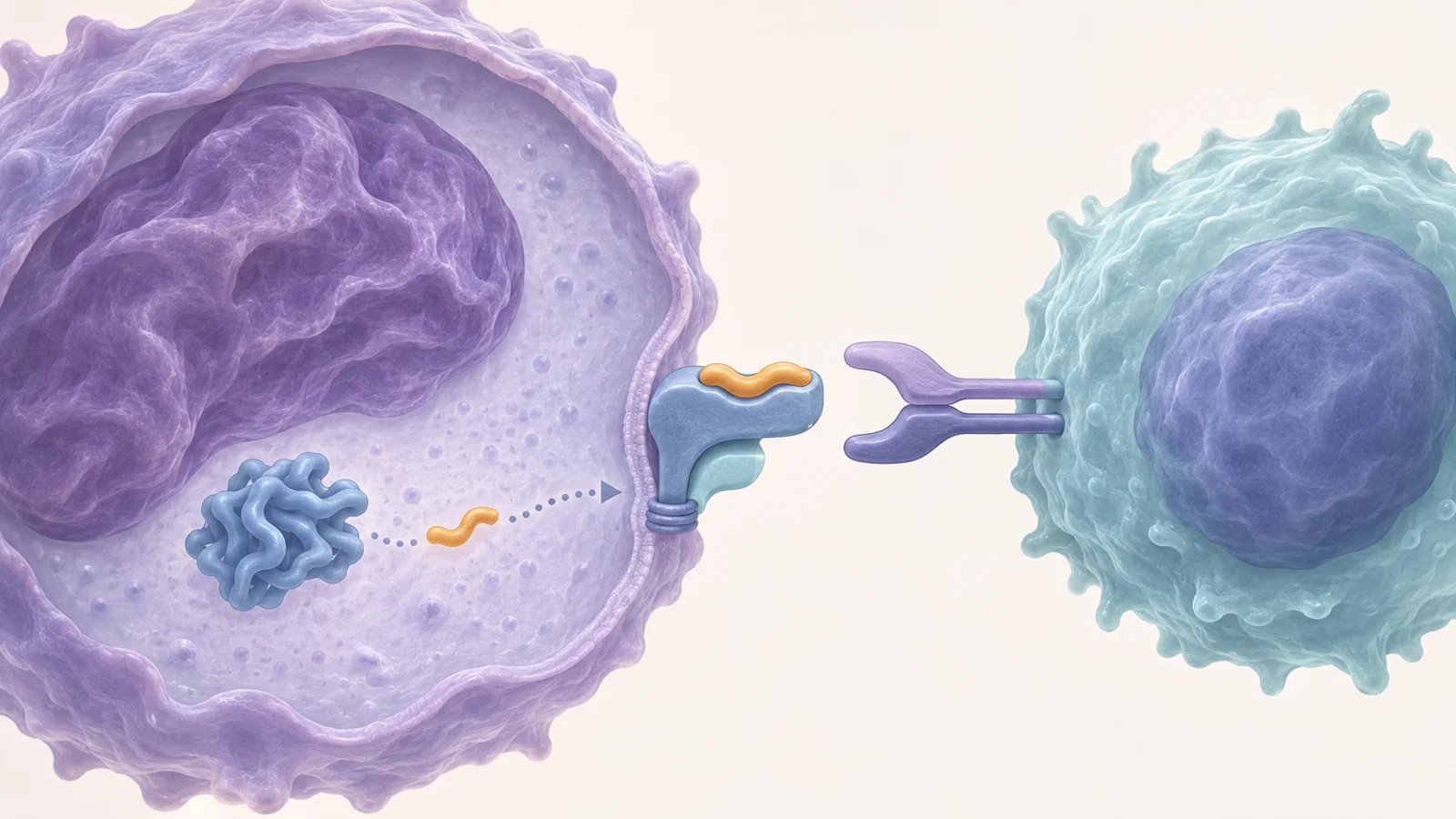
T cells naturally use their T-cell receptors to recognize fragments of proteins presented at the cell surface by human leukocyte antigen molecules, or HLA. HLA acts as a display system: a fragment comes from a protein inside the cell, but the T cell can inspect it on the outside. In T-cell receptor therapy, researchers equip a patient’s or donor’s T cells with a receptor aimed at a chosen fragment-HLA combination.
This gives the approach a broader potential target range than therapies that must attach to a whole protein on the cell surface. AML cells may contain proteins that are not exposed intact outside the cell, yet fragments of those proteins can be displayed by HLA. The method’s reach depends on both parts of the match: which fragment is present and which HLA type displays it. A receptor built for one HLA-fragment pair may not recognize the same target in someone with a different HLA type.
The target also has to distinguish leukemia from healthy blood-forming tissue. WT1 is an intracellular protein found at high levels in the bone marrow of people with AML and some other blood disorders, while its expression in healthy tissues is limited. That pattern made it a leading candidate, but it does not remove the need to check whether healthy cells display enough of the target fragment to be attacked. The review emphasizes that targets should be much more abundant in cancer cells and limited in healthy blood-forming cells; if normal blood cells do express a target, their ability to tolerate its loss and the duration of the engineered cells matter.
WT1 studies show several different kinds of progress
The human WT1 reports summarized in the review were small and varied in cell source, disease mix, treatment setting and outcome. In one study of eight people with refractory AML or high-risk myelodysplasia, two had a decrease in bone-marrow blast counts after receiving their own WT1-directed cells. The review also reports that the transferred cells persisted in five patients; four of those five survived for more than 12 months. These findings provide early clinical observations, not a general estimate of benefit for AML.
A separate report involved donor-derived WT1-directed cells given to 12 people with relapsed or high-risk AML in an effort to prevent relapse. The review describes 100% relapse-free survival at a median follow-up of 44 months in that cohort, compared with approximately 54% in a similar-risk control group. This is a notable result, but the review’s comparison alone cannot show that the treatment caused the difference or establish what would happen in a larger, directly comparable group.
In another study, ten people with several kinds of high-risk myeloid malignancy received their own WT1-directed cells; six had AML. Seven of the ten had cells that expanded in the body and persisted through the 12-month study period. Persistence is evidence that cells remained detectable, not proof that leukemia was controlled. Blast reduction, relapse-free survival and cell persistence are distinct outcomes, and one cannot stand in for another.
Mutation targets narrow the search in a different way
WT1 is a tumor-associated target: it is present at increased levels in some blood cancers, but the protein is not exclusive to cancer cells. A neoantigen, by contrast, can arise from a mutation in the cancer. The review discusses NPM1 mutations, which it says occur in about 30% to 35% of AML cases, as a possible source of such targets. A mutation-derived fragment could offer a more cancer-specific address, but it still must be displayed by a compatible HLA type.
In preclinical work, NPM1-directed T cells killed AML cell lines and primary AML blasts. The review also describes tumor control and longer survival in a xenograft model, in which human cancer cells are studied in animals. These are laboratory and animal findings. They make NPM1 scientifically interesting for a subset of AML, but they do not show that patients treated with NPM1-directed cells would benefit.
Recognition can injure healthy tissue in two ways
The safety challenge is not simply whether engineered cells can recognize their intended target. If a healthy cell displays the same target fragment, the cells may attack it as well. The review discusses this on-target, off-tumor risk as a concern for blood-forming tissue and other normal organs.
A separate danger is cross-reactivity: a receptor may bind a similar-looking fragment from an unrelated protein. The review cites severe examples from T-cell receptor treatments for other cancers. In one, two patients died after engineered cells recognized a peptide from titin, a protein in heart tissue. In another, two of nine people treated with cells aimed at a melanoma antigen died after neurological injury associated with recognition of a related antigen in the brain. These cases warn that receptor specificity must be tested carefully; they were not adverse events reported in the AML WT1 cohorts described above.
Cells and leukemia can both change the outcome
Even a well-chosen receptor may not help if transferred T cells do not expand or remain active long enough. The review identifies limited persistence as a challenge for adoptive cell therapy. It discusses ways researchers have tried to support T-cell signaling and survival, but durable activity remains a goal to demonstrate in patients.
AML can also make itself harder to recognize or attack. Leukemia relapse after a stem-cell transplant has been associated with loss of a mismatched HLA type or reduced display of HLA molecules. Those examples concern post-transplant AML and illustrate how a change in antigen presentation could hide targets from T cells. The review also cites a study in which AML cells released damaging molecules that killed T cells, another way leukemia can weaken an immune attack. A tumor may therefore persist not only because the engineered cells fade, but because the leukemia changes the conditions needed for recognition or weakens immune activity.
The 2022 review brings together cell and animal experiments with small, varied human WT1 studies. It does not test one treatment or settle which target, HLA-defined group or treatment setting could produce reliable benefit with acceptable harm. The early results are a reason to investigate carefully, not a basis to assume that engineered cells can already prevent AML relapse.
Where this research could lead
For someone recovering after an established stem-cell transplant, a carefully matched additional cell treatment could one day lower the chance that AML returns while preserving normal blood formation. The route toward that possibility is visible in fragment-based recognition, early observations with WT1-directed cells in people, and the search for targets that are scarce on healthy tissue. Reliable relapse prevention and safety would require advances beyond what this review reports; the proposed cell treatment would complement transplantation, not replace it.
A meaningful step toward that future would be a prospectively designed AML study in a clearly defined target-and-HLA group, measuring relapse outcomes alongside harm to normal tissues. If such research showed that engineered cells could reduce recurrence without damaging healthy blood formation, the difference for patients could be more time without leukemia after transplant. That benefit remains conditional on the target, the immune match and the treatment proving safe and effective in a suitable group.
Key Sources
- Primary source: Antigen-Specific TCR-T Cells for Acute Myeloid Leukemia: State of the Art and Challenges.
DOI or Journal Page · Review or Meta-Analysis · 2022-03-09
Keep exploring