
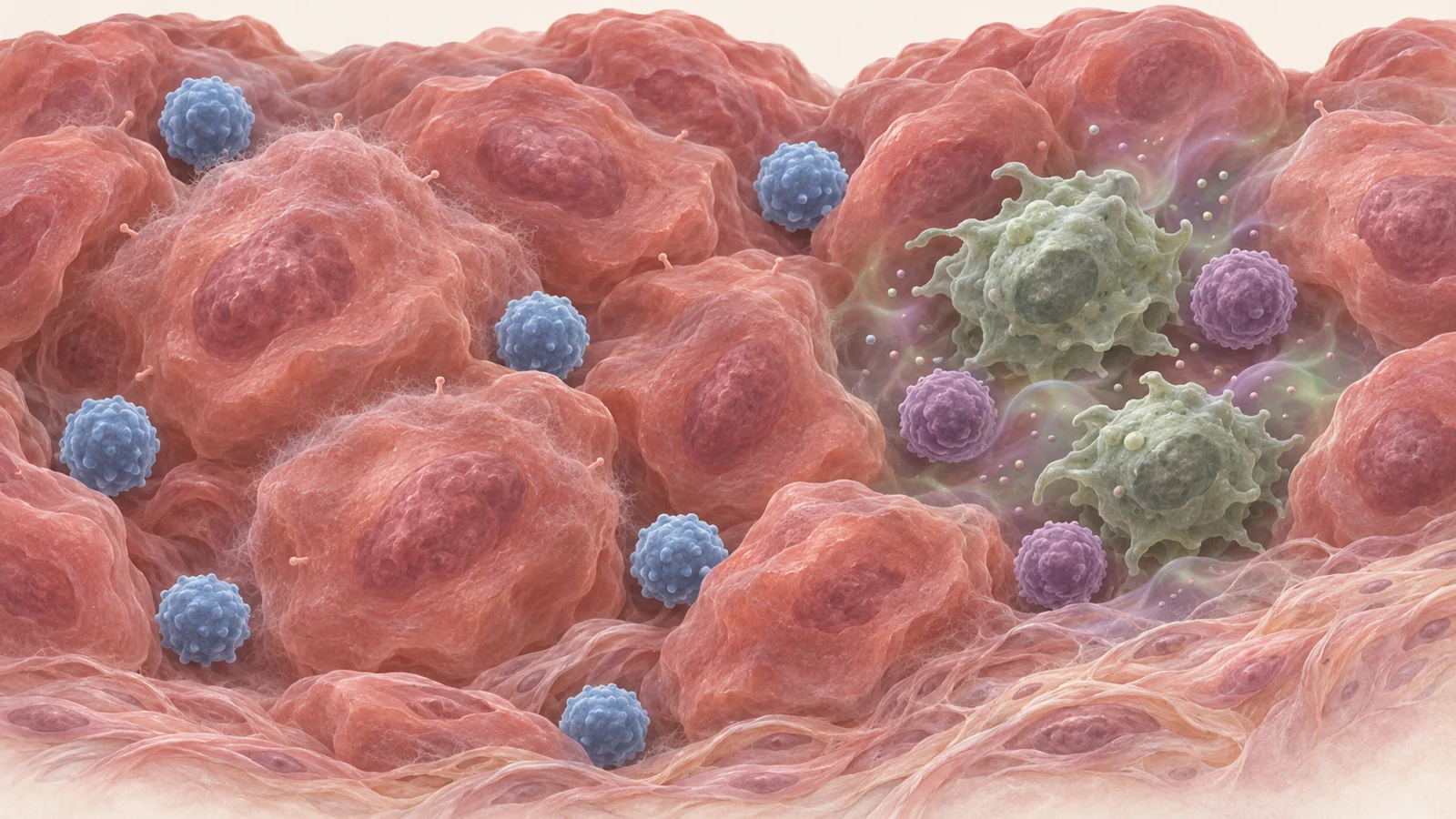
Research Signal – Source date 2022-03-05
Cancer treatment can release some of the immune system’s brakes and still fail. A central point in the 2022 review Challenges of the Immunotherapy: Perspectives and Limitations of the Immune Checkpoint Inhibitor Treatment is that immune cells inside a tumor are not necessarily able to destroy it. Checkpoint inhibitors are drugs intended to release inhibitory signals on immune cells. For them to help, cancer cells must be recognizable, immune cells must be able to act, and the conditions around the tumor must not shut that activity down.
The review brings together findings on why those requirements can break down, why a response may fade, and what researchers are exploring to improve treatment. Its picture is less like a single switch and more like an evolving contest between cancer cells and immune defenses.
Treatment failure can start at different times
Primary resistance means that a cancer does not respond to checkpoint treatment that the patient has not previously received. The drug may stimulate immune activity, yet the tumor remains stable or progresses because an effective attack does not get started, or because the tumor’s suppressive effects are not overcome.
Acquired resistance describes a different course: treatment worked at first, then stopped working. The review notes that its cited criteria require at least six months of progression-free survival before resistance is classified as acquired. In melanoma, the review cites reports in which about 30% of patients treated with checkpoint inhibitors responded well initially but developed resistance during treatment. That figure belongs to the melanoma context described; it is not a general rate for every cancer or patient.
The distinction matters because a treatment that never gains traction may be failing for different reasons than one that loses its effect over time. Cancer also evolves. A tumor contains different cell populations, and the cells left behind after an immune attack may not be as visible or vulnerable as the ones that were eliminated.
The immune system needs a recognizable target
Before a T cell can attack a cancer cell, it needs to recognize pieces of that cell displayed at its surface. This display process is called antigen presentation. It gives immune cells a way to identify what is happening inside a cell; if the display machinery is disrupted, the cancer can become harder for them to recognize.
The review describes failures in the cellular machinery that processes and transports these fragments, as well as structural problems with MHC class I molecules, which display them. Changes affecting beta-2 microglobulin, a protein involved in getting MHC molecules to the cell surface, can interfere with that display. Releasing an inhibitory signal on a T cell cannot solve a recognition problem if the cancer cell is no longer showing a useful target.
Recognition can also change under pressure. The review describes how an immune response may eliminate cancer cells carrying visible neoantigens—new features that immune cells can recognize—while less visible cancer-cell populations remain. Over time, those survivors can make the tumor more difficult for the immune system to see. This is one possible route to immune escape, among several discussed in the review.
T cells can enter a tumor and still be held back
A tumor is more than its cancer cells. The surrounding tumor microenvironment includes immune cells, blood-vessel-forming cells, and signaling molecules such as hormones and cytokines. Some of its features may be associated with better responses. Tumor-infiltrating lymphocytes, or TILs, are immune cells found within tumor tissue, and higher levels are often associated with a better prognosis. But their presence alone does not guarantee that they can eliminate cancer cells.
Within a suppressive microenvironment, T cells can become exhausted or anergic—present and able to recognize a target, yet ineffective at carrying out an attack. Regulatory T cells, certain macrophages, and myeloid-derived suppressor cells are among the cell types the review links with stronger immune suppression. Signals from cancer-associated fibroblasts and nearby supporting tissue can also shape the conditions around a tumor.
Several checkpoint molecules may be active at once on tumor cells and other cells in the microenvironment. Blocking one inhibitory signal may leave others in place, while the wider suppressive conditions continue to disable T cells. This helps explain the opening puzzle: counting immune cells inside a tumor does not tell us whether those cells can function there.
A single marker may miss important differences
The biology can vary across a tumor and between tumor sites. The review describes cancers made up of different cell populations, as well as metastases whose genetic and protein-expression patterns can differ from the original tumor. In some reported cases, distant metastases did not show the same PD-L1 expression as tumors nearer the original site. That kind of variation may help explain why one site responds while another persists.
Tumor mutation burden, or TMB, counts mutations in tumor DNA and has been studied as a possible clue to whether checkpoint treatment will work. The review notes associations between higher TMB and response in particular settings, including advanced melanoma treated with anti-CTLA-4 antibodies and non-small-cell lung cancer treated with anti-PD-1 therapy. Yet cancers with similar TMB can respond differently to the same drug. A mutation count alone may not capture whether targets are displayed, whether T cells can act, or what other signals are operating in the tumor.
One research approach groups cancers by features of their tumor microenvironments rather than by the tissue where they began. The review describes patterns reported across at least 20 cancer types in an analysis of more than 8,500 samples. In the cited work, subtype IE was associated with higher overall response to checkpoint inhibitors and longer progression-free and overall survival. Outcomes varied by cancer type and subtype: subtype F was associated with lower response and a worse prognosis in bladder cancer, while melanoma outcomes were less favorable for subtypes F and D than for IE.
These groupings could add information alongside genetic data, but they are proposed tools for refining prediction, not a prospectively validated rule for selecting treatment for an individual patient. The review’s broader message is that useful prediction may need to account for several layers of tumor biology at once.
The wider body may shape the response
The review also raises questions about factors beyond the tumor itself, including age, biological sex, diet, hormones, other health conditions, concurrent drugs, and the gut microbiome. These factors are not all supported by the same kind of evidence, and the review presents many as areas where further research is needed.
For example, it describes a mouse experiment in which transferring gut microbes that included certain bacterial strains increased susceptibility to anti-CTLA-4 treatment. That result is a research lead from an animal model; it does not establish a microbiome transplant or dietary change as a treatment for people. The review also cites patient associations between antibiotics and poorer outcomes during checkpoint treatment. Such associations raise questions about how concurrent medicines and the microbiome relate to treatment, but they do not by themselves show that a drug caused the outcome.
This wider context matters because the immune response is not determined by the cancer cell alone. At the same time, observations about people and results from mice answer different questions. The review treats environmental and host factors as possible contributors whose roles need to be clarified, rather than as ready-made instructions for changing a patient’s care.
Combinations can add benefit and toxicity
If several inhibitory signals or suppressive pathways are active, researchers may try combining checkpoint inhibitors or pairing them with other treatments. The review cites two examples of clinical-trial findings: in CheckMate-227, first-line nivolumab plus ipilimumab was associated with longer overall survival than chemotherapy in patients with non-small-cell lung cancer. In CheckMate-067, patients with metastatic melanoma receiving nivolumab plus ipilimumab had a better objective response rate and five-year survival rate than those receiving either drug alone.
These trial results show why combinations are investigated, but they do not establish that combination treatment is preferable across cancers or for every patient. Adding treatments can also add harm. A meta-analysis summarized in the review reported treatment-related adverse events in 86.8% of immunotherapy-combination cases, with 35.9% at grade 3 or higher. Its separate estimates were 97.7% for all-grade events and 68.3% for grade 3 or higher with chemotherapy-immunotherapy combinations; for radiotherapy-immunotherapy combinations, the corresponding estimates were 89.4% and 12.4%. These figures come from different combination categories in the cited analysis and should not be treated as a head-to-head comparison of regimens.
The review describes fatigue, anemia, swallowing difficulty, and blood, skin, thyroid, and lung effects among reported adverse events. Severe reactions were also reported, and treatment-related death was described as rare but possible. The practical challenge is to find combinations that improve control of cancer without exposing patients to more toxicity than the added benefit warrants.
How this could shape the future
If researchers can connect features of the tumor—what it displays, which immune cells can function there, and which suppressive signals are active—with the conditions of the wider body, clinicians could eventually have a more useful way to match treatment to the biology of an individual cancer. That could help identify when releasing one immune brake is unlikely to be enough, or when adding another treatment is unlikely to justify its extra risks.
The path to that capability runs through proposed markers and tumor-environment groupings that must prove useful in prospective patient studies. The review does not establish a new treatment or a validated selection rule. But if those measurements become reliable and can be linked to treatment benefit and harm, decisions about checkpoint inhibitors could become more tailored, helping patients avoid ineffective or unnecessarily toxic combinations while giving more suitable options a clearer chance to work.
Key Sources
- Primary source: Challenges of the Immunotherapy: Perspectives and Limitations of the Immune Checkpoint Inhibitor Treatment.
DOI or Journal Page · Review or Meta-Analysis · 2022-03-05
Keep exploring