
Research Signal – Source date 2022-02-05
A positive PD-L1 result can point to different things in different digestive cancers. In colorectal cancer, the review says PD-L1 alone does not precisely predict response to drugs that block the PD-1/PD-L1 pathway. In stomach and esophageal cancers, it describes treatment decisions and response associations involving PD-L1. The result is not a universal forecast: its meaning depends on the cancer type, the treatment setting and the other features measured alongside it.
That comparison comes from a 2022 review of research on immune checkpoint inhibitors in gastrointestinal tumors. The review brings together findings on several biomarkers, including PD-L1, DNA-repair status, tumor mutation burden and immune cells inside tumors. It presents a field where some tests already inform treatment decisions, while other markers and combinations remain candidates for further study.
The same immune brake can have different meaning
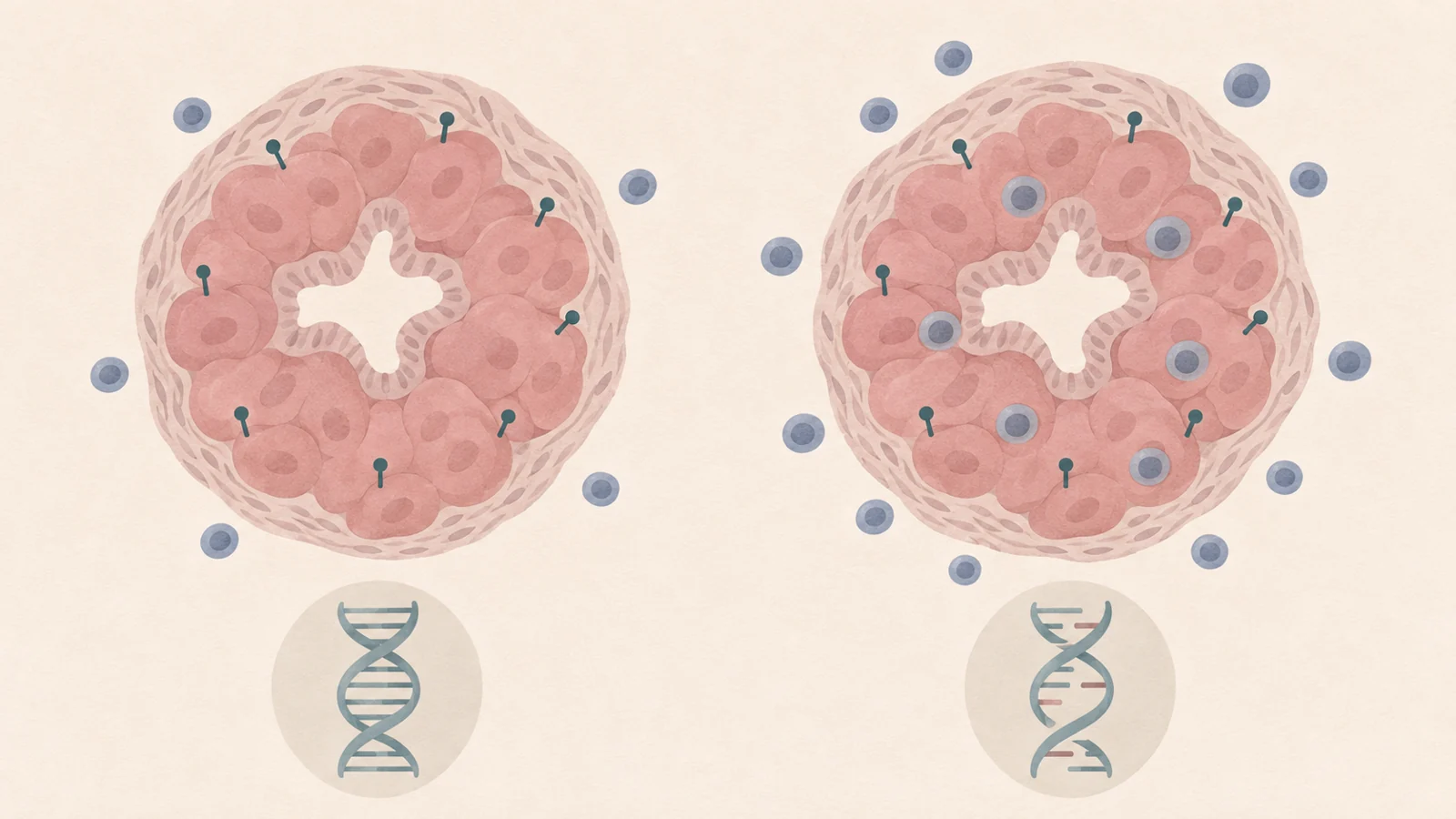
PD-1 is a protein found on several kinds of immune cells, including tumor-infiltrating lymphocytes, or TILs: immune cells present within tumor tissue. PD-L1 is a partner protein that can appear on tumor cells and other cells in the tumor environment. When PD-L1 binds to PD-1, it can dampen immune-cell activity. This braking interaction is one way a tumor can evade immune surveillance. Checkpoint inhibitors are designed to block such interactions and help restore immune activity against cancer.
A test that detects PD-L1 captures one part of this interaction. It does not, by itself, describe whether relevant immune cells are present in the tumor, how active they are, or how the tumor’s other biology may shape treatment response. The review notes that PD-L1 levels differ across tumor types and even between lesions in the same person. Test methods and the tissue being measured can also affect the result.
The colorectal findings make the limits of a single-marker reading concrete. The review reports that about 53% of colorectal cancers tested positive under a 10% PD-L1 cutoff. Yet, in colorectal cancer, PD-L1 expression did not precisely predict response to PD-1 or PD-L1 inhibitors. In the MSI-H/dMMR subgroup, the review describes studies in which PD-L1 did not predict the effectiveness of nivolumab, alone or with a CTLA-4 inhibitor, or pembrolizumab. A marker can be common, and still be an unreliable guide to who will respond in a particular setting.
The picture differs in other digestive cancers. The review describes PD-L1 expression in roughly 25–65% of stomach cancers. It says PD-L1 testing has been accepted as one condition for using certain immunotherapies, including pembrolizumab, while also noting reports of benefit from some checkpoint inhibitors, especially nivolumab, regardless of PD-L1 level. For esophageal cancer, the review reports response and survival associations for PD-L1 combined positive score of 10 or higher in comparison with chemotherapy in different treatment lines. These findings are tied to their own cancer types, tests and clinical settings; a cutoff or association cannot simply be carried over from one organ to another.
DNA repair connects to a different kind of evidence
Cells use mismatch repair to correct errors made when DNA is copied. When this repair system is defective, errors can persist, especially in repeated DNA sequences called microsatellites. A tumor with many such changes may be described as having high microsatellite instability, or MSI-H; defective mismatch repair is abbreviated dMMR. The review treats MSI-H and dMMR as biologically connected states that can identify a distinct tumor group.
The connection matters because accumulated mutations can produce altered proteins that the immune system may recognize. In colorectal cancer, the review describes MSI-H/dMMR status as associated with better response to PD-1 inhibitors in specified treatment settings. It also describes treatment decisions that, as of the review’s 2022 perspective, used this status to identify some patients for checkpoint therapy. These are examples of a biomarker being applied in defined contexts, not a prediction that applies to every digestive cancer or every individual.
Tumor mutation burden, or TMB, is a related but separate measure: it estimates the number of mutations in the coding parts of a tumor’s genome. MSI-H/dMMR can contribute to a high mutation burden, but the terms are not interchangeable. The review cites pooled analyses across cancers in which higher TMB was associated with better response to PD-1 or PD-L1 inhibitors. In one analysis spanning 21 cancer types, including gastrointestinal tumors, the high-TMB group had a higher reported response rate than the moderate- or low-TMB group: 58% versus 20%. The analysis also reported longer median progression-free survival, the time before disease worsened, and longer overall survival in the high-TMB group. Those pooled results describe groups of patients across cancers; they do not establish a single TMB threshold that predicts an individual’s outcome across digestive tumors.
Tumor location changes the biomarker picture
The contrast between colorectal and liver cancer shows why a promising marker cannot automatically be transferred between organs. The review reports that MSI-H/dMMR is relatively uncommon in hepatocellular carcinoma, a major form of liver cancer, with estimates ranging from 0% to 18%. It says the clinical significance of MSI-H as a predictor of immunotherapy response in hepatocellular carcinoma had not been confirmed in clinical studies discussed by the review. A marker associated with response in a defined colorectal cancer group therefore cannot be assumed to have the same predictive role in liver cancer.
Pancreatic cancer adds another distinct setting. The review reports PD-L1 overexpression in about 19–40% of pancreatic cancers and an average TMB of 5 mutations per megabase, with about 1% classified as TMB-high. It also describes MSI-H/dMMR as a possible predictor for response to checkpoint drugs and T-cell receptor profiling as a candidate response marker. These findings concern different measurements and questions. How often a marker occurs, whether it is linked with prognosis, and whether it can guide a treatment choice are not the same thing.
A test result is one view of a changing tumor
Tumors are not always uniform from one area to another. The review notes that biomarker expression can vary between lesions in the same tumor, as well as between cancer types. Different detection techniques also have particular uses and limitations. A result from one sample is therefore a measurement of the tissue examined under a particular method, rather than a complete portrait of every tumor site and immune interaction.
The review also discusses looking at PD-L1 together with TILs. One proposed classification separates tumors into four groups according to whether PD-L1 is present and whether TILs are present. A tumor with both PD-L1 and TILs, for example, may reflect immune cells already in the tumor alongside a braking signal. The review describes this as a possible way to organize tumor immune context. It does not present the four-group scheme as a demonstrated rule for choosing checkpoint treatment across gastrointestinal cancers.
These distinctions help explain three different uses of biomarker evidence. A prognostic association concerns how a cancer is expected to behave; a predictive association concerns whether a treatment may work differently for a group. A tested treatment-selection rule goes further by showing that a result can guide a decision in a defined clinical setting. The review describes some biomarker testing as already used in treatment decisions, alongside emerging markers and combinations that still need validation. An association from a study, on its own, is not the same as a dependable rule for an individual patient.
How this could shape the future
A more dependable, tumor-specific profile could eventually help a person with digestive cancer and their clinician understand why checkpoint treatment is more plausible in one case than another. Such a consultation could draw on molecular features like DNA-repair status and mutation burden alongside immune context, including PD-L1 and the presence of TILs. The review’s evidence points to why that broader view may matter: markers differ across digestive cancers, and their levels can vary between lesions and testing methods. Turning those observations into a reliable guide would require validation beyond this 2022 synthesis.
A nearer milestone would be studies that analyze digestive-cancer groups separately and test whether combinations of markers predict treatment response more reliably than one marker alone. If those combinations prove useful in defined settings, they could make biomarker results easier to interpret when treatment choices are discussed. The possibility rests on further evidence, not on a universal test established by this review.
Key Sources
- Primary source: A Review of Emerging Biomarkers for Immune Checkpoint Inhibitors in Tumors of the Gastrointestinal Tract.
DOI or Journal Page · Review or Meta-Analysis · 2022-02-05
Keep exploring