
Research Signal – Source date 2022-02-04
In a 2022 review of 15 clinical trials, dendritic-cell vaccination was not linked to a clear difference in survival at six months. Comparisons at one and two years favored treatment regimens that included the vaccine. That shift is intriguing, but it does not show that the vaccine caused a later benefit—or that an individual immune response takes a year to appear.
The contrast matters because glioblastoma is an aggressive brain cancer, and the disease can progress quickly. Standard care commonly combines surgery, radiotherapy and the chemotherapy drug temozolomide. The review asked whether adding a vaccine made a difference for people with newly diagnosed glioblastoma, and whether the answer depended on how long researchers followed them.
The early comparisons were unclear; later ones favored vaccination
At six months, the pooled comparison showed no statistically clear difference in progression-free survival (PFS), which tracks how long patients live without their cancer progressing, or in overall survival (OS), which tracks how long they live. The reported hazard ratio (HR) was 1.385 for six-month PFS (95% confidence interval, 0.822–2.335; p = 0.673) and 1.408 for six-month OS (95% CI, 0.882–2.248; p = 0.754). In both cases, the confidence interval crossed 1, and the reported p-value did not indicate a statistically clear difference.
The one-year and two-year OS comparisons were different. Both favored regimens that included dendritic-cell vaccination: HR 1.936 at one year (95% CI, 1.396–2.85; p = 0.001) and HR 3.670 at two years (95% CI, 2.291–5.879; p = 0.001), as reported by the authors. These are pooled comparisons at specified follow-up points. They do not mean that a particular patient was 1.9 or 3.6 times as likely to survive, nor that the vaccine multiplied anyone’s survival time.
PFS and OS answer different questions. A treatment might affect the timing of cancer progression without producing the same pattern in survival. Here, the review’s six-month PFS and OS comparisons were both unclear, while the later comparisons it reported were for OS. The time points describe when outcomes were compared across the pooled studies; they do not identify when any participant’s immune response began.
A vaccine is meant to help the immune system recognize tumor material
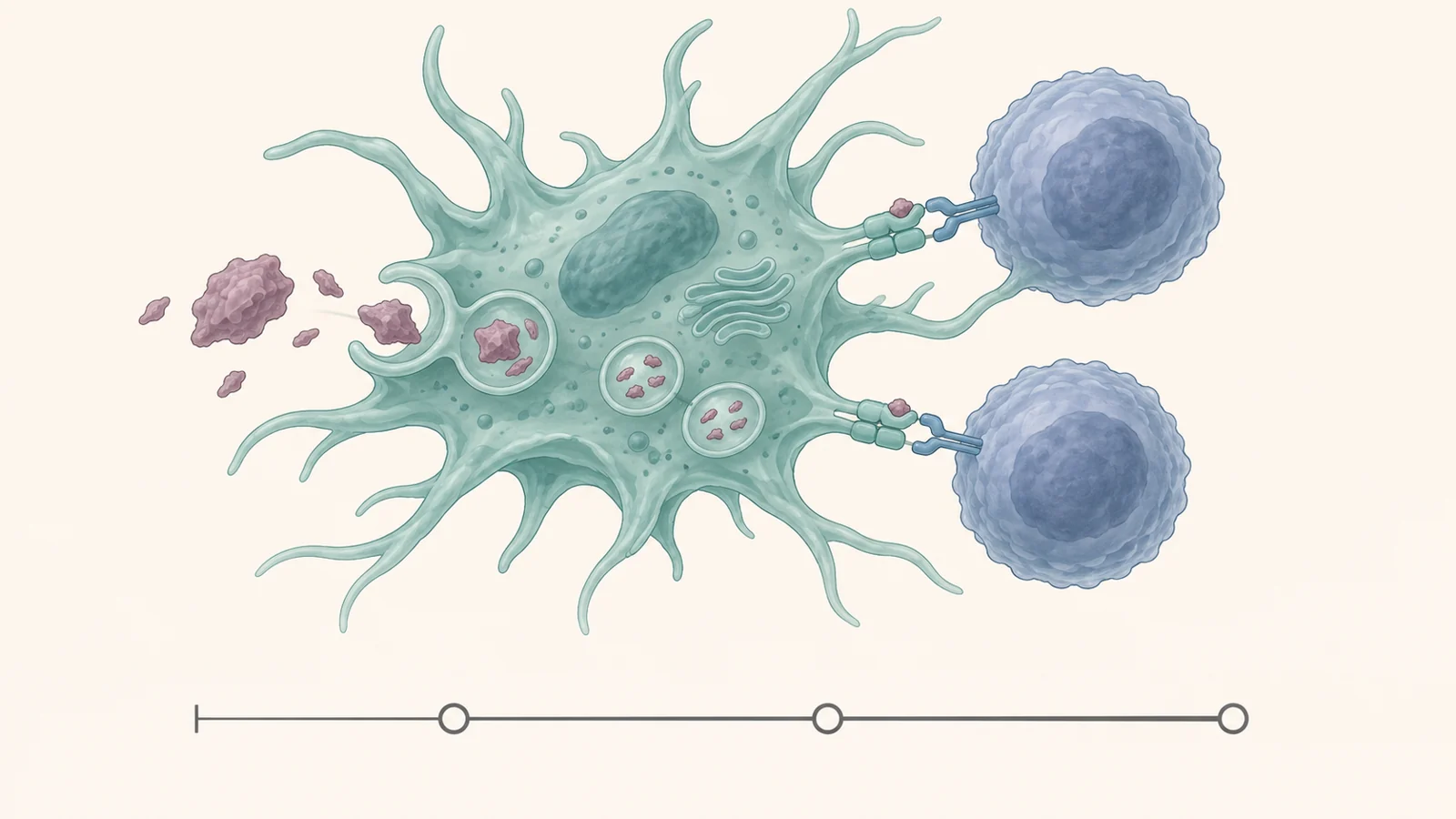
Dendritic cells help coordinate immune responses. In vaccination, they are used to present material from a tumor so the patient’s immune system can learn to recognize cancer cells. The aim is an active response generated by the body, rather than a response supplied directly by an antibody or another immune drug.
The trials did not all use the same vaccine preparation. The review describes variation in how dendritic cells were activated and in the tumor material used, including peptides, tumor-antigen RNA and whole-tumor lysates. Some regimens also combined vaccination with other treatments. Those differences matter: “dendritic-cell vaccination” covers approaches that may not prompt the same response or be used in the same treatment context.
The authors propose that an immune response might take time to develop and that an early assessment could miss a later effect. That is one possible explanation for the pattern, not a biological waiting period measured by this meta-analysis. The analysis compared reported outcomes at different follow-up points; it did not establish the timing of immune activity in individual patients.
Fifteen trials brought a sizeable but uneven evidence base
The review searched several research databases and included 15 prospective clinical trials in newly diagnosed glioblastoma. Across those trials, 452 people were in vaccine groups and 629 were controls. The trials ranged from first-in-human studies to phase II studies. Their populations, vaccine preparations and accompanying treatments differed, and some comparisons were non-randomized or used historical controls.
Pooling studies can help reveal patterns across a limited research area, but it cannot make unlike comparisons equivalent. A difference in survival between groups could reflect the vaccine, other features of treatment, differences among patients, or a combination of factors. Historical comparisons are especially difficult to interpret because the groups were not necessarily formed under the same conditions.
The review also reports substantial heterogeneity in its pooled OS and PFS measurements, with I² values ranging from about 91.6 to 92.3. Heterogeneity means the study results varied more than would be expected from chance alone under the statistical model. Alongside the small number of studies and differences in trial design and treatment, that variation makes the pooled estimates less definitive as evidence of cause and effect.
The safety account is limited to the included reports
The review says no side effects were reported following the dendritic-cell vaccination protocols in the included material. It describes drug-related complications as tolerable and reversible. That is a narrow summary of what these studies reported, not a guarantee that a single standardized vaccine would be safe for a broader group of patients.
The trials used varied protocols and included a limited number of people. Their safety account therefore cannot settle how a common regimen would perform across different patients, or what might happen in people with recurrent glioblastoma. The review’s discussion of combining vaccination with checkpoint inhibitors likewise points to a proposed avenue for study; this pooled analysis does not demonstrate that such combinations are effective.
What this could make possible
If a later survival advantage were confirmed in well-matched trials using clearly described vaccine regimens, dendritic-cell vaccination could become a way to help some people with newly diagnosed glioblastoma live longer alongside established treatment. The practical benefit would depend on showing that the difference comes from vaccination, and that it applies to patients who could receive the regimen safely.
The evidence bridge is still incomplete: the later overall-survival comparisons are encouraging, but the included studies varied and some relied on non-randomized or historical controls. A meaningful milestone would be consistent results from stronger comparisons that use comparable patient groups and treatment protocols, with follow-up long enough to assess later survival. Until then, the timing pattern is a reason to investigate the approach, not proof that waiting reveals a vaccine effect.
Key Sources
- Primary source: Delayed Effect of Dendritic Cells Vaccination on Survival in Glioblastoma: A Systematic Review and Meta-Analysis.
DOI or Journal Page · Review or Meta-Analysis · 2022-02-04
Keep exploring