
Research Signal – Source date 2022-02-01
In one mouse experiment, a tumor-matched vaccine packaged in a peptide structure and paired with an immune-checkpoint drug eradicated seven of eight tumors during 24 days of observation. With the same checkpoint drug but a free, un-packaged vaccine, one of eight tumors was eradicated. The result points to a possible partnership: help the immune system see a tumor-specific target, then ease a brake that can limit the immune cells responding to it.
The comparison came from a small experiment using MC38 colon tumors in mice. It is striking, but it is not evidence that the approach works in people, and the short observation period cannot show whether the tumors stayed gone permanently. The study’s more useful question is how the vaccine’s packaging changed what happened before and during the response to treatment.
A carrier designed to keep vaccine ingredients together
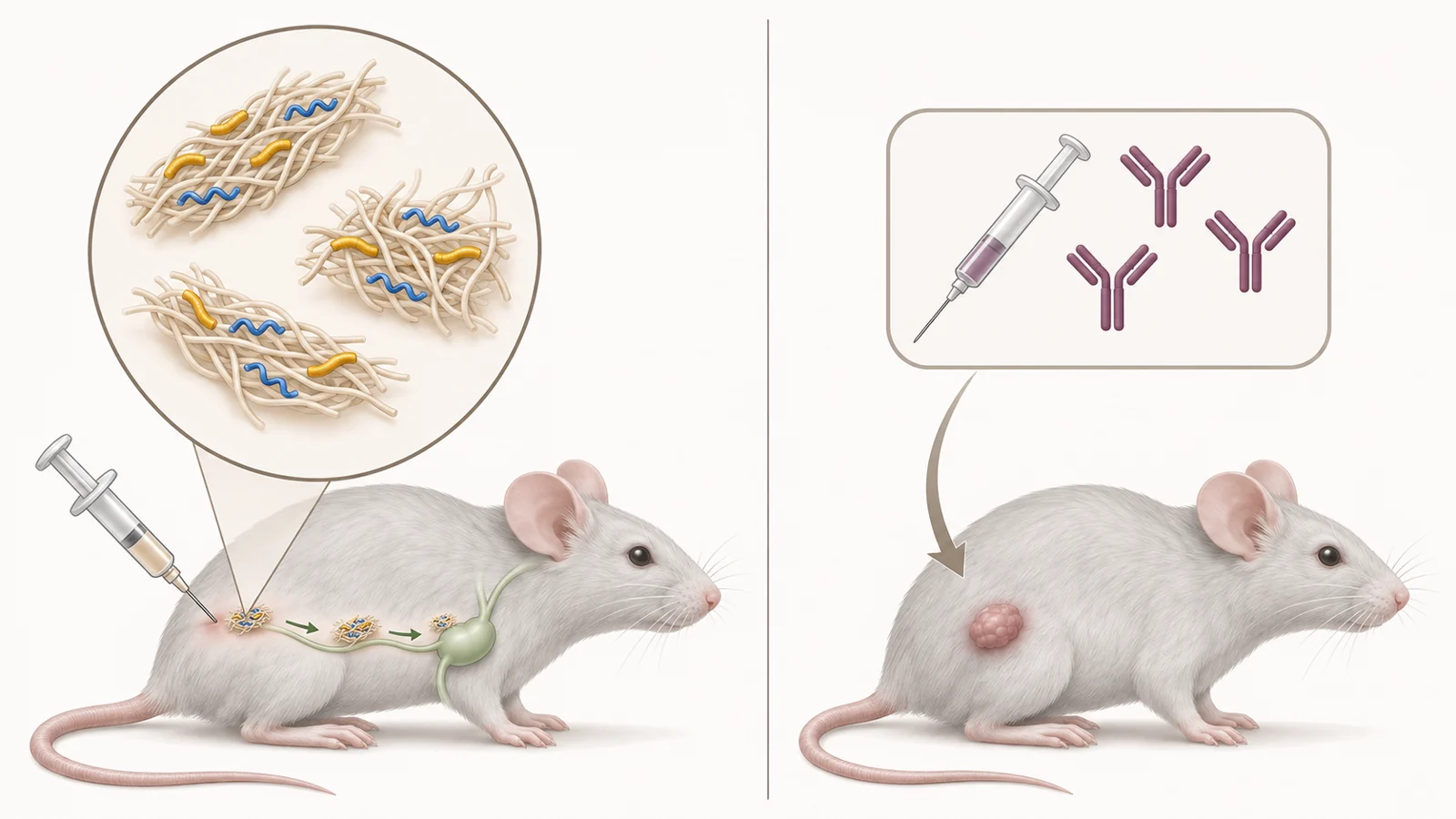
The researchers built a peptidic microarchitecture, or PMA, from a newly synthesized short peptide. It assembles into a fibrous network that can trap two vaccine ingredients: a tumor-specific peptide and CpG, an immune-stimulating molecule. The tumor peptide, called a neoantigen in this setting, is a target associated with the cancer. A microfluidic chip helped produce particles with a more uniform size, around 3–5 micrometers across.
The carrier’s proposed job was practical: package the target and immune stimulant together so that immune cells could take them up and respond. In cell experiments, antigen-presenting cells—immune cells that show potential targets to T cells—took up more of the packaged vaccine than the simple free mixture. The packaged formulation also prompted stronger measures of immune-cell activation in those assays.
The researchers then tracked a labeled tumor peptide after injection into mice. More peptide from the packaged vaccine was detected in the draining lymph nodes, where immune responses can be organized, from two to 12 hours after injection than from the free formulation. With the PMA carrier, peptide remained detectable at 72 hours; little was detected in the free-vaccine group by then.
Mice given the packaged vaccine also developed a more robust and longer-lasting measured response among CD8 T cells, including cells associated with immune activity and memory. These observations support the idea that packaging improved delivery and helped sustain immune recognition. They do not, by themselves, show that better delivery must control a tumor; the tumor experiments test that separate question.
Releasing a brake after the target is presented
In the MC38 experiment, the packaged neoantigen vaccine alone slowed tumor growth more than the free vaccine, but it did not eradicate tumors. The stronger result appeared when the researchers paired PMA-NeoV with an antibody against PD-L1, a protein involved in restraining immune activity. Blocking this checkpoint can release some of that restraint on T cells.
Over the 24-day observation, seven of eight mice in the packaged-vaccine plus anti-PD-L1 group had their tumors eradicated, compared with one of eight given free vaccine plus anti-PD-L1. The groups were small, so each mouse represents a substantial share of the result. The comparison suggests that the carrier mattered even when both vaccine groups received the same checkpoint treatment; it does not establish that packaging alone explains every difference between individual tumors.
The immune measurements offer a possible account of how the combination worked. The packaged vaccine increased immune-cell infiltration into tumors, and the combined treatment was associated with more tumor-infiltrating T cells and more cells producing immune-signaling molecules such as interferon gamma and tumor necrosis factor. The researchers also found higher PD-1 expression on T cells after vaccination, a sign consistent with immune exhaustion. The anti-PD-L1 treatment may have helped restore activity in those T cells while the vaccine supplied a specific target.
A repeat using a lower initial number of implanted MC38 cells showed a similar treatment trend over 46 days. That is a longer observation under a different starting tumor burden, not proof of permanent eradication. It also does not turn this mouse result into a forecast of a human response.
A separate route through suppressive macrophages
The paper tested another combination in a separate MC38 experiment. This time, the vaccine was paired with IPI-549, a drug that inhibits PI3Kγ, an enzyme linked in this study to immune-suppressive activity in the tumor environment. The researchers were asking whether changing that environment could make the vaccine-driven response more effective.
Five of eight tumors were eradicated during the 24-day observation with PMA-NeoV plus IPI-549. The combination was accompanied by more CD4 and CD8 T cells in tumors, an increase in measured M1 macrophages, and a decrease in M2 macrophages. These labels describe macrophage states associated in the study with more active or more suppressive immune behavior. The findings are consistent with a shift toward a tumor environment more supportive of immune attack, alongside increased T-cell activity.
A separate repeat with fewer implanted tumor cells showed a similar trend over 46 days. This was not a head-to-head comparison with the anti-PD-L1 experiment: the two combinations were tested separately, so their eradication counts cannot establish which companion drug is better. The IPI-549 findings instead suggest a distinct route—altering suppressive cells as well as supporting the vaccine response.
The second tumor model used a different vaccine
The researchers also tested the carrier in mice with 4T1 breast tumors. Here, they used a whole-tumor-cell-lysate vaccine, made from tumor material, rather than the MC38-specific neoantigen peptide vaccine. The PMA-packaged version slowed tumor growth more than the un-packaged lysate vaccine, but the tumors regrew after vaccination.
Adding anti-PD-L1 to the packaged whole-cell vaccine reduced tumor growth more than either treatment alone or the corresponding free-vaccine combination. This provides evidence in another mouse tumor model that packaging and checkpoint blockade can work together. It does not reproduce the seven-of-eight MC38 result: the tumor type, vaccine contents, and reported outcome differed.
Across these experiments, the mice received treatment on a schedule that included three vaccine doses. The anti-PD-L1 treatment was given repeatedly, while IPI-549 was given daily for two weeks. The MC38 groups generally contained eight mice, and the 4T1 model used five. The authors reported no obvious weight loss or major-organ damage in the observed mice. Those findings describe the animals and periods studied; they cannot establish safety in people or rule out less visible or longer-term harms.
How this could shape the future
A personalized cancer vaccine would need to get selected tumor targets in front of the immune system reliably, and a treatment may also need to address the ways tumors restrain that response. If this carrier approach can be made to work beyond these mouse models, pairing sustained delivery of tumor-specific targets with a suitable immune therapy could help more immune cells recognize and attack a patient’s cancer. That could make tailored vaccines more useful as part of treatment, rather than relying on target selection alone.
The bridge to that possibility remains substantial. A meaningful early milestone would be showing, in further well-controlled studies, that the carrier consistently delivers chosen tumor targets and produces durable tumor control across models without unacceptable harm. The current experiments offer a reason to investigate that sequence; they do not show that it is ready to benefit patients.
Key Sources
- Primary source: Peptidic microarchitecture-trapped tumor vaccine combined with immune checkpoint inhibitor or PI3Kγ inhibitor can enhance immunogenicity and eradicate tumors.
DOI or Journal Page · Peer-Reviewed Paper · 2022-02-01
Keep exploring