
Research Signal – Source date 2022-01-13
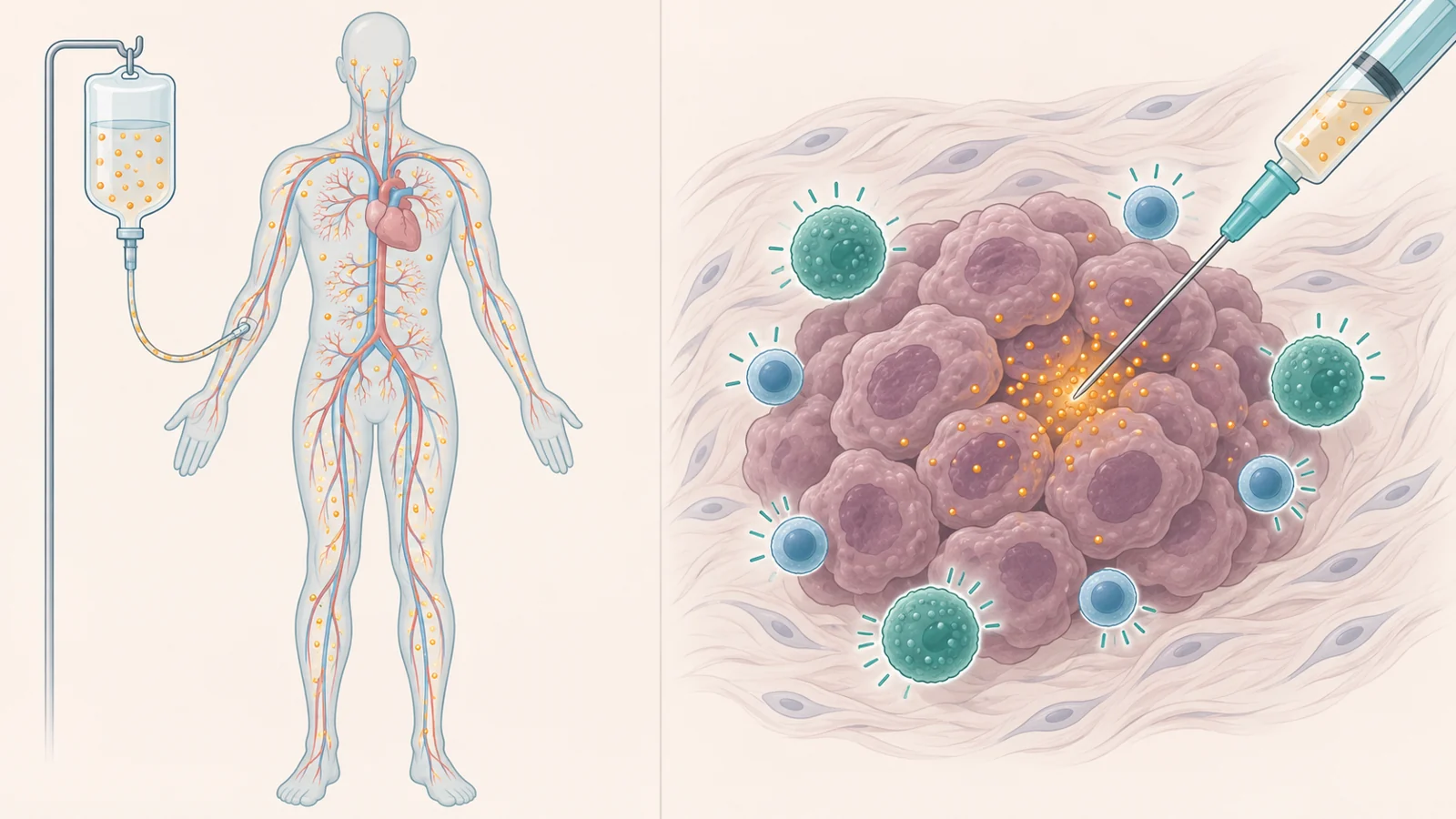
In one mouse experiment reviewed in a 2022 paper, injecting an IL-12-based treatment into a tumor led to greater tumor regression than giving it through a vein. Yet the tumor injection produced about ten times less interferon-gamma in the body. Interferon-gamma is a sign of immune activity, but that measurement alone cannot tell us whether a treatment is safe or effective overall.
The finding points to a central challenge for IL-12: this immune messenger can help mobilize anti-tumor defenses, while its systemic administration has caused toxicity in cancer patients. Researchers have therefore explored ways to concentrate or retain IL-12 near tumors. The reviewed evidence includes distinct strategies, from antibodies designed to target tumor tissue to a material that holds an injected dose in place. Their encouraging results come from specific experiments, not a head-to-head test across cancers or proof of a treatment for people.
An immune message with a powerful reach
IL-12 is a signaling protein involved in both innate and adaptive immunity. It stimulates T cells and natural killer cells, immune cells that can attack abnormal cells, and induces interferon-gamma, another immune signal. The aim of using IL-12 against cancer is to strengthen immune activity where it can help control a tumor.
An in situ vaccination approach uses a tumor as a site for immune activation. The idea is that treatment at the tumor could stimulate an immune response there and potentially contribute to activity elsewhere in the body. In this context, “vaccine” describes the treatment strategy; it does not mean the reviewed experiments established lasting protection in patients.
The challenge is that the route and delivery method can change where IL-12 goes and how much immune activity appears beyond the treated tumor. A strong body-wide interferon-gamma measurement is not, by itself, a complete score of tumor control, toxicity, or the balance between them. The comparison in the review is notable because the local route did better on tumor regression in that experiment while producing a lower systemic immune marker.
Two ways to bring IL-12 to a tumor
Some approaches attach IL-12 to an antibody designed to recognize features of tumor tissue. These engineered molecules, called immunocytokines, aim to carry the immune signal toward the tumor. One example discussed in the review, L19-mIL-12, uses an antibody fragment that targets a component found in tumor tissue. In mouse models, intravenous L19-mIL-12 had greater anti-tumor activity than untargeted IL-12. This is a targeted approach delivered through a vein: its purpose is to concentrate the signal at tumor tissue after administration.
A different strategy puts the treatment directly into a tumor. The review describes KS-IL12/IL2, an engineered molecule combining tumor-targeting antibody regions with IL-12 and IL-2, another immune signal. In mice with bulky lung tumors expressing EpCAM, a tumor-associated marker, injection into the tumor produced complete regression. It outperformed the separate KS-IL12 and KS-IL2 combination in that experiment. Tumor injection also produced greater regression than intravenous administration of the engineered molecule, while systemic interferon-gamma was about tenfold lower.
Those results suggest why a body-wide marker need not track neatly with tumor response: the treatment’s location and design matter. But the comparison belongs to this particular mouse model and regimen. It does not show that all local injections outperform targeted intravenous delivery, or that interferon-gamma can stand in for a full safety assessment.
Chitosan kept the injected dose nearby
Antibody targeting is not the only way researchers tried to concentrate IL-12. In a separate mouse experiment, IL-12 was co-formulated with chitosan, a biodegradable polysaccharide. The formulation increased local retention of IL-12 for up to four days. The researchers compared it with weekly injections of IL-12 alone into tumors.
In established MC32a tumors, complete regression rose from no more than 10% with IL-12 alone to 80% with chitosan/IL-12. In established Panc02 tumors, the reported proportion rose from no more than 10% to 100%. These percentages describe outcomes in those two models under the compared regimens; they are not pooled results or estimates for patients.
The review reports that the chitosan/IL-12 treatment was well tolerated in the mice. When researchers exposed mice whose tumors had disappeared to the cancer again, more than 80% showed at least some protection. That result suggests an immune response beyond the original treated tumor, but it does not establish durable protection in people. Nor does it tell us whether chitosan is better than an antibody-linked treatment; the approaches were studied separately.
The patient question remains open
The promise of localized delivery has to be read alongside the reason researchers pursued it. The review describes toxicity when IL-12 was administered systemically to cancer patients. That history makes the amount, location and control of IL-12 exposure central to developing an approach that could be used in people.
The review, published on January 13, 2022, synthesizes earlier animal experiments, delivery strategies and reports of patient toxicity. It does not report a new clinical trial or show that localized IL-12 improves patient outcomes. The mouse interferon-gamma comparison does not establish clinical safety, and tumor regression in mice does not establish human benefit. Even a targeted or locally retained dose would need to show that it can reach and activate tumors effectively while keeping treatment acceptably safe in people.
Some approaches had advanced to clinical trials by the time of the review, including an antibody-linked IL-12 treatment and local IL-12 given with cetuximab in patients with head and neck tumors. Their presence in clinical research does not resolve whether these strategies work well enough, or safely enough, to become useful treatment options. The evidence described here cannot rank delivery methods across cancer types.
What this could change
If local or tumor-targeted IL-12 can reliably activate immunity without repeating the body-wide exposure associated with toxicity, a person with an accessible tumor might one day receive a treatment focused at that site while also prompting immune activity against cancer elsewhere. The bridge to that possibility is visible in the mouse findings: some delivery methods concentrated or retained IL-12 near tumors, and the chitosan experiment reported systemic tumor-specific immunity after local treatment. Whether that pattern can produce meaningful benefit with acceptable safety in people remains an open clinical question.
A useful milestone would be a human study that reports safety alongside responses in both treated and untreated tumors. Such evidence could show whether local immune activation reaches beyond the injected site in patients, and whether the approach is tolerable enough to develop further. Until then, localized IL-12 remains an experimental strategy, not an established cancer treatment.
Key Sources
- Primary source: Interleukin-12 as an in situ cancer vaccine component: a review.
DOI or Journal Page · Review or Meta-Analysis · 2022-01-13
Keep exploring