
Research Signal – Source date 2021-04-16
Inside compact electronics, a material that carries heat away must fit into a crowded space. Plastics offer useful freedom in shape and weight, but many conduct heat poorly. Adding carbon seems like an obvious solution because materials such as graphite and graphene can conduct heat extremely well. The difficulty is turning that ability into a continuous route through the plastic without also creating an unwanted electrical connection.
A review published on April 16, 2021, examines how researchers are tackling that problem in polymer composites—plastics containing added materials. It brings together earlier studies of connected carbon structures, electrically insulating filler systems, and arrangements that direct heat through a layer. Its contribution is to explain how the internal construction of a composite changes what it can do.
The examples come from different polymers, carbon fillers, proportions, and measurement directions. They illustrate design choices rather than establish a single winning formulation. Read together, they show why the conductivity of a carbon particle cannot simply be assigned to the plastic surrounding it.
Building a connected route for heat
Heat moving through a solid is carried in part by atomic vibrations. In ordinary polymers, disordered molecular chains and interruptions to that transfer make the journey inefficient. The review gives thermal conductivities of about 0.2 watts per meter-kelvin, written W/m·K, for polymethyl methacrylate and polystyrene. Thermal conductivity describes how readily a material transfers heat across a temperature difference; a higher value means easier transfer under comparable conditions.
Carbon fillers can provide more conductive routes, but heat still has to reach them and pass between them. Every boundary between carbon and polymer, and every imperfect contact between separate pieces of carbon, can add resistance. A collection of highly conductive particles may therefore perform very differently from a connected structure made from the same material.
Adding more filler increases opportunities for contact. Yet the review describes a practical cost: large amounts can make the mixture harder to process. Researchers are consequently exploring a different sequence of construction. They first build a connected, three-dimensional carbon skeleton, then introduce the polymer into it. This gives heat a network to follow while reducing the interruptions associated with scattered particles.
One example reported in the review combined interconnected reduced graphene oxide with graphene nanoplatelets, which helped make the network denser. After treatment to improve the carbon structure, the resulting epoxy composite reached a through-thickness thermal conductivity of 35.5 W/m·K at a graphene loading of 19.0% by volume. The useful lesson is that both the continuity and the quality of the network matter. Its demanding preparation also becomes part of the manufacturing problem.
Across a sheet or through its thickness
Imagine a thin layer between a heat-producing component and a surface intended to receive that heat. Heat spreading sideways along the layer and heat passing directly through it serve different purposes. A sheet can be an effective sideways heat spreader while offering a much poorer route from its bottom face to its top face.
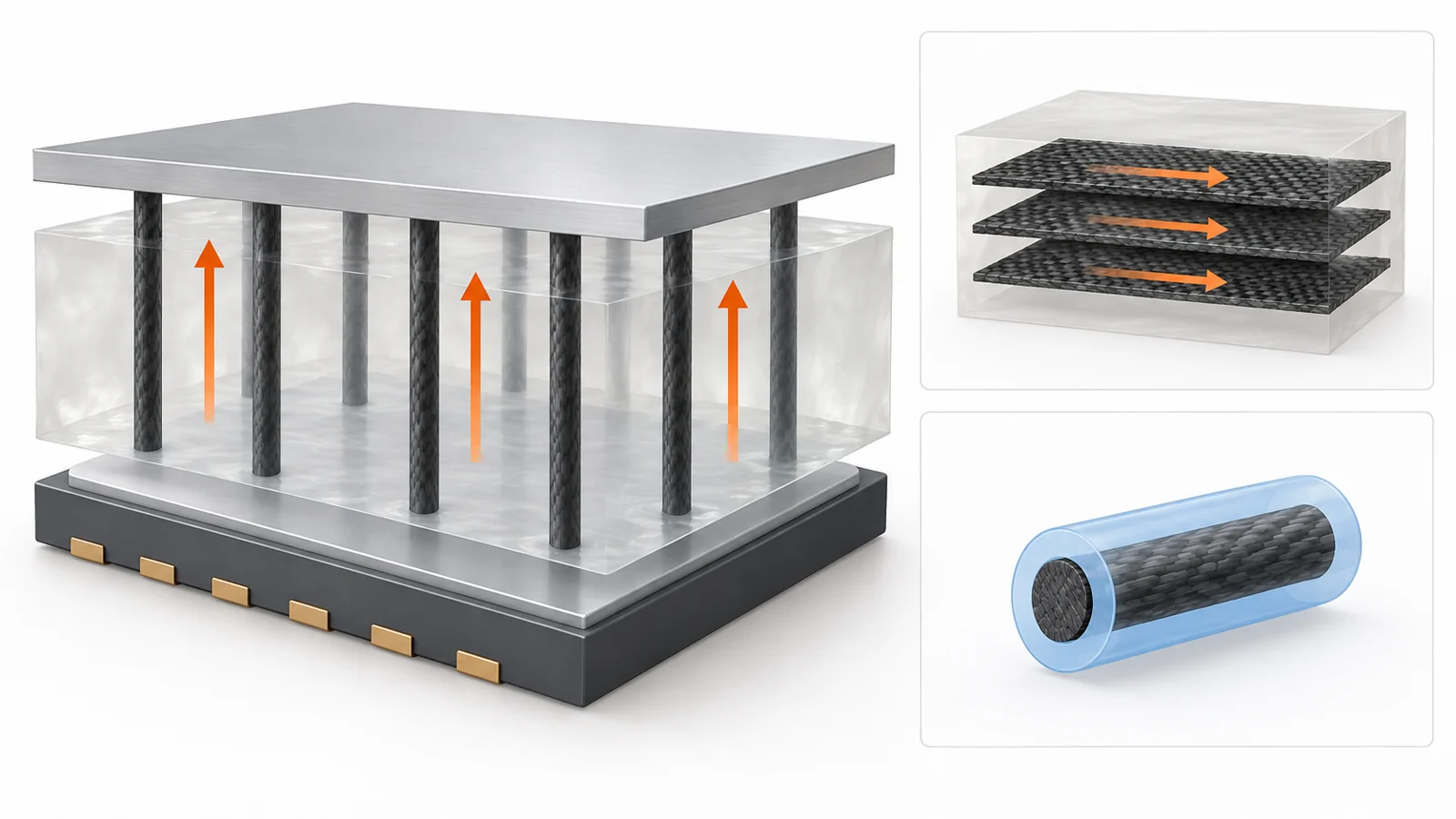
This distinction is especially relevant to carbon fillers because their ability to carry heat can depend strongly on direction. The review describes carbon-filled polymer films with much greater conductivity along their plane than through their thickness. Arranging fibers or flakes to cross the layer changes the route available to heat.
In a study summarized in the review, an electric field propelled carbon fibers toward an opposing electrode, creating an upright array. The fibers were approximately 1 millimeter long and 10 micrometers in diameter. Filling the array with fluorinated rubber produced a composite containing 13.2% carbon fiber by weight. Its reported conductivity was 23.3 W/m·K through the thickness and 8.96 W/m·K along the plane.
Those two measurements describe the same material in different directions. They make the importance of orientation tangible: a designer trying to move heat across a thin gap would care particularly about the through-thickness result. The degree of alignment and the proportion of fibers spanning the full layer remain variables that can change that route.
Loading units also need attention. A percentage by weight describes how much of the composite’s mass is filler; a percentage by volume describes how much space it occupies. These are not interchangeable. Together with the polymer and measurement direction, they help explain why numbers from separate studies cannot be treated as a straightforward ranking.
Keeping an electrical path from forming
The starting plastic may be electrically insulating, but adding conductive carbon can change that behavior. The same contacts that connect carbon pieces into a useful heat-transfer network can also allow electrical current to pass. In an electronic component that requires insulation, the filler arrangement must therefore control two kinds of transport.
One approach puts an insulating coating around the carbon. The review describes work using aluminum oxide to coat graphene nanoplatelets. An epoxy composite containing 12% of this hybrid filler by weight reached 1.49 W/m·K while retaining electrical insulation. The coating’s structure matters because it occupies the boundary through which heat must travel. Its thickness and coverage become design variables, rather than merely a finishing treatment.
Another approach separates the electrically conductive carbon regions while incorporating a material that can help transfer heat without providing the same electrical connection. In a study summarized by the review, researchers combined chemically modified graphene with hexagonal boron nitride. By controlling their proportions, they changed how the graphene sheets were distributed on the boron nitride surfaces.
At a hybrid-filler loading of 30% by weight, that epoxy composite reached 3.409 W/m·K and maintained low electrical conductivity. The explanation given was that the graphene sheets remained separated and could not form a connected electrical network. Here, the arrangement permits useful thermal transfer without requiring an uninterrupted carbon route for current.
These examples represent different formulations and strategies. They do not establish a single specimen that combines the strongest thermal result, directional control, flexibility, and electrical insulation. They do show that electrical behavior can be deliberately shaped alongside heat transport.
What repeated heating can reveal
A composite begins its working life with a particular internal arrangement. Repeated heating and cooling tests ask whether its thermal performance persists through specified exposure. That adds a time dimension to a conductivity measurement: a useful route for heat must continue functioning after the material has been cycled.
The review describes a graphene-foam structure filled with epoxy that reached 8.04 W/m·K at a filler loading of 6.8% by weight. Researchers subjected it to 15 heating and cooling cycles between 25 °C and 100 °C. The relatively small deviations in thermal performance supported stability under those test conditions.
Fifteen laboratory cycles do not establish years of service inside a device. The result is evidence about persistence over a defined temperature range and number of repetitions. Likewise, material conductivity alone cannot be translated into a particular drop in an electronic component’s operating temperature or an increase in its lifetime. Those outcomes depend on how the material functions within the complete heat-removal arrangement.
Making the architecture is part of the challenge
The internal structures that improve heat transfer can require substantial work to produce. In the graphene-network example that reached 35.5 W/m·K, preparation included graphitization at 2,800 °C. This treatment improved the carbon network by removing residual oxygen-containing groups and healing defects. It was applied to the carbon structure before the final epoxy composite was made, not to the finished plastic component.
That distinction helps explain both the result and its production burden. Improving the quality of the conductive skeleton can improve heat transfer, but the skeleton then becomes a separately manufactured ingredient with its own processing requirements.
Other routes impose geometric constraints. The review describes forcing a molten polymer and graphene-nanoflake mixture through an L-shaped tube to orient the fillers. This produced preferential alignment for through-thickness conduction, but the required forming process limited the shapes and sizes to which the method could readily be applied. A successful orientation technique must eventually fit the geometry of the component it is intended to make.
The review also discusses a potentially simpler route using compressed expanded graphite in phase-change composites, materials intended for thermal energy storage. Mechanical compression brought large graphite sheets into stronger contact, reducing resistance between them. The authors presented the relatively inexpensive filler and simple compression step as promising for scalable preparation. That is a proposed manufacturing advantage, rather than proof of established production economics.
In their 2021 outlook, the authors identify economical manufacture of connected and vertically aligned structures as an unresolved translation problem. They also emphasize resistance at the carbon–polymer interface and the preparation of thermally conductive, electrically insulating fillers. These challenges meet at the same physical task: producing the intended internal structure consistently in a usable component.
What this could change
If these fabrication and interface problems can be solved, carbon-filled polymers could give electronic-component designers greater freedom over where a heat-transfer part fits and which direction it carries heat. A lightweight layer could be shaped for a compact assembly, with its internal carbon arrangement directing heat across the required gap. Where electrical isolation is necessary, coatings or hybrid filler structures could help preserve that function.
For compact or flexible electronics, the potential benefit is more freedom to integrate heat-transfer components into the available weight, shape, and space. The causal step is the ability to manufacture a reliable internal route for heat within a formable polymer. Achieving that would let designers adapt the thermal component more closely to the electronic assembly it serves.
Key Sources
- Primary source: A Review of Polymer Composites Based on Carbon Fillers for Thermal Management Applications: Design, Preparation, and Properties.
DOI or Journal Page · Review or Meta-Analysis · 2021-04-16
Keep exploring