
Research Signal – Source date 2021-01-08
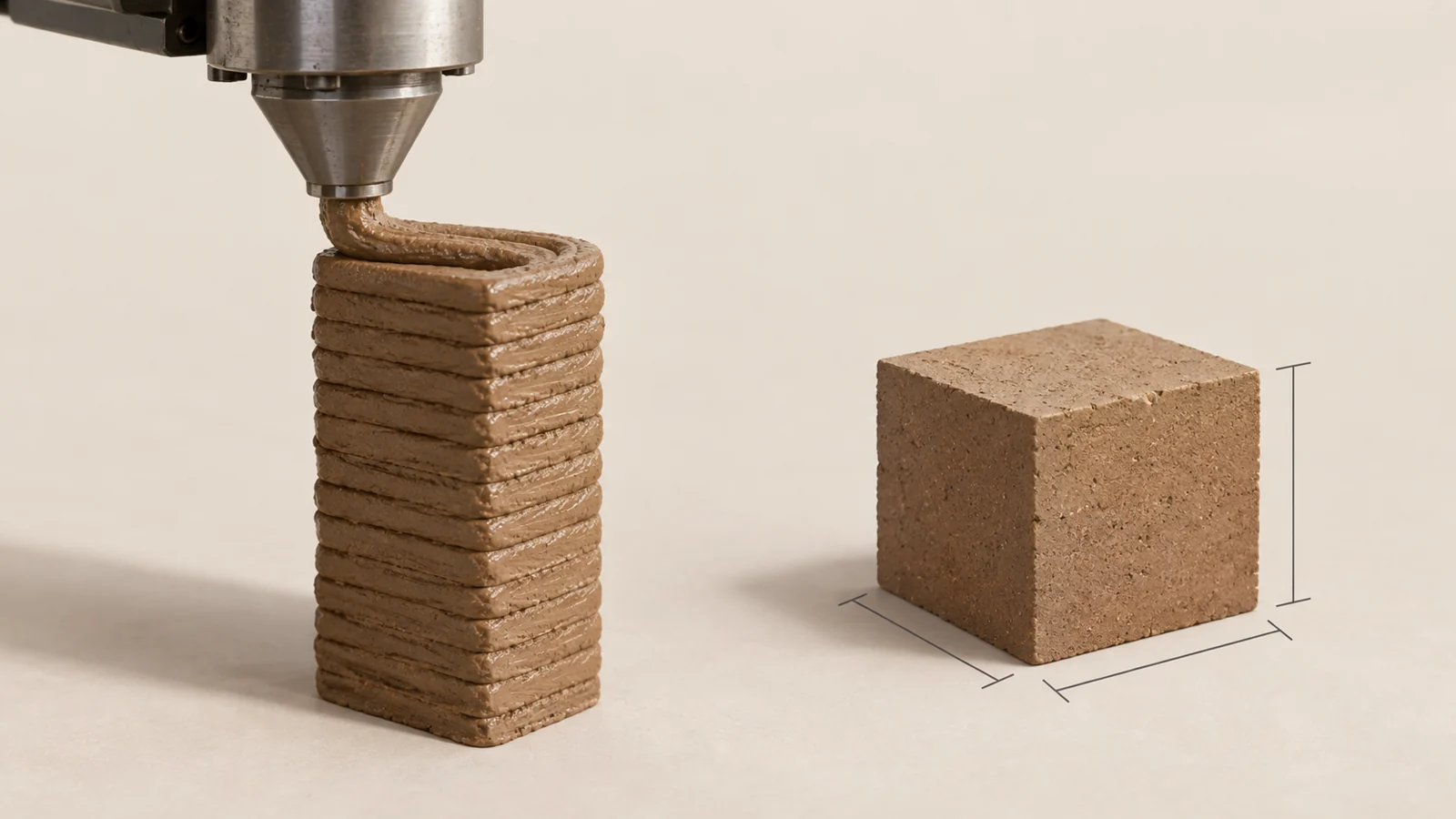
An earth-based paste faces two competing demands inside a 3D printer. It must flow through a narrow nozzle, then retain enough shape to support the material deposited above it. A mixture that hardens well inside a mold may still be difficult to print. A mixture that extrudes easily may struggle to stay where the printer puts it.
A study published on January 8, 2021, explored that balance using loess, a natural earth material, mixed with quicklime, gypsum, and water. The researchers printed narrow rectangular columns and small cubes, then investigated their mechanical behavior and internal structure. The cubes, just 2 centimeters on each side, reached an average compressive strength of 7.7 MPa. Understanding that result requires following both the recipe and the route from wet paste to hardened object.
The earth needs a binding system
Loess supplied the earth-based constituent, but the printable material was an engineered composite. Its behavior depended on the added minerals and water as well as the loess itself.
Gypsum played a central role in the binding system. In the molded specimens, mixtures without gypsum performed poorly in compression; adding it increased strength up to an optimum in the tested series. Quicklime also participates in reactions with water, forming calcium hydroxide. Water therefore serves two connected purposes: it makes the powders into a workable paste and participates in the chemistry of setting.
The researchers used X-ray diffraction to identify crystalline phases. Their starting gypsum powder was identified as bassanite, a calcium sulfate mineral containing chemically bound water. After setting, they detected bassanite and portlandite, the mineral form of calcium hydroxide, alongside other phases in the composite.
The authors proposed that gypsum-hydrate formation helped explain the strength. That is an interpretation of how the binding system works. Identifying minerals in a hardened specimen does not, by itself, establish how much each reaction contributed to its ability to carry a load.
Getting the paste through the nozzle
The preparation sequence shows how much of the result depended on processing. The researchers distinguished higher-viscosity mixtures intended for molding from lower-viscosity mixtures intended for printing. The formulation that worked in a mold was therefore not simply transferred unchanged into a printer.
For printing, they loaded the paste into a cylindrical container and mechanically compressed it to remove bubbles. A motor-driven mechanism then applied pressure to push the material through a nozzle 4 millimeters in diameter. This produced rectangular columns measuring approximately 15 × 15 × 245 millimeters—long, slender laboratory specimens.
The printed columns were cured at 60 °C and 95% relative humidity. The methods also describe these warm, humid conditions for the molded cubes, which were removed from their molds after 24 hours. Controlled curing was part of the preparation behind the results, alongside powder selection, water content, bubble removal, and extrusion pressure.
Particle characteristics mattered to this process too. Microscopy showed irregular loess and quicklime particles, while the gypsum particles were larger and angular. The ingredients also differed in their particle-size distributions. These details help explain why developing a printable paste involves adjusting how a mixture flows as well as how it eventually hardens.
Two strength numbers from different specimens
The paper reports a higher strength elsewhere: 23.9 MPa. That value belongs to the bulk-mixture compression series, using molded cubes approximately 5 centimeters on each side. Strength peaked at a gypsum content of 20% by weight after one day of curing.
The 7.7 ± 0.93 MPa result belongs to optimized, 3D-printed cubes measuring 2 × 2 × 2 centimeters. This is the compression result that directly describes printed cubes. MPa, or megapascals, expresses force per unit area, allowing the measured resistance to compression to be reported as a stress rather than simply a force.
The printed result is lower, but subtracting these values cannot reveal a penalty caused by printing. The specimens differed in formulation, preparation, and size. Establishing the effect of printing itself would require a comparison designed to hold those other factors consistent.
The rectangular printed columns served a different mechanical test. They were supported at two points and loaded between them in a three-point bending experiment. Bending and compression challenge a specimen differently, so the beam tests should not be folded into a single interchangeable measure of “strength.”
Together, these experiments demonstrate printable shapes with measurable mechanical resistance. They do not establish an allowable load for a building component or a general strength rating for printed earth materials.
Electricity follows the changing pore liquid
The researchers also watched setting through an electrical measurement. While a compression test loads a specimen until it fails, impedance spectroscopy probes how a material responds to an alternating electrical signal across a range of frequencies.
In this composite, ions in the liquid occupying its pores carry current. As the mixture reacts, changes in the liquid chemistry and the connected internal pathways can change the measured electrical response. The experiment separated responses associated with the material’s interior from those associated with the electrodes.
The effect of gypsum depended on when the measurement was taken. At one hour, adding gypsum was associated with decreasing resistance, which the authors linked to evolving solution chemistry. At 24 hours, impedance increased with gypsum content. Bulk resistance also rose with longer curing.
These observations offer a way to follow changes inside the setting material, beyond inspecting its surface. They are not a calibrated conversion from electrical resistance to load-bearing strength: a resistance reading and a compression test answer different questions.
Pores complicate the environmental promise
The pore measurements introduce an important inconsistency within the paper. Mercury intrusion porosimetry, which uses pressure to push mercury into accessible pores, gave porosities of 41.84% for the bulk loess composite and 50.69% for the printed rectangular specimens. The cement reference specimens measured 19.94% and 24.43%, at different water-to-cement ratios.
Those numerical results place the tested loess composites above the cement references in porosity. The conclusion says the opposite, describing lower porosity for the loess composites. The numerical results therefore do not support that concluding comparison, and the discrepancy should remain visible when interpreting the work.
Nor does a porosity percentage alone establish water permeability or weather resistance. Total accessible pore volume and the arrangement of connecting pathways describe different aspects of a material. These measurements cannot settle how a printed object would withstand repeated wetting, outdoor exposure, or long service.
The same care applies to the paper’s environmental ambition. Using an earth-based constituent creates a reason to investigate environmental benefits, but the reported printing and characterization results do not establish lower life-cycle emissions or exposure safety. Those claims require evidence that accounts for the ingredients, their processing, curing, use, and eventual disposal. The warm curing conditions are one concrete part of the process such an assessment would need to consider.
Building-scale suitability, construction-code compliance, and commercial production readiness likewise remain unverified by these laboratory results. The useful achievement here is specific: a formulated earth-based paste could be extruded into small objects and hardened sufficiently for mechanical testing.
What this could change
If the balance between extrusion and hardening can be maintained across larger objects and dependable production conditions, this approach could let designers fabricate earth-based components directly from digital shapes. Changing the printer’s path could change an object’s geometry without requiring a new mold for every design, opening possibilities for customized decorative pieces and other shaped components.
The causal step demonstrated here is the coupling of a mineral binding system with controlled deposition. Loess supplies the earth-based material, the formulation enables it to pass through a nozzle, and setting gives the deposited shape mechanical resistance. Extending that combination could expand the range of materials available for digital fabrication, with environmental advantages dependent on separate verification of the complete process.
Key Sources
- Primary source: Three-Dimensional Printing of Natural Materials Involving Loess-Based Composite Materials Designed for Ecofriendly Applications.
DOI or Journal Page · Peer-Reviewed Paper · 2021-01-08
Keep exploring