
Research Signal – Source date 2022-01-01
A pooled analysis found a modest survival advantage for immune checkpoint inhibitors over chemotherapy in patients with metastatic urothelial cancer whose tumors were PD-L1 positive. In the group whose tumors were classified as PD-L1 positive, the estimated risk of death over follow-up was lower with immunotherapy. The analysis did not show a clear survival difference in the PD-L1-negative group.
That pattern makes PD-L1 worth studying as a treatment-selection marker. It does not tell an individual how likely they are to benefit, or settle which first-line treatment is right for them. The study combined results across groups; a personal outcome depends on more than the group average captured by this comparison.
A first-line comparison across three trials
Metastatic urothelial cancer is cancer that has spread from urothelial tissue, which lines parts of the urinary tract. The review asked whether PD-L1 expression could help distinguish which patients might fare better with immune checkpoint inhibitors (ICIs) or chemotherapy when treated first for metastatic disease. PD-L1 is a protein whose expression was used to divide patients into positive and negative groups in the trials. The abstract does not specify the tests or cutoffs used to assign those labels.
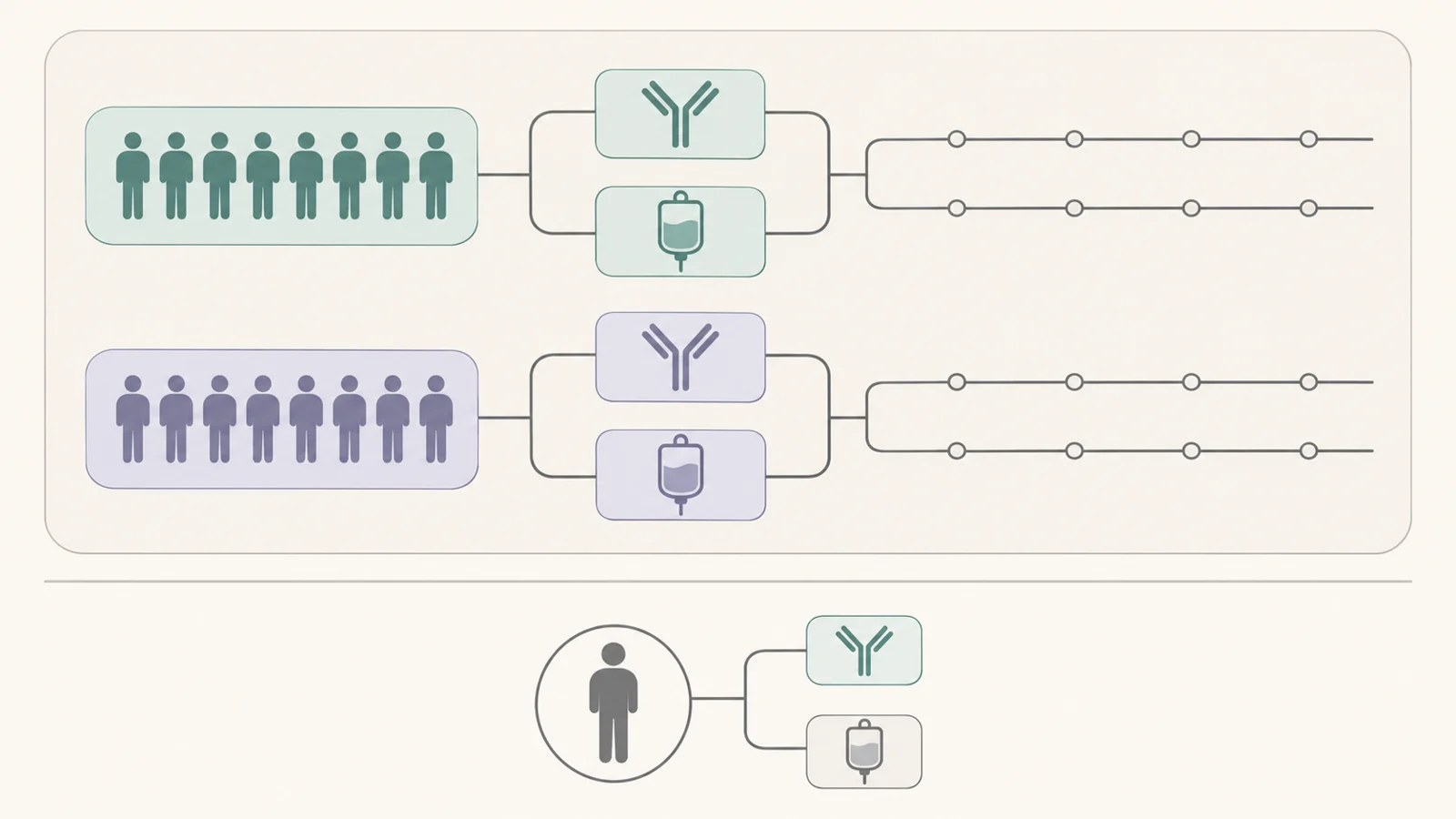
The researchers brought together three phase III randomized trials that compared first-line ICIs with chemotherapy. Across the PD-L1-positive patients, 1,125 received an ICI and 1,112 received chemotherapy, for 2,237 people in that group. Random assignment helps make the treatment groups comparable on average, giving researchers a stronger basis for comparing outcomes than an observation of patients who happened to receive different treatments.
The main outcome was overall survival: how long people lived during the period they were followed. It captures whether a treatment comparison is associated with living longer, without relying on whether a tumor shrank at a particular assessment. For the PD-L1-positive group, the pooled hazard ratio was 0.86, with a 95% confidence interval from 0.78 to 0.96. In this comparison, a hazard ratio below 1 favors the ICI group. The interval did not include 1, which is consistent with a survival advantage for that group in the pooled analysis.
A hazard ratio is a comparison of death rates over follow-up, not a prediction for one person. The value 0.86 does not mean that each patient lived 14% longer, had a 14% chance of benefit, or gained a fixed number of months. It summarizes the relative pattern between groups over time; it cannot supply an individual prognosis.
For patients classified as PD-L1 negative, the reported hazard ratio was 1.03, with a 95% confidence interval from 0.89 to 1.19. Because that interval includes 1, the estimate is compatible with no clear difference in overall survival between treatments. The abstract describes no observed difference for this group. It does not establish that the treatments are equivalent or that no individual in the group could benefit from an ICI.
A promising pattern is not a personal test result
A biomarker is predictive when it helps show that the relative effect of one treatment versus another changes according to the marker. The positive-group result and the negative-group result point toward that question: did treatment perform differently depending on PD-L1 status? But seeing one group’s estimate favor one treatment and another group’s estimate show no clear difference is not, by itself, enough to establish that the marker reliably selects treatment.
A formal treatment-by-marker analysis can test whether the relative treatment effect differs between marker groups. The supplied abstract does not establish whether such an analysis was reported or what it found. Without that result, the two group comparisons should be read as an important signal to investigate, rather than as proof that a positive test identifies who will do better on immunotherapy.
There is another gap between a group result and a decision for an individual. Even if a marker separates groups with different average treatment effects, people within each group can have different outcomes. A positive label cannot guarantee response or durable benefit, and a negative label cannot tell a person with certainty that immunotherapy will not help. The pooled hazard ratios do not provide those individual probabilities.
The label has to mean the same thing
A treatment-selection marker is only useful if clinicians and researchers can interpret its measurement consistently. If tests classify the same tumor differently, or if positive groups are defined differently across trials, a pooled comparison may not translate cleanly into a dependable decision aid. Standardized PD-L1 assessment is therefore part of the evidence needed to turn a group-level association into a usable clinical tool.
The abstract calls for more reliable, standardized assessment of PD-L1 in urothelial cancer. It does not provide the assay thresholds or enough detail to assess how definitions varied across the three trials, or how much their results differed from one another. Those details matter to judging how portable the pooled estimate is. Their absence from the abstract is a limit on what can be concluded from the summary, not evidence that the full paper lacks the information.
The authors also caution that the synthesis has issues. The findings are best understood as a comparison of trial groups assembled in a systematic review and meta-analysis, with the positive-group estimate favoring ICIs and the negative-group estimate remaining uncertain. For a marker to guide treatment more confidently, the difference between groups needs to be reproducible and tied to a consistent way of measuring PD-L1.
What this could make possible
A person newly facing a first-line choice for metastatic urothelial cancer could one day discuss immunotherapy and chemotherapy with a clinical team using a PD-L1 result that means the same thing across validated tests. That could make the marker part of a more dependable comparison of treatment options, rather than leaving a positive label to carry more certainty than the evidence supports. Reaching that point depends on standardized measurement and further evidence that treatment effects differ reliably by marker status; this review contributes the observed survival pattern, not those remaining validations.
A nearer milestone would be a randomized comparison with PD-L1 assessment specified in advance that reports whether treatment effects differ reproducibly between marker groups. If that pattern holds across trials using consistent assessment, the result could help build a more credible decision aid. It would still need to support realistic expectations for people, not promise an outcome from a test alone.
Key Sources
- Primary source: Expression of Programmed Cell Death Ligand 1 as a Predictive Biomarker in Metastatic Urothelial Carcinoma Patients Treated with First-line Immune Checkpoint Inhibitors Versus Chemotherapy: A Systematic Review and Meta-analysis.
DOI or Journal Page · Review or Meta-Analysis · 2022-01-01
Keep exploring