
Research Signal – Source date 2021-12-17
A brain metastasis from kidney cancer returned after laser treatment, focused radiation and immunotherapy. After surgeons removed the recurrent tissue and placed tiny cesium-131 radiation seeds in the cavity, the patient remained clinically and radiographically stable for 18 months. The case offers a detailed example of a salvage approach for a difficult location; it cannot tell which part of treatment produced that outcome.
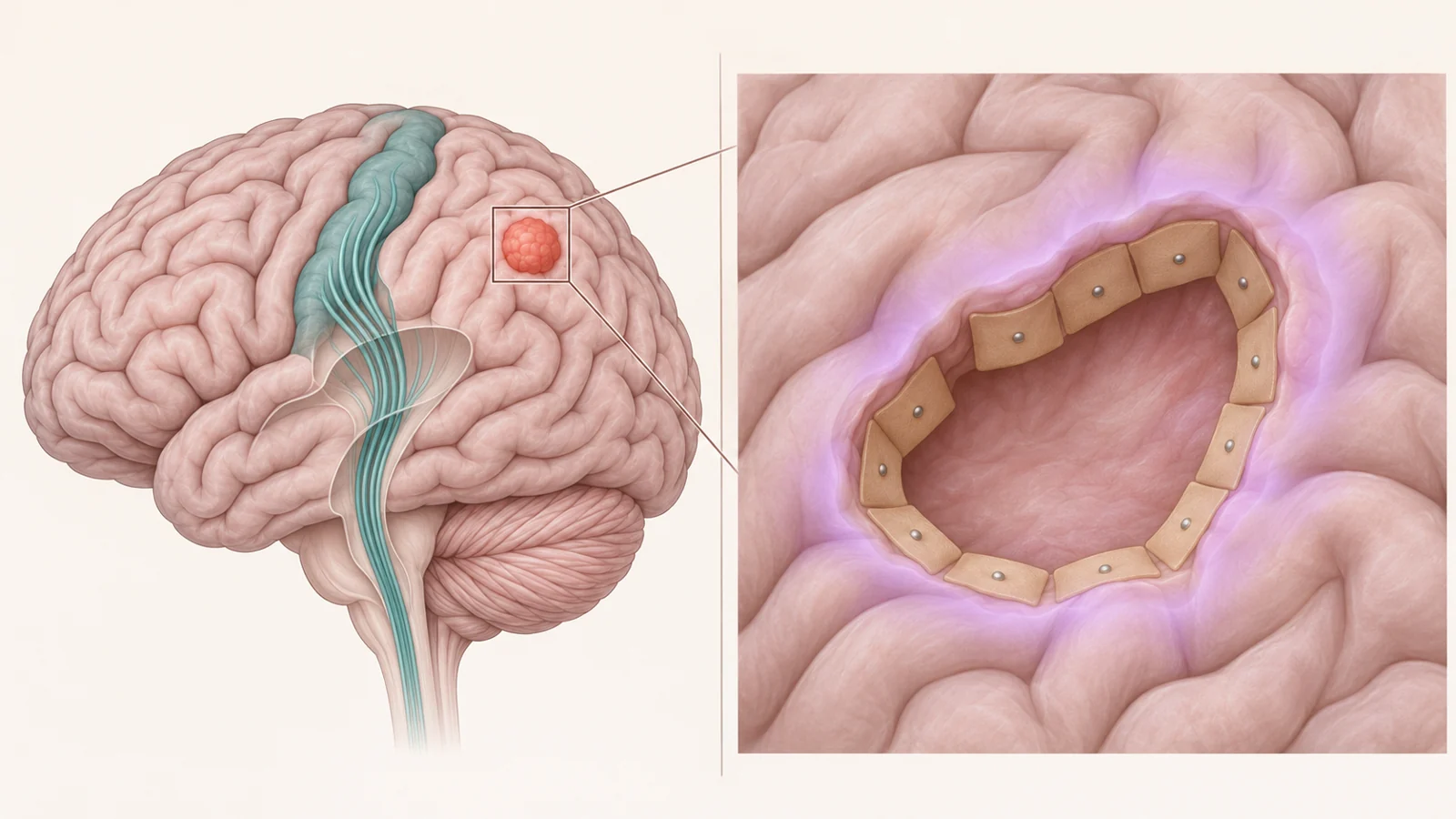
The patient was a 53-year-old man whose kidney cancer had been treated 14 years earlier. When he developed weakness and tingling in his left hand, imaging showed a mass in the right parietal region of his brain. A biopsy identified it as clear cell renal cell carcinoma that had spread from the kidney. The lesion lay close to pathways involved in movement and sensation, making local treatment a matter of controlling the tumor while working around important brain function.
The tumor returned inside a previously treated area
Doctors first used laser interstitial thermal therapy, or LITT. Guided by imaging, a probe delivers heat to destroy tissue in a targeted area. The biopsy and laser treatment were done together, providing a diagnosis while treating the mass. Follow-up scans soon showed rapid growth along the lesion’s edge. About a month after laser treatment, the team gave stereotactic radiosurgery, a focused form of radiation, in three sessions.
The case report describes another important change in the patient’s situation: later scans also identified cancer in his lungs. He also received nivolumab and ipilimumab, two immune checkpoint drugs, as part of his treatment. Even after this sequence, imaging showed new growth in the previously treated area.
A change on a scan after radiation can have more than one explanation, including tumor or treatment-related tissue change. Here, imaging findings favored tumor, and the rapid growth and enhancement along the earlier laser path supported that interpretation. The clinicians treated the findings as recurrent disease rather than assuming every post-treatment change represented tumor.
Nearby nerve pathways constrained the first treatment
The mass sat close to the corticospinal and thalamocortical tracts, pathways that carry movement and sensation signals. That proximity mattered because LITT relies on heat, and the amount delivered can be limited when a lesion is near sensitive structures. The paper discusses how under-treated areas can be a site of recurrence; in this patient, growth appeared at the margin and along the prior treatment tract.
This anatomy also shaped the later operation. The patient was considered for salvage after multidisciplinary review, with good functional status and controlled cancer outside the brain at that point in the course. Surgery could remove the recurrent tissue and relieve pressure from the mass, while mapping during the operation helped the team locate movement-related pathways as they worked near them.
Surgery removed tissue and placed radiation in the cavity
Five months after the brain metastasis was diagnosed, surgeons removed the recurrent tissue from the original site and treatment tract. They used intraoperative subcortical motor mapping to help identify the nearby pathways. After removal, they placed cesium-131 seeds embedded in foam tiles along the surgical cavity. This is brachytherapy: radiation delivered from material positioned inside or next to the treated area.
The prescribed dose was 60 gray (Gy), a unit of absorbed radiation, at a depth of 5 millimeters from the cavity edge. That describes the planned radiation around the cavity; it should not be read as a direct comparison with the earlier laser or focused-radiation treatments, which use different methods and treatment plans. In the combined procedure, resection addressed the visible recurrent tissue, while the implanted seeds were intended to provide radiation around the area where it had been removed.
After surgery, the patient’s left leg strength was mildly improved and later returned to near-normal function. At 18 months, he remained clinically and radiographically stable, with no evidence of recurrence reported at follow-up.
One course sits beside a difficult salvage record
The paper reviews studies of focused radiation after brain metastasis surgery. In prospective studies, 62% to 78% of treated sites had no recurrence in the treated area at one year. Retrospective studies, which look back at patient records, reported 85% to 93% at one year, with lower rates later. The paper also notes that another round of focused radiation can injure nearby brain tissue, a condition called radiation necrosis.
These figures come from different groups of patients and treatment settings, so they do not form a direct comparison with this single case. Nor can the patient’s stable scans show whether the operation, the implanted radiation, the earlier immunotherapy, or a combination of factors accounts for the course. The report provides no comparison group from which to calculate a success rate or determine which salvage approach is best. Its follow-up describes stability through 18 months, not what happened after that point or how the same approach would apply to people with different disease or functional circumstances.
How this could shape the future
For a person whose brain metastasis returns near tissue responsible for movement or sensation, while cancer elsewhere is controlled, a dependable way to compare salvage choices could help a clinical team weigh local control against the risks of treating near critical pathways. This case makes one option concrete: remove recurrent tissue with mapping, then place radiation seeds along the cavity. It does not establish that this combination is better or that it will work for another patient.
The next useful evidence would come from prospective studies of people with similarly treated recurrences, tracking both local recurrence and neurological function and describing alternatives clearly enough to compare. If those data show durable local control with acceptable risks to movement and sensation, this combined operation could become a more dependable option for selected patients whose tumors recur near critical pathways. The case supplies one example of the approach and its 18-month course; broader evidence would need to establish when that possibility is a reliable one.
Key Sources
- Primary source: Multimodality durable salvage of recurrent brain metastases refractory to LITT, SRS and immunotherapy with resection and cesium-131 brachytherapy: case report and literature review.
DOI or Journal Page · Review or Meta-Analysis · 2021-12-17
Keep exploring