
Research Signal – Source date 2021-09-01
A water-repellent coating can fail through an opening too small to see. If water reaches the surface underneath, it can spread beneath the coating, form blisters, and gradually lift the protective layer away. Making the coating thicker can help it withstand damage, but thickness creates a problem for equipment that needs heat to pass through the surface. A protective polymer layer can also become an insulating layer.
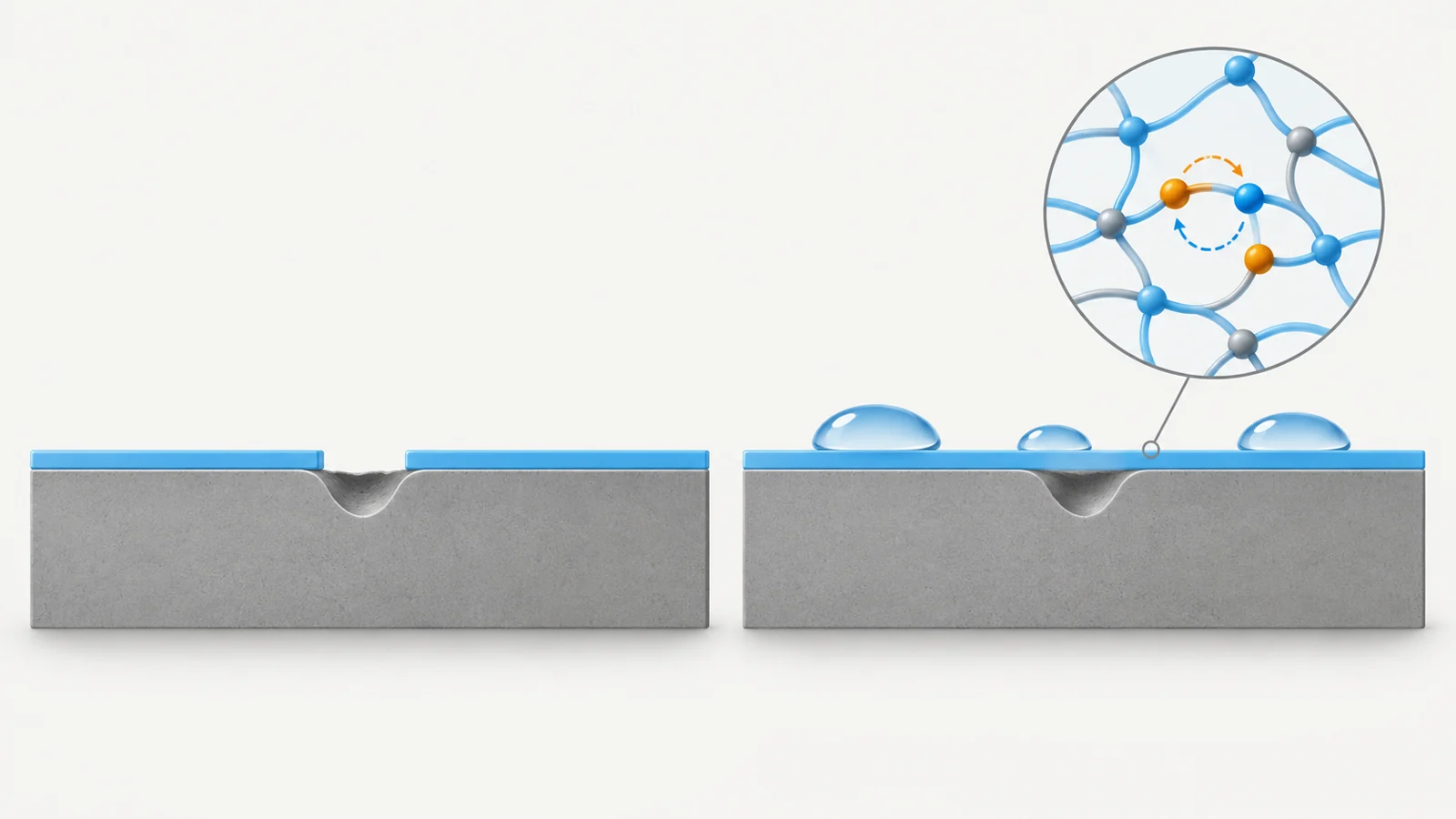
An experimental study published in Nature Communications on September 1, 2021, explores another way to keep that barrier working. The researchers made silicone coatings with molecular connections that can rearrange, allowing nearby material to cover tiny defects. On polished silicon, a specified preparation produced films averaging just 6 nanometers thick. Damage experiments showed both coverage of nanoscale openings and recovery of water-repellent behavior across larger scratches. Understanding those results requires distinguishing what happened to the coating from what happened to the solid beneath it.
Molecular connections that can change partners
The material is a vitrimer, a polymer network whose connecting bonds can exchange while preserving network connectivity. Its strands are polydimethylsiloxane, or PDMS, a silicone with an inherently water-repellent backbone. The researchers linked those strands using chemistry formed from boric acid. Exchangeable boron–oxygen bonds give the network a way to rearrange after damage.
This places the healing mechanism within the molecular structure. Other self-healing materials can carry repair liquids inside microscopic capsules, but the capsules themselves take up space. Molecular connections can operate within a film much thinner than such containers, making the approach relevant to coatings below 100 nanometers.
The team also checked whether the network chemistry survived the processing used to make an extremely thin film. Conventional infrared measurements were insufficiently sensitive for a 5-nanometer sample, so the researchers used a technique combining infrared excitation with atomic force microscopy. They detected the characteristic boron–oxygen signal in that film and mapped it across a small surface area. That supports the presence of the network even at this thickness, although detecting its bonds does not directly measure how quickly they exchange.
What recovered after damage
The smallest damage experiment used the tip of an atomic force microscope to scratch an area measuring 200 by 200 nanometers. In subsequent imaging, surrounding coating material had come together over the opening, forming a bump about 10 nanometers tall. The defect was covered, but the surface had not simply returned to its original flat profile.
The microscope could not capture the repair as it happened. By the time the damaged area could be scanned, material already covered it. The observation therefore establishes a recovered state within the imaging interval, rather than an exact healing time or a directly measured molecular exchange rate.
A separate test examined why closing openings matters when water condenses. The researchers indented both the dynamic silicone coating and a fluorinated comparison film deeply enough to penetrate each coating. During condensation, water blisters formed beneath the fluorinated film at the artificial pinholes. With the dynamic silicone, the team observed neither persistent visible pinholes nor blister initiation under the reported conditions. This connects the coating’s response to damage with its ability to prevent a particular route of water penetration.
Larger scratches tested a different kind of recovery. A glass cutter damaged the coating and gouged the polished silicon wafer beneath it. On the fluorinated comparison surface, condensed water formed a narrow film along the exposed scratch and became pinned there. On the dynamic silicone, separate droplets grew across the damaged region without becoming pinned at the scratch, demonstrating recovery of water-repellent behavior.
That finding concerns the function of the surface. It does not establish that the gouged silicon regained its original shape or strength. Across these experiments, the evidence moves from material covering a nanoscale opening to preventing visible water blisters and restoring water behavior over a larger damaged area. Those are related achievements, but they are different measurements of recovery.
A beaded droplet does not always move easily
Water repellency is often illustrated with round droplets perched on a surface. The study shows why their shape tells only part of the story.
A contact angle describes the angle where a droplet meets the surface; a larger angle generally means the water beads up more strongly. The researchers measured an advancing angle of 93 ± 3 degrees on a flat dynamic silicone film. They also measured contact-angle hysteresis, the difference between the advancing and receding angles as the droplet’s edge moves. That difference helps describe how readily the edge can move rather than remain pinned.
The flat dynamic film had hysteresis of 13 ± 4 degrees. A comparison film made from linear PDMS had a somewhat larger advancing angle, 100 ± 1 degrees, but much greater hysteresis, 40 ± 1 degrees. A more rounded droplet shape therefore did not automatically indicate easier movement.
Surface texture changed the result substantially. On etched aluminum with microscopic roughness, a selected dynamic silicone formulation reached an advancing angle of 157 ± 2 degrees, with hysteresis below 5 degrees. This combination produced a superhydrophobic surface. In an impact experiment, a droplet bounced completely away from the textured coated aluminum, while a droplet striking the flat coated surface remained attached.
The textured surface combined a particular formulation with a particular geometry. Its bouncing-droplet behavior cannot be assigned to every flat silicone film. For an application, the relevant question is whether water can leave the actual coated surface under the conditions in which it forms or arrives.
Nanometer thickness depends on the process
Applying this silicone mixture does not automatically produce a film a few nanometers thick. The final thickness depended strongly on how the deposited material was heated and exposed to vacuum.
One procedure used a vacuum oven at 100 °C for 15 hours. Films prepared this way reproducibly measured 6 ± 3 nanometers on polished silicon. The authors attributed the large reduction from the initially deposited layer to evaporation of small PDMS molecules before they became incorporated into the network. A different heating sequence without vacuum produced films around 2 micrometers thick—thousands of nanometers.
Other vacuum-curing conditions gave intermediate thicknesses. The processing step is therefore part of the material’s performance, because it determines how much coating remains and the conditions under which the network forms. A recipe for the chemistry alone would not specify the finished surface.
The team demonstrated spin coating and dip coating across substrates including silicon, glass, copper, and aluminum. Dip coating offers a practical route for applying material by immersing an object in the solution, but the dip-coated samples were generally thicker than spun samples after equivalent curing. Thickness measurements were made on polished silicon; the rougher features of metal surfaces made comparable measurements difficult. These demonstrations establish versatility in deposition, while leaving industrial throughput and consistent thickness across different objects as further engineering challenges.
The laboratory conditions still matter
Condensation provides a useful durability test because it can expose defects that a single droplet measurement misses. Water reaching the coating–substrate interface can reveal a weakness through blister formation or spreading wet regions. The study’s long-term condensation setup used vertically mounted samples cooled to 5 °C in surrounding air at 22 °C and 45% relative humidity. Those conditions give the observations a defined laboratory setting; they do not establish an operating lifetime in an industrial condenser.
Some of the unresolved questions concern the material itself. The authors identify uncertainty about whether extreme thinness changes the network’s stiffness, its time-dependent deformation, or its bond-exchange behavior relative to bulk material. The nanoscale repair images show the result of rearrangement without resolving its precise molecular mechanism.
Water interactions also need closer explanation. The researchers did not observe the thin coating spreading over droplets to cloak them, a behavior that can deplete some liquid-based water-repellent surfaces. They suggest that the small amount of material available may limit that process. Understanding such interactions matters for predicting how the coating behaves as droplets repeatedly form and leave.
The coating chemistry avoids perfluorinated compounds, providing a different materials option. That distinction alone cannot establish its overall environmental safety, toxicity, or lifecycle performance.
What this could change
If the coating can retain its behavior under practical operating conditions and be applied consistently to equipment, it could help condensation surfaces keep forming separate droplets while adding very little insulating material. Preserving that surface behavior could make it easier for condensed water to leave and for heat to pass through the underlying equipment.
That capability could be useful in heat exchangers and systems that collect water through condensation. The route to the benefit is specific: maintain water-repellent coverage despite small defects, support droplet removal on the chosen surface, and avoid a thick thermal barrier. Turning those laboratory findings into dependable equipment would require control over fabrication and durability in the intended environment. The study supplies an experimental basis for pursuing that possibility.
Key Sources
- Primary source: Ultra-thin self-healing vitrimer coatings for durable hydrophobicity.
DOI or Journal Page · Peer-Reviewed Paper · 2021-09-01
Keep exploring