
Research Signal – Source date 2025-10-01
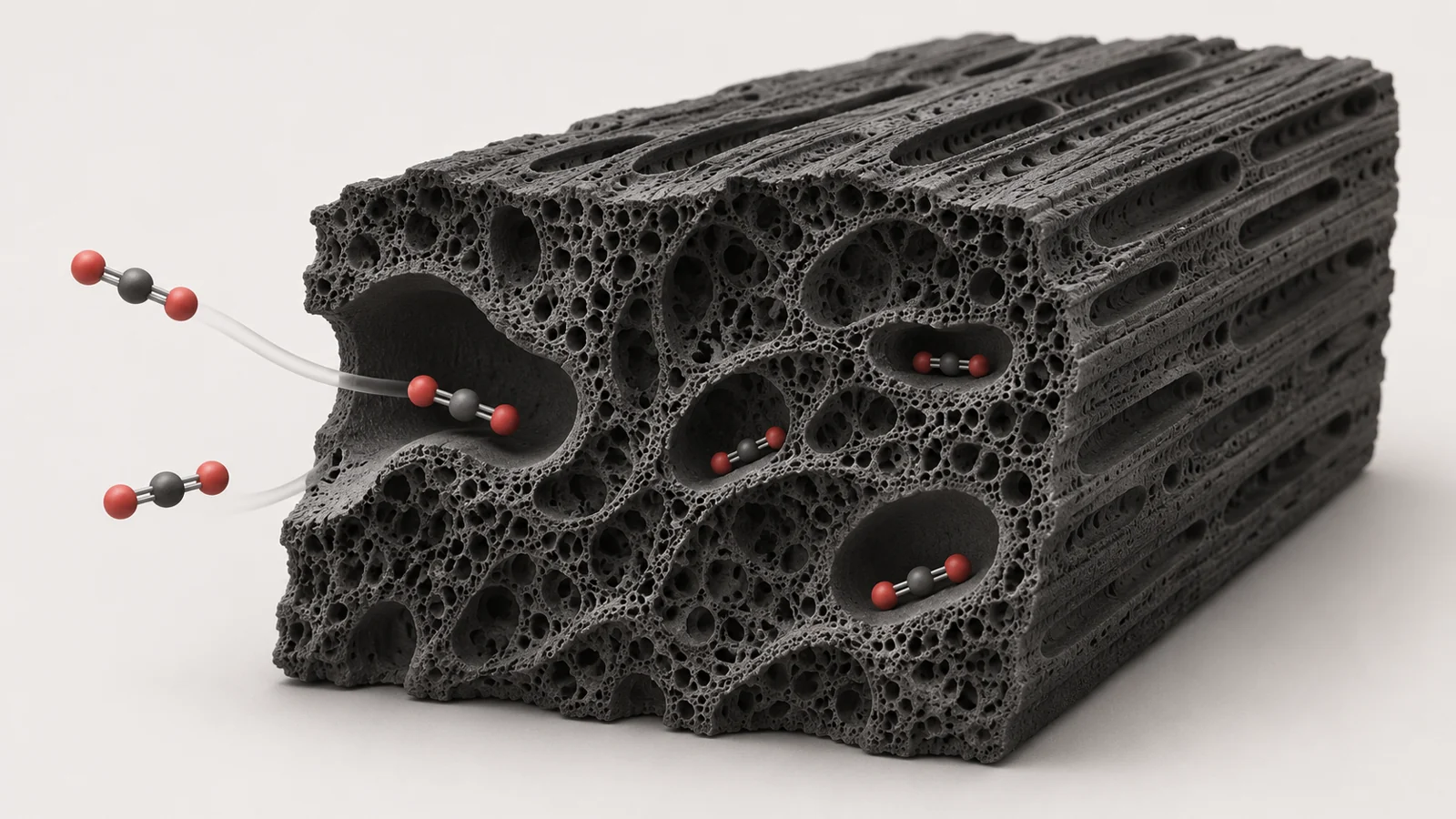
A bamboo-derived carbon held 6.08 millimoles of carbon dioxide per gram at 0 °C and 1 bar—about twice the amount held by the non-activated comparison sample. The result came from a laboratory study of how a mild potassium carbonate treatment changed the material’s internal pores. The strongest sample, BPAC-3, had a measured surface area of 1,913.85 square metres per gram and a pore volume of 1.087 cubic centimetres per gram.
Those numbers describe different features: surface area is the internal surface available for gas molecules to contact, while pore volume measures the space inside the material. The authors’ explanation is that the treatment made more of that area and pore space accessible to carbon dioxide. The measurements and simulations support that account, while leaving a practical question open: how well would the material perform in a working capture process?
A single treatment changed the pore structure
The researchers made activated carbon from bamboo powder in a one-step process using potassium carbonate, or K₂CO₃. Activation changes a carbon material’s pore structure; here, the amount of K₂CO₃ mattered because the study compared samples made with different treatment levels. BPAC-3 had the highest reported surface area and pore volume among the samples, but its label alone does not specify the treatment recipe.
Compared with the non-activated sample, BPAC-3 had about 4.9 times the specific surface area and 6.6 times the pore volume. These are physical-characterization results, separate from the carbon dioxide adsorption measurement. They show that the treatment substantially altered the material’s internal architecture; they do not, by themselves, establish how much gas a capture system could remove.
The proposed link is access. Carbon dioxide molecules can enter some of a porous material’s small internal spaces and interact with its surfaces. The authors attribute the higher uptake chiefly to increased surface area and micropore volume accessible to CO₂. Grand Canonical Monte Carlo simulations, a computational method for estimating how molecules occupy pores, also supported a role for greater microporosity and free volume. The simulations reinforce the pore-based explanation; the reported adsorption measurement remains the experimental result.
The measured capacity has specific conditions
BPAC-3 adsorbed 6.08 mmol of CO₂ per gram at 0 °C and 1 bar, approximately twice the amount reported for BPAC-0. This is a useful comparison under a stated test condition, not a general capacity across temperatures, pressures, or gas mixtures. A capture bed used at an emission source would encounter flowing gas, and the supplied evidence does not establish how the material would perform under those operating conditions.
The study also reports selectivity for CO₂ over nitrogen, the main gas named in the comparison. Selectivity matters because a material intended to separate carbon dioxide has to distinguish it from other gases, rather than simply take up a substantial amount of CO₂ in isolation. The abstract describes the selectivity as good but supplies no numerical value here, so the result cannot be compared quantitatively from the evidence available.
Reported adsorption heats were 8–26 kJ/mol. Adsorption heat describes energy released when molecules bind to a surface; this range helps characterize the measured interaction, but it is not enough to determine the energy needs of a full capture process. Those depend on the material’s behavior in the equipment and conditions where it would be used.
Five cycles are an early reuse check
A capture material would need to release the gas it has collected so that it can be used again. In the reported adsorption–desorption tests, the bamboo-derived carbons maintained high adsorption performance after five cycles. That is an encouraging short-term reuse result: uptake remained high through the cycle count tested.
Five cycles do not answer how performance changes over extended operation. The abstract does not establish long-term durability, nor does it show whether the material would retain its capacity in a humid, flowing mixture over many more cycles. Those conditions matter to a reusable separator, and the reported laboratory capacity alone cannot establish capture-system performance, production scale, cost, or comparative environmental impact.
How this could shape the future
At an industrial emission source, a dependable bamboo-derived carbon in a reusable capture bed could help separate CO₂ from an outgoing gas stream. The potential contribution is a candidate material made through this mild, one-step activation route. Its measured pore architecture offers a plausible explanation for the higher uptake, while the reported CO₂-over-N₂ selectivity and five-cycle result provide early evidence relevant to separation and reuse.
Whether that possibility holds up depends on performance under realistic mixed-gas operation, durability, and the demands of a capture process. A useful nearer milestone would be a benchmark test of uptake and regeneration in a humid, flowing CO₂/N₂ mixture over substantially more cycles. That would show whether the pore advantage measured in the laboratory persists as the material repeatedly captures and releases gas.
Key Sources
- Primary source: Elucidating the role of moderate K2CO3 activation in tuning microporous architecture of bamboo-derived carbon for superior CO2 capture
DOI or Journal Page · Peer-Reviewed Paper · 2025-10-01
Keep exploring