
Research Signal – Source date 2025-07-25
Flue gas contains far more nitrogen than carbon dioxide, so capturing the smaller share means a material must do more than hold gas: it must favor carbon dioxide when both gases are present. A study published on July 25, 2025, reports a porous material designed for that sorting job, with two headline measurements that address different parts of the challenge.
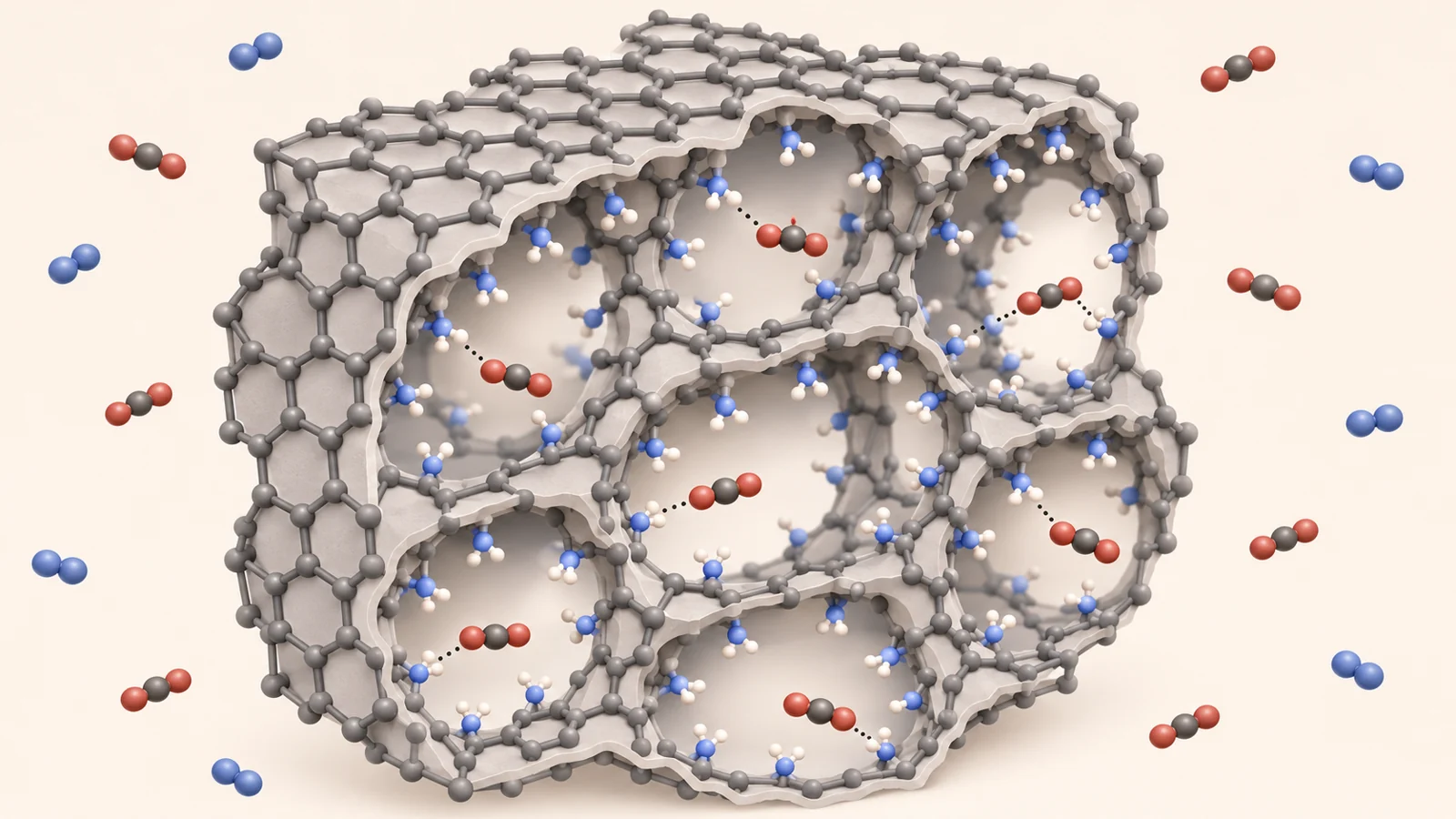
The material, called TaTp-COF, is a covalent organic framework: a molecular structure joined into a porous solid. The researchers placed many secondary amine groups—nitrogen-containing chemical sites—throughout its structure. Those sites are intended to give carbon dioxide places to bind, even when nitrogen is also in the gas mixture.
Two numbers answer different questions
TaTp-COF took up 5.0 millimoles of carbon dioxide per gram at 0 °C and 1 bar. That is a measure of capacity under the stated conditions: how much carbon dioxide a given mass of material held. It does not, by itself, show how effectively the material separates carbon dioxide from nitrogen in an exhaust-like mixture. The uptake measurement was reported at 0 °C and 1 bar; the abstract does not establish that the same capacity applies at the mixture used for the selectivity result.
For separation, the researchers report a carbon dioxide–nitrogen selectivity of 233 at a gas-volume ratio of 15:85. Selectivity describes the material’s preference for one gas over another in a mixture. The ratio matters because a strong capacity in a carbon-dioxide measurement alone could leave unanswered whether nitrogen competes for the material’s binding sites. The separate selectivity result addresses that preference at the stated 15:85 gas ratio.
The abstract also describes high adsorption efficiency at low carbon dioxide partial pressures—the share of the gas pressure attributable to carbon dioxide. That is relevant to gas streams where carbon dioxide is diluted, but the supplied summary gives no specific low-pressure test conditions or value to compare with the headline measurements.
Amine sites give carbon dioxide a place to bind
The researchers report that a spontaneous chemical rearrangement during synthesis creates many secondary amine sites, which are evenly distributed throughout TaTp-COF.
Spectroscopy, supported by theoretical calculations, points to carbamic acid species forming when carbon dioxide adsorbs. In other words, the evidence supports a specific chemical interaction between the gas and the amine-bearing material, rather than relying only on the observation that gas entered its pores. The authors connect the evenly distributed active sites with stronger binding and efficient use of those sites.
Strong binding helps explain why the material can favor carbon dioxide. It also raises a practical question for any capture process: the gas must eventually be released so the sorbent can be used again. The abstract reports thermal stability and cycling durability, but provides no operating figures here for the energy needed to regenerate the material or its long-term performance in an exhaust system.
What laboratory durability leaves open
The reported results make TaTp-COF a promising candidate for further evaluation, not a demonstrated exhaust-treatment process. A real installation would need to separate carbon dioxide repeatedly from a representative gas stream, release the captured gas for handling, and maintain performance as operating conditions change. The supplied evidence does not establish those system-level outcomes or quantify regeneration energy, operating life, or net emissions reduction.
The distinction matters because capacity, selectivity, and durability each describe a different part of the problem. Capacity says how much carbon dioxide is held under a specified condition. Selectivity addresses preference in a gas mixture. Stability and cycling durability speak to the material’s ability to withstand heat and repeated use, as reported in the study. None alone measures the full separation-and-release cycle required at an industrial facility.
How this could shape the future
If TaTp-COF’s preference for carbon dioxide holds up in repeatable tests with representative exhaust, an industrial facility could have another selective sorbent option for separating carbon dioxide from nitrogen-rich gas. The separated carbon dioxide could then be handled or stored as part of a broader capture system, rather than simply vented. Such systems already pursue that goal; this study’s possible contribution is an amine-lined porous material that favors carbon dioxide under the reported laboratory conditions. Integration with equipment, practical regeneration, and downstream handling would still need to work together.
A useful nearer milestone would be reproducible cyclic separation in representative exhaust conditions, with measured working capacity—the amount captured and then released—and the energy or other requirements for regeneration. Those results would show whether the material’s laboratory selectivity can translate into a workable capture step.
Key Sources
- Primary source: Amine-functionalized covalent organic frameworks for high-performance carbon dioxide capture.
DOI or Journal Page · Peer-Reviewed Paper · 2025-07-25
Keep exploring