
Research Signal – Source date 2024-09-20
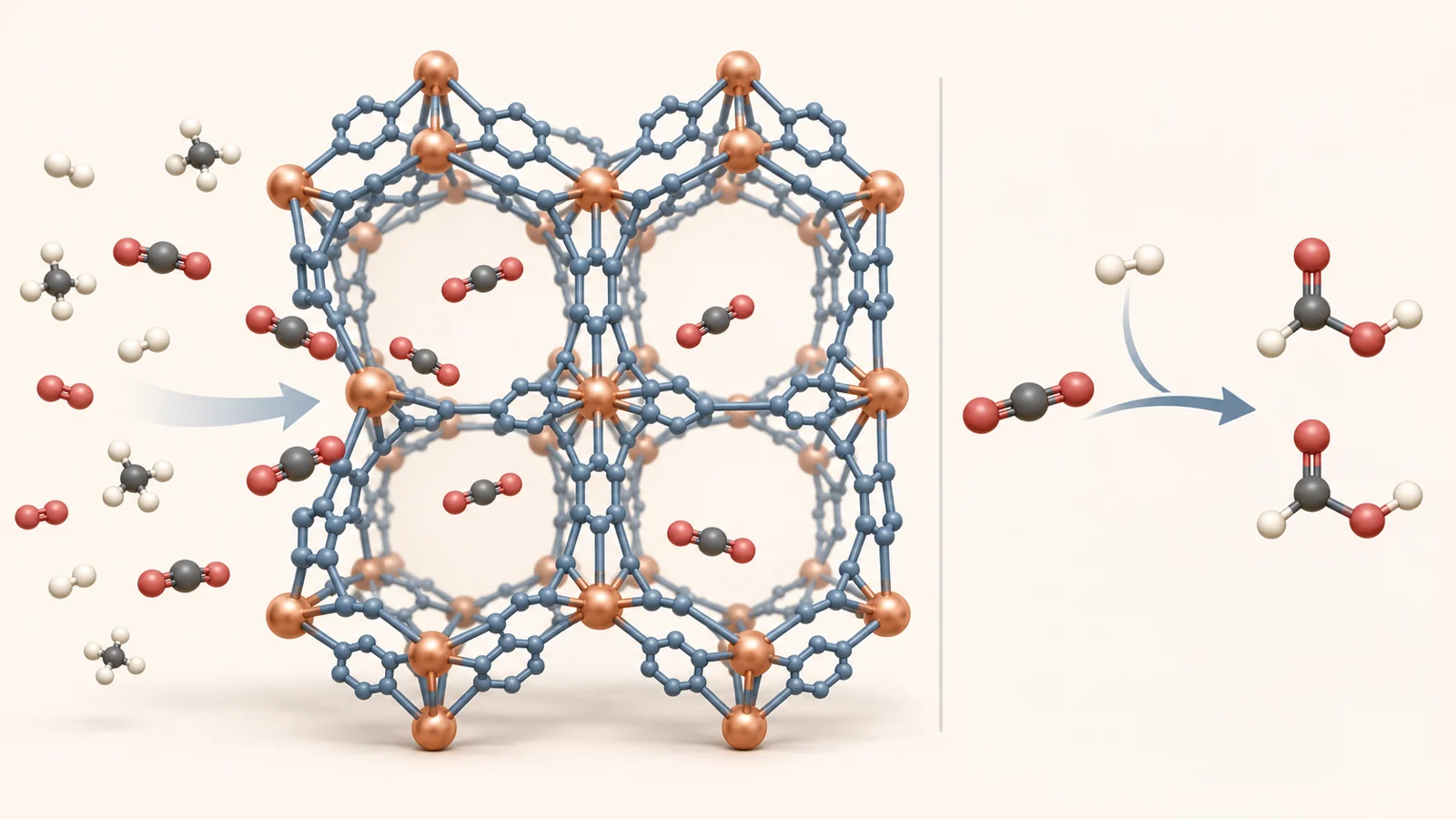
A porous copper material called NU-2100 was reported to do two distinct things: favor carbon dioxide over several gases found in exhaust-like mixtures, and catalyze a reaction that turns carbon dioxide into formic acid. The result is interesting because capture and conversion pose different tests. A material can attract carbon dioxide without making a useful product, or help a reaction without first separating its ingredient from a mixture.
The researchers describe NU-2100 as an ultramicroporous metal-organic framework, or MOF. A MOF is a solid built from metal atoms connected by organic molecules, leaving small spaces that can interact with gases. NU-2100 contains copper in the +1 oxidation state, written Cu(I). Copper(I) frameworks can support carbon dioxide conversion, but selectivity during capture and stability around air and moisture have been difficult to combine in one material.
What the gas tests measured
Exhaust-like gas is not pure carbon dioxide. Water vapor can be present, while nitrogen and oxygen are common components. For capture to help prepare carbon dioxide for a later reaction, the material must favor it amid these competing gases. Separately, the material needs to withstand exposure to air and moisture rather than lose its useful structure or behavior.
The study reports tests addressing both questions. Exposure evaluations involving air, oxygen, water and varying temperatures found NU-2100 more stable than other known Cu(I) frameworks included in the comparisons. Adsorption isotherms, which measure how much gas a material takes up as conditions change, and thermogravimetric analysis coupled with gas chromatography-mass spectrometry supported a preference for carbon dioxide over water, nitrogen and oxygen.
These findings speak to resistance under tested exposures and to relative gas preference. They do not by themselves say what fraction of carbon dioxide a practical stream would yield, or how much the material could process. The supplied evidence does not provide a capture fraction, throughput or overall process-efficiency figure.
The reaction result has a different meaning
The reported catalytic test used a temperature of 50 °C and a hydrogen-to-carbon-dioxide ratio of 3:1. Under those conditions, NU-2100 converted carbon dioxide to formic acid with 100% selectivity. Formic acid is a chemical feedstock, so the result identifies which product was reported from the reaction rather than a mixture of products.
Selectivity is not the same as yield or capture efficiency. A 100% selectivity result does not tell us how much of the starting carbon dioxide was converted, how much the material captured, or how quickly product was made. Nor does a reaction test establish that capture and conversion can run continuously on a real exhaust stream. The abstract reports a promising combination of adsorption behavior, stability tests and catalytic conversion, while leaving sustained operation and repeated use unresolved in the evidence available here.
Where the operating gap remains
A working process would have to bring the gas mixture, the material and the reaction conditions together over time. The reported tests are relevant steps toward that goal, but the supplied evidence does not establish repeated capture-and-conversion cycles using realistic humid, oxygen-bearing mixed gas. It also does not establish long-term cycling performance or commercial readiness.
That gap matters because a material’s preference in adsorption measurements and its selectivity in a reaction answer different practical questions. A process would need to show both that it can draw carbon dioxide out of a competing mixture and that it can keep producing formic acid under sustained operating conditions. Measurements of uptake, product output and framework stability across repeated cycles would help make that bridge visible.
Where this research could lead
If NU-2100’s reported gas preference, resistance to air and moisture, and catalytic reaction can hold up in a sustained process, an industrial site might one day pass carbon dioxide-bearing exhaust through a material-based system and obtain formic acid as a chemical feedstock. That could make capture and conversion parts of a more integrated operation, instead of treating them as wholly separate steps. The study offers an early material-level basis for that possibility; it does not demonstrate the process itself.
Hydrogen supply, reliable operation and further engineering would all shape whether such a system is useful in practice. A nearer milestone is to test repeated capture and conversion with humid, oxygen-bearing mixed gas, measuring how much carbon dioxide is taken up, how much formic acid is produced and whether the framework remains stable. Those results would show whether NU-2100’s laboratory combination can support a dependable process.
Key Sources
- Primary source: Integrated CO 2 Capture and Conversion by a Robust Cu(I)-Based Metal-Organic Framework.
DOI or Journal Page · Peer-Reviewed Paper · 2024-09-20
Keep exploring