
Research Signal – Source date 2024-07-08
At low pressure, a tighter porous crystal held more carbon dioxide. As pressure rose, a roomier one took the lead. In measurements of two related materials, Zn-(6BA)(TBAPy) adsorbed 0.51 millimoles of carbon dioxide per gram at 0.2 bar, compared with 0.37 for Zn₂-(TBAPy). At 1 bar, the measured amounts were 1.26 and 1.52 millimoles per gram, respectively.
Both materials belong to a family of metal-organic frameworks, or MOFs: porous crystals built from metal nodes joined by organic linkers. The study combined gas-uptake measurements with structural analysis and computer simulations to investigate how the pores and their chemistry shape carbon dioxide adsorption. Its central finding is practical in a basic sense: a material that grabs gas strongly at first may not have the room to hold as much when more gas is available.
The first molecules favor a close fit
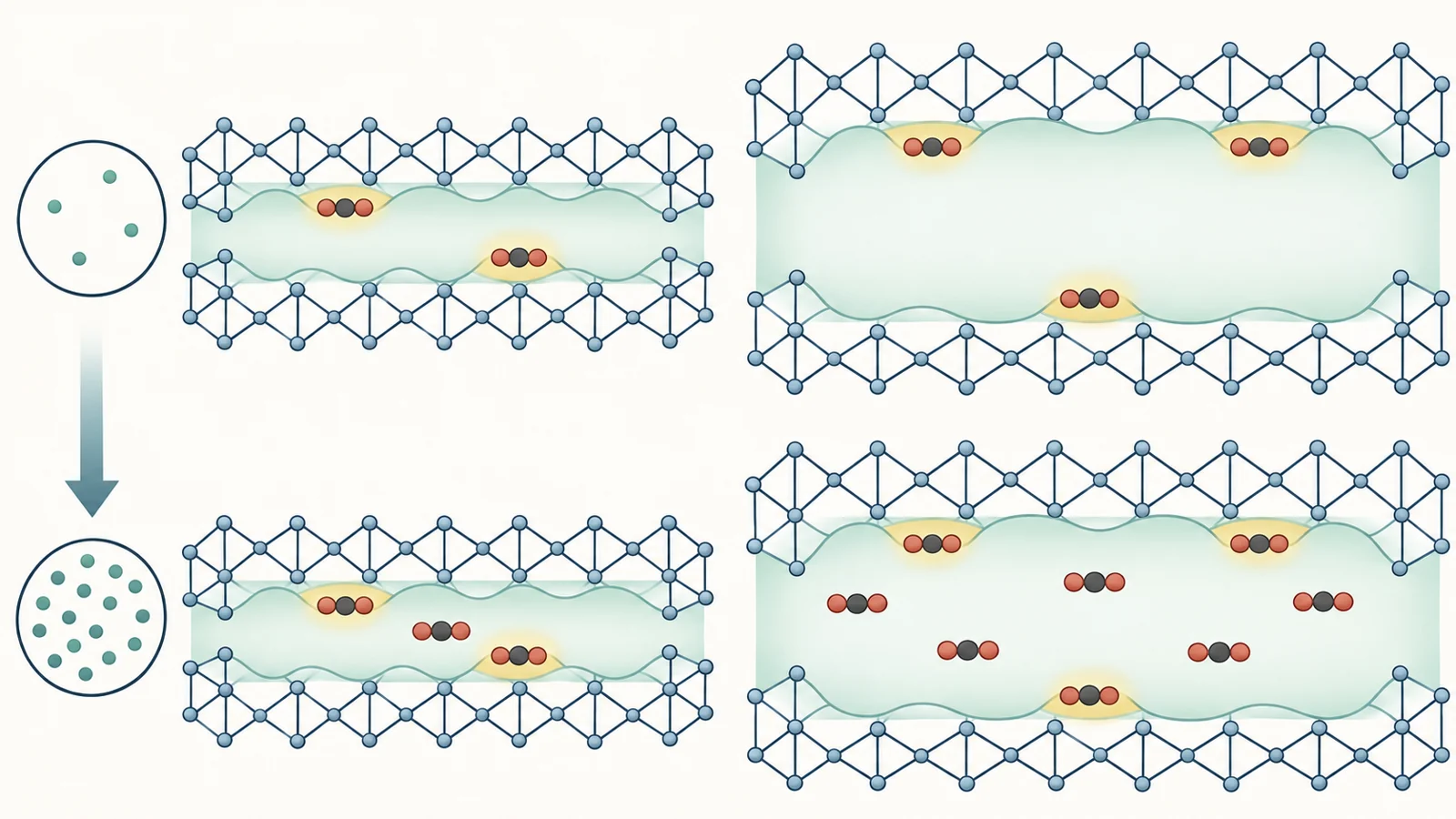
At low pressure, relatively few carbon dioxide molecules enter the pores, so the strongest available adsorption sites matter. In a narrow channel, molecules can sit close to several pore walls at once. Their interactions with those walls reinforce one another, making the channel a stronger place to bind gas. The researchers’ simulations show carbon dioxide concentrated around favored sites in both materials at 0.2 bar.
For Zn-(6BA)(TBAPy), the compact pores and stronger modeled interactions help explain its early lead. The simulations indicate that carbon dioxide initially occupies localized sites there. In Zn₂-(TBAPy), the adsorption pattern at low pressure is concentrated in a narrower channel within the structure. The maps are computer-generated distributions of molecule positions, not photographs of gas inside a crystal, but they help connect the measured uptake to likely adsorption locations.
As pressure increases, more molecules arrive. A material with additional accessible pore space can accommodate them even if its strongest binding sites are less powerful. In the simulations, carbon dioxide remains concentrated in Zn-(6BA)(TBAPy), while it spreads into more of Zn₂-(TBAPy)’s channels. The larger pore volume of Zn₂-(TBAPy) gives the gas more places to occupy, helping it overtake the tighter-pore material at 1 bar.
The reversal therefore reflects two different advantages: strong, closely spaced interactions that favor early uptake, and more available volume that supports greater loading as pressure rises. Which matters more depends on the pressure range a material is meant to handle.
The chemistry inside the channels matters too
Pore dimensions are only part of the story. Carbon dioxide also responds to the local chemistry of the pore walls. The study identifies several attractive sites, including exposed zinc centers, oxygen atoms in carboxylate groups, and regions of concentrated electrical charge in some frameworks.
One model of Zn₂-(TBAPy) illustrates how much the metal’s surroundings can matter. In a version with an exposed, unsaturated zinc site, a simulated carbon dioxide molecule binds near that metal with a calculated interaction energy of −47.2 kilojoules per mole. In a model where water molecules remain coordinated at the metal, the favored location is instead in the channel, with a weaker calculated interaction of −25.7 kilojoules per mole. These figures describe idealized structures in simulations; they do not establish that every activated sample contains the exposed-zinc arrangement.
A different framework, Zn-(Ade)(TBAPy), shows how charge and oxygen sites can work together. Its negatively charged framework has free carboxylate oxygens in a pore. Simulations place carbon dioxide near one of these oxygens, where electrical interactions contribute to a calculated binding energy of −33.4 kilojoules per mole. Experimentally, this material had the highest reported carbon dioxide uptake among the three studied frameworks, at 1.75 millimoles per gram at 1 bar.
Together, the examples show why a useful adsorbent cannot be selected by pore size alone. The identity and arrangement of atoms lining a pore can create stronger or weaker places for carbon dioxide to bind.
Activation can change the crystal being measured
Before gas adsorption is measured, solvent is removed from the samples by heating under vacuum. That activation can alter the framework itself. For Zn₂-(TBAPy), diffraction patterns changed after activation, consistent with a structural transformation from a layered arrangement toward a distorted three-dimensional framework. The researchers compared possible structural models against experimental diffraction and pore-volume measurements to identify which models best resembled the activated material.
The distinctions matter because the idealized models predict different adsorption behavior. In Zn₂-(TBAPy), the distorted model—with narrower channels and no exposed metal site—matched the experimental adsorption results more closely than models with wider channels or open zinc sites. The evidence therefore supports using the distorted structure to interpret the measured sample, while the stronger binding calculated for an exposed zinc site remains a result for a different modeled arrangement.
The comparisons also leave room for structural variation within a sample. For example, the measured pore volume for Zn₂-(TBAPy) was close to the value calculated for the distorted structure, but not identical. The authors discuss possible coexistence of structural forms after activation. This is a reminder that a crystal’s behavior depends on the structure it actually adopts, not only on the framework proposed in a drawing or simulation.
Nitrogen access raises a separation question
The materials adsorbed much less nitrogen than carbon dioxide in the reported separate-gas measurements. At 1 bar, measured nitrogen uptake was below 0.15 millimoles per gram for Zn-(Ade)(TBAPy) and Zn-(6BA)(TBAPy); Zn₂-(TBAPy) took up about 0.16. This difference makes the frameworks interesting to investigate for carbon dioxide–nitrogen separation.
Zn-(6BA)(TBAPy) offers a particularly striking structural clue. Its measured nitrogen uptake was nearly negligible. A model that includes counterions predicts a very narrow passage, with a pore-limiting diameter below the size of a nitrogen molecule. In plain terms, some channels may be too restricted for nitrogen to pass through readily. The prediction helps explain the low uptake, though calculated accessibility depends on the model and can differ from access in a real, flexible structure.
Separate-gas uptake is not the same as separating a flowing mixture. In a mixture, the gases compete for sites and move through the material together. The study’s measurements do not show how these frameworks would perform under those conditions, especially when water vapor is present. The authors identify stability in humid conditions as an important question for any practical carbon dioxide–nitrogen application. Durability and process economics also remain beyond what these adsorption comparisons establish.
Where this research could lead
A future separation unit handling moist exhaust could use a porous crystal chosen for the pressure range it actually encounters. If a candidate can retain carbon dioxide preferentially while nitrogen passes through, the gas mixture could be separated with less guesswork about which pore structure and binding sites will work under those conditions. Existing adsorbents already separate gases; the possible advance here is more dependable selection and design based on verified structure and pressure-dependent behavior.
The uptake reversal is measured; structural comparisons and simulations offer an explanation for it. A nearer milestone would be reproducible carbon dioxide–nitrogen separation by a candidate framework in a humid mixed-gas test at a stated operating pressure, such as 1 bar. Until such tests show both separation and stability, the study points toward a design strategy rather than an established capture process.
Key Sources
- Primary source: Adsorption in Pyrene-Based Metal-Organic Frameworks: The Role of Pore Structure and Topology.
DOI or Journal Page · Peer-Reviewed Paper · 2024-07-08
Keep exploring