
Research Signal – Source date 2024-04-11
Heating a porous crystal more might seem like a way to make it more stable. But in a study of ZIF-78, the form prepared at the middle of three activation temperatures had the highest reported carbon dioxide capture capacity and methane purification productivity. The hottest-treated form did not lead on either measure.
The result points to a useful design question: how can a porous material hold its shape well enough to separate gases while keeping enough accessible space to take them up? The researchers isolated three distinct forms of ZIF-78. Their results suggest that the middle treatment struck the most productive balance under the reported laboratory conditions.
Three activation temperatures produced distinct forms
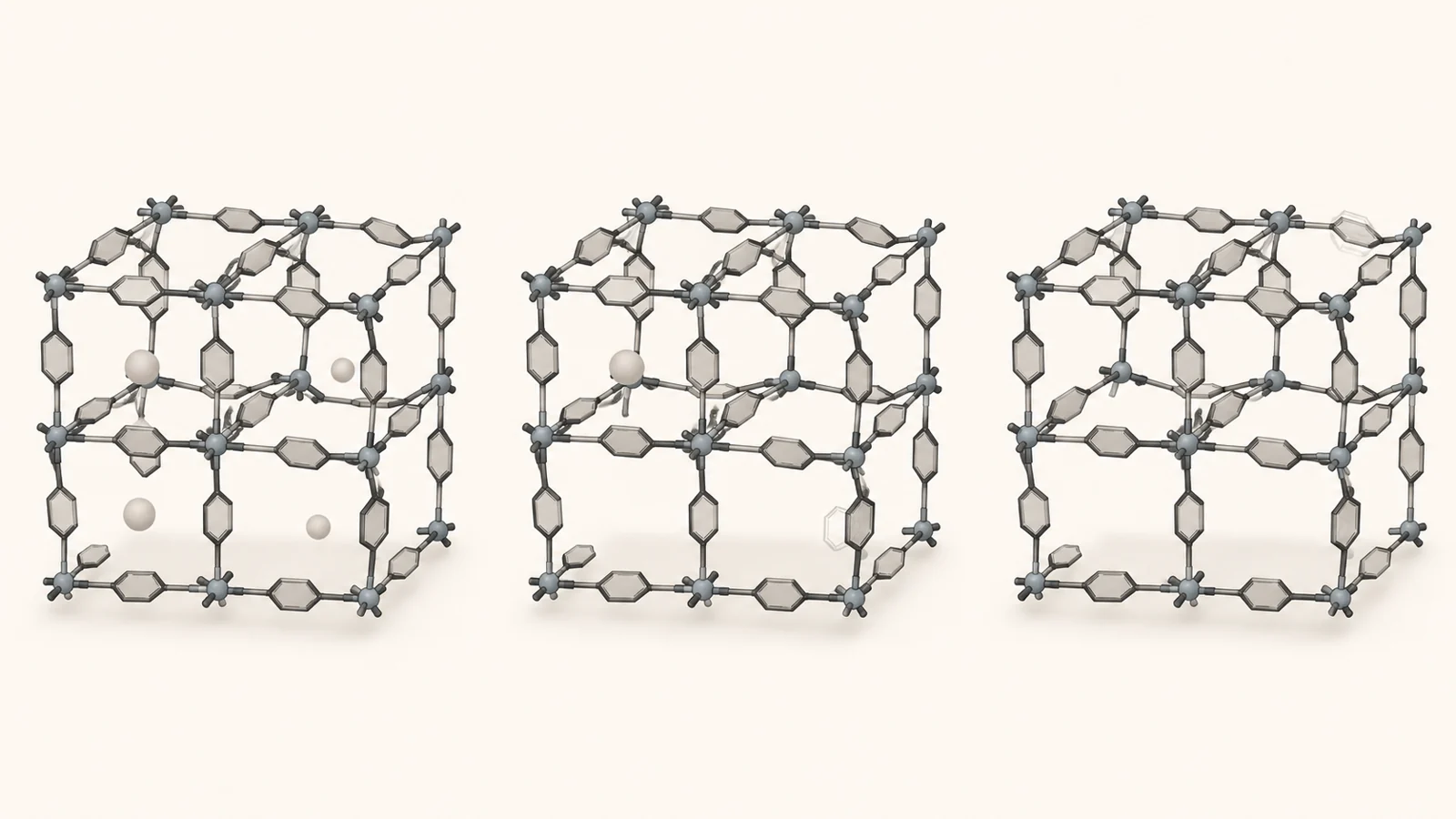
Activation is a preparation step that exposes a material to heat. The researchers used it to isolate three functionality-locked phases of ZIF-78: ZIF-78-lt after activation at 50 °C, ZIF-78-ht1 at 160 °C, and ZIF-78-ht2 at 210 °C. These temperatures describe how the forms were prepared; they are separate from the conditions used to measure gas performance.
ZIFs, or zeolitic imidazolate frameworks, are porous crystals built from metal-connected organic linkers. Those linkers can move, giving a framework flexibility. In gas separation, their motion can affect how much gas the material takes up as pressure changes. Locking the linkers can restrain that movement, but the material still needs usable pore space to capture carbon dioxide.
Gas adsorption measurements and powder X-ray diffraction indicated different levels of locking across the three forms. In other words, the treatments produced measurable structural differences alongside differences in gas uptake. ZIF-78-ht1 had the strongest reported combination of the two performance measures in this comparison.
The linkers became more strongly held
The proposed explanation lies in how neighboring linkers interact. Single-crystal X-ray diffraction mapped the framework, and density functional theory calculations modeled interactions between its parts. Together, they supported a sequence in which π–π attractions between linkers gave way to C–H···O hydrogen bonds as locking increased. The calculated binding energies became more negative, from −0.64 to −2.77 and then −5.72 kilocalories per mole, indicating stronger interactions in the later locked states.
This gives the temperature sequence a molecular interpretation: heating did not simply tighten one uniform structure. It was associated with distinct locked phases and changing interactions between parts of the framework. The middle phase, ZIF-78-ht1, retained the highest measured performance in the study’s comparison, even though the hotter treatment produced a more strongly bound state in the proposed sequence.
Two measurements describe different outcomes
At 298 K (about 25 °C) and 30 bar (about 30 times atmospheric pressure), ZIF-78-ht1 reached a reported carbon dioxide capture capacity of up to 18.6 millimoles per gram. Capacity describes how much carbon dioxide the material takes up per unit of its mass under those conditions. Its reported methane purification productivity reached up to 7.6 millimoles per gram, a measure of methane purified per unit mass in the reported process.
These figures describe different outcomes, and neither should be read as a plant output. They are maxima measured for a particular material form at stated laboratory temperature and pressure. The comparison shows why tuning the framework’s structure matters: the best reported form was not simply the one prepared at the highest temperature.
Pressure-swing adsorption separates gases by changing pressure so an adsorbent can take up and release components. For methane purification, the practical question is whether a material can keep removing carbon dioxide while producing a useful methane-rich stream. The supplied evidence establishes the reported laboratory maxima, but does not establish sustained performance over repeated pressure swings or with a realistic mixed and impure gas stream. Those are important tests for judging transfer to operating conditions; their outcomes remain open here.
What this could make possible
At a biogas upgrading plant, a dependable adsorbent could repeatedly take up carbon dioxide while allowing a methane-rich stream to be collected. Pressure-swing adsorption is the separation approach considered in this study; the possible contribution from this work is a more precisely tuned porous material. The link from the study to that future use runs through its distinct locked phases and the strong measured result for the middle-treated ZIF-78-ht1. Whether that advantage carries over to a realistic operating stream remains to be shown, and the evidence here does not establish that it would outperform existing separation materials.
A nearer milestone is sustained carbon dioxide removal and methane purification productivity from ZIF-78-ht1 in repeated pressure-swing tests using a realistic carbon dioxide–methane mixture. If those tests preserve useful performance, this material’s carefully adjusted linker interactions could become relevant to practical gas purification. For now, the study offers a laboratory result and a molecular route for tuning porous frameworks, not a promise of commercial readiness.
Key Sources
- Primary source: Popping and Locking: Balanced Rigidity and Porosity of Zeolitic Imidazolate Frameworks for High-Productivity Methane Purification.
DOI or Journal Page · Peer-Reviewed Paper · 2024-04-11
Keep exploring