
Research Signal – Source date 2024-02-24
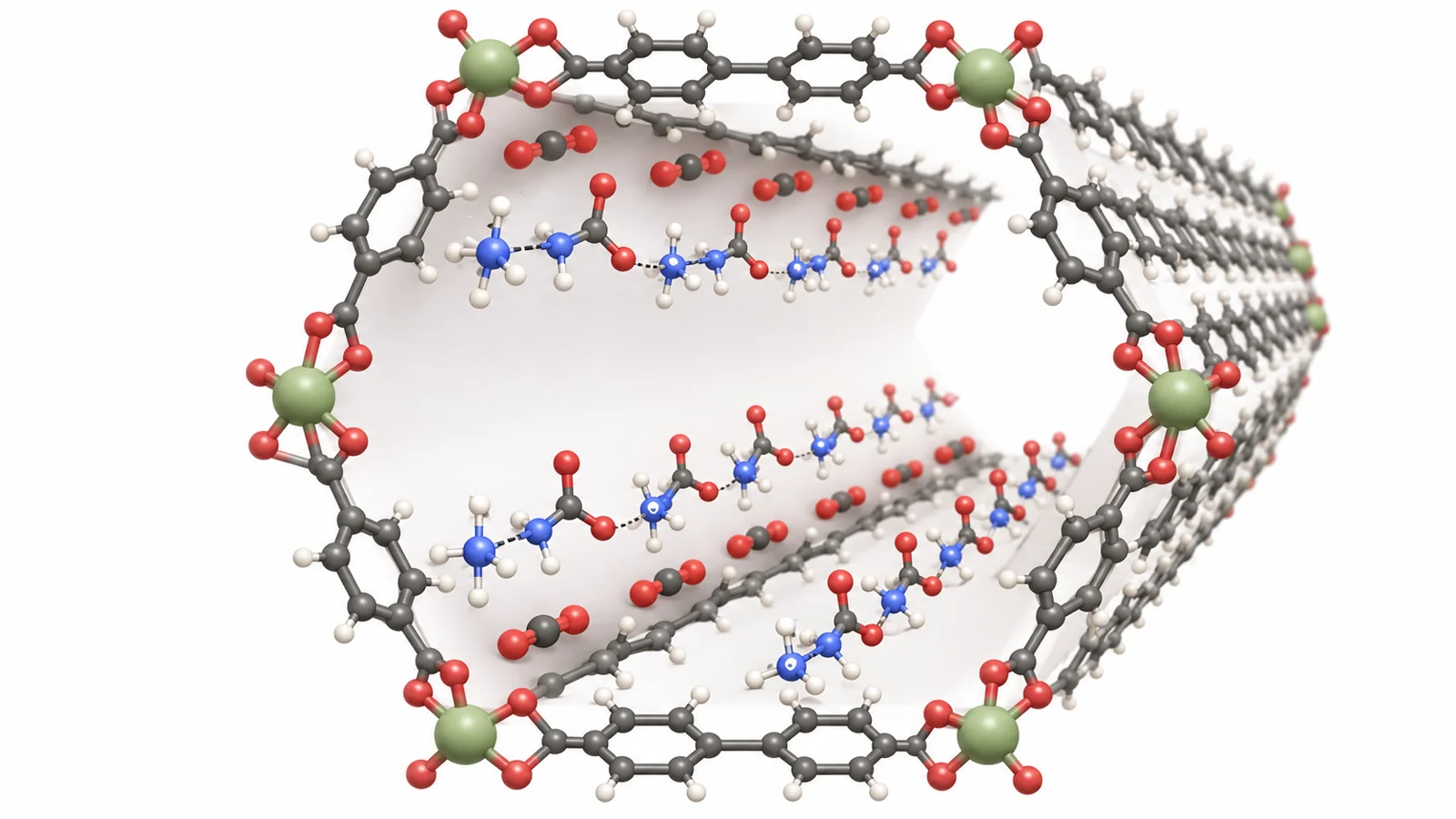
A carbon-capture material built around chemical binding sites would usually be expected to hold about one carbon dioxide molecule per site. In a study published in 2024, a porous solid exceeded that apparent ceiling: it took up about 1.4 CO2 molecules per attached diamine, with the added gas held partly in nearby pore space.
The material, called pip2–Mg2(dobpdc), showed two distinct rises in CO2 uptake. The first added close to 0.5 molecule per diamine; the second added nearly twice as much, bringing the total to about 1.4. Under some reported conditions, its capacity approached 1.5 molecules per diamine. Those figures count CO2 against each attached diamine molecule, rather than per gram of material.
The result matters because it suggests the pore can contribute storage beyond the chemical sites themselves. Measurements under a dry, simulated gas stream also tested whether the material could capture CO2 as gas flowed through it and whether it retained capacity across repeated cycles. Those are useful early tests, though they do not reproduce the full mixture found in landfill gas.
Two uptake steps, with different amounts
The solid belongs to a family of porous materials made from magnesium and organic linkers, with diamine molecules attached inside their channels. A diamine is a molecule with two nitrogen-containing ends. Here, the attached molecule is 1-(2-aminoethyl)piperidine, shortened to pip2.
In many related materials, CO2 reacts at the attached amine sites. This chemical binding, or chemisorption, changes the molecules and forms linked structures called ammonium carbamate chains. Because each diamine typically accommodates one CO2 molecule through this mechanism, chemical binding alone has generally set the capacity near one CO2 per diamine.
Pip2–Mg2(dobpdc) behaved differently in measurements of uptake as pressure and temperature changed. At one bar of CO2, its adsorption curve had two steps, around 55°C and 40°C. The first step corresponded to about half a CO2 molecule per diamine. The second added close to one more molecule per diamine, producing an overall capacity of about 1.4 at 30°C, or 5.1 millimoles per gram.
The two steps also appeared in measurements at fixed temperature while CO2 pressure changed. The uptake curves established the unusually large second step; spectroscopy was needed to identify how the additional CO2 was held inside the pores.
Chemical binding happens alongside physical adsorption
Physical adsorption, or physisorption, holds a molecule in a pore through interactions with nearby surfaces rather than by forming the same kind of chemical bond. In pip2–Mg2(dobpdc), the evidence indicates that this weaker form of holding joins chemical binding during the second uptake step.
The researchers tracked CO2 uptake using two spectroscopic methods. Infrared measurements showed signals associated with carbamate formation after the material was exposed to CO2. At a lower pressure, the spectra did not show the expected signal for physically adsorbed CO2. At a higher pressure, signals from both carbamate and physisorbed CO2 appeared. They grew together over time, indicating that the two processes were occurring concurrently.
Solid-state nuclear magnetic resonance (NMR), which detects how carbon atoms experience their chemical surroundings, supported that interpretation. After dosing at 100 millibars, the material showed a signal assigned to carbamate. At 200 millibars, a second signal assigned to physically adsorbed CO2 appeared while the carbamate signal remained. At one bar, the measured ratio of chemically bound to physically adsorbed CO2 was about 1 to 0.43. If the material was saturated under those conditions, that ratio was consistent with a total near 1.4 CO2 per diamine.
The measurements therefore point to a sequence: an initial portion of CO2 forms carbamate chains, then additional chemical binding and physical adsorption proceed together. The second step is not just a second round of the same reaction; part of its extra capacity comes from molecules held in the surrounding pore.
The extra molecules sit between chains
Where could that additional CO2 fit? The proposed location is a pocket between neighboring ammonium carbamate chains and the framework’s organic linker, the structural component that connects magnesium-containing parts of the solid.
The researchers used powder X-ray diffraction to study the CO2-dosed material’s structure. They compared candidate arrangements with calculations that included van der Waals interactions, which help describe how nearby molecules attract one another. Of the tested arrangements, a model placing the additional CO2 in the pocket between carbamate chains and the linker best matched the diffraction data. The calculations also found that this arrangement was more stable than two alternatives.
This is a refined structural model supported by diffraction and computation, rather than a photograph of molecules in place. In the model, extra CO2 runs along the framework channels between adjacent chains. Its estimated proximity to oxygen atoms in the carbamates is consistent with stabilizing interactions. Refinement placed the additional CO2 at about 59% occupancy at that position, corresponding to roughly 0.3 extra CO2 molecule per carbamate. That estimate fits the uptake measurements.
Flow and cycling tests used dry gas
A gas-flow breakthrough experiment tested capture in binder-free pellets. The researchers passed dry gas containing 60% CO2 and 40% nitrogen through a column at 25°C and ambient pressure. They used nitrogen instead of methane for safety, so this was a simulated stream, not a test using actual landfill gas. The outlet showed a sharp CO2 breakthrough after 15 minutes, and the measured capacity was 5.1 millimoles per gram. The high capacity remained through four consecutive capture and release cycles; a post-test analysis found that the material retained about 100% of its diamine loading.
A separate thermogravimetric experiment tested repeated cycling. The material was exposed to dry 60% CO2 in nitrogen at about one bar and 30°C for 15 minutes, then heated to 80°C for one minute while dry CO2 flowed over it. Across 500 adsorption and desorption cycles, capacity remained around 3.83 millimoles per gram. The figure was lower than in the breakthrough test, in part because the cycling test adsorbed at a slightly higher temperature. Afterward, the material remained highly crystalline and retained about 100% of its diamine loading.
Landfill gas commonly includes substantial methane as well as CO2, and may contain moisture and other impurities. The experiments used dry CO2 and nitrogen, so they establish capture under those controlled conditions, not separation performance in a methane-containing landfill-gas stream or a full-scale facility. The results make a case for further testing in more representative mixtures.
Regeneration has an estimated energy cost
Capturing CO2 is only part of a separation process. The material also has to release the gas so it can be collected and the solid used again. In these experiments, warming the material supported release during the cycling tests.
The paper estimated a regeneration energy of about 1.58 megajoules per kilogram of CO2 for a temperature-swing process operating between 25°C during adsorption and 80°C during desorption. The calculation used the material’s measured reversible heat capacity. The authors compared this estimate with about 4.5 megajoules per kilogram for a monoethanolamine solution used in landfill CO2 capture.
That comparison is a calculation under stated operating assumptions, not a measurement of energy use at a plant. Actual energy demand, cost and emissions would depend on how a process is built and operated; the estimate alone does not establish commercial readiness or a climate benefit.
What this could change
At a landfill-gas upgrading facility, a reusable solid bed that removes CO2 before methane-rich gas moves on could offer another route for preparing that gas. Gas upgrading already exists; what might change is the availability of a solid that combines high capacity with repeated use. Pip2–Mg2(dobpdc) links those possibilities to measured uptake above one CO2 per diamine, a dry-stream breakthrough test, and stable capacity over 500 dry-gas cycles. Whether that performance carries over depends on progress with methane-containing gas, moisture, impurities and process integration.
A useful next milestone would be a repeated breakthrough and regeneration test using a representative, moist landfill-gas mixture that contains methane. Reporting both CO2 capacity and separation behavior over time would show how the material performs under conditions closer to the stream it might eventually treat.
Key Sources
- Primary source: High-Capacity, Cooperative CO 2 Capture in a Diamine-Appended Metal-Organic Framework through a Combined Chemisorptive and Physisorptive Mechanism.
DOI or Journal Page · Peer-Reviewed Paper · 2024-02-24
Keep exploring