
Research Signal – Source date 2023-12-29
A strong first impression is only part of the story
Mg-MOF-74 looked like a leading candidate for capturing carbon dioxide when researchers compared adsorbents using simpler technical measures. In a more detailed model of a capture process, however, it did not keep that lead. The difference matters because a solid that holds carbon dioxide well in a material-level comparison may not perform as well once the full sequence of capture, release, equipment operation and cost is considered.
This comparison comes from a 2023 Accounts of Chemical Research Account on linking molecular and process modeling. The authors describe work on porous solids such as metal-organic frameworks (MOFs), zeolites and carbon- or silica-based materials. Their central point is that selecting a material for large-scale capture requires evidence at more than one level: how molecules interact with its pores, how the solid behaves through a repeated operating cycle, and how that cycle fits into a modeled plant.
The result for Mg-MOF-74 is a modeled comparison, not a report of a commercial capture installation changing its choice. It shows why an early ranking can help narrow candidates while still leaving questions that a process-level assessment must answer.
Capture means holding carbon dioxide, then letting it go
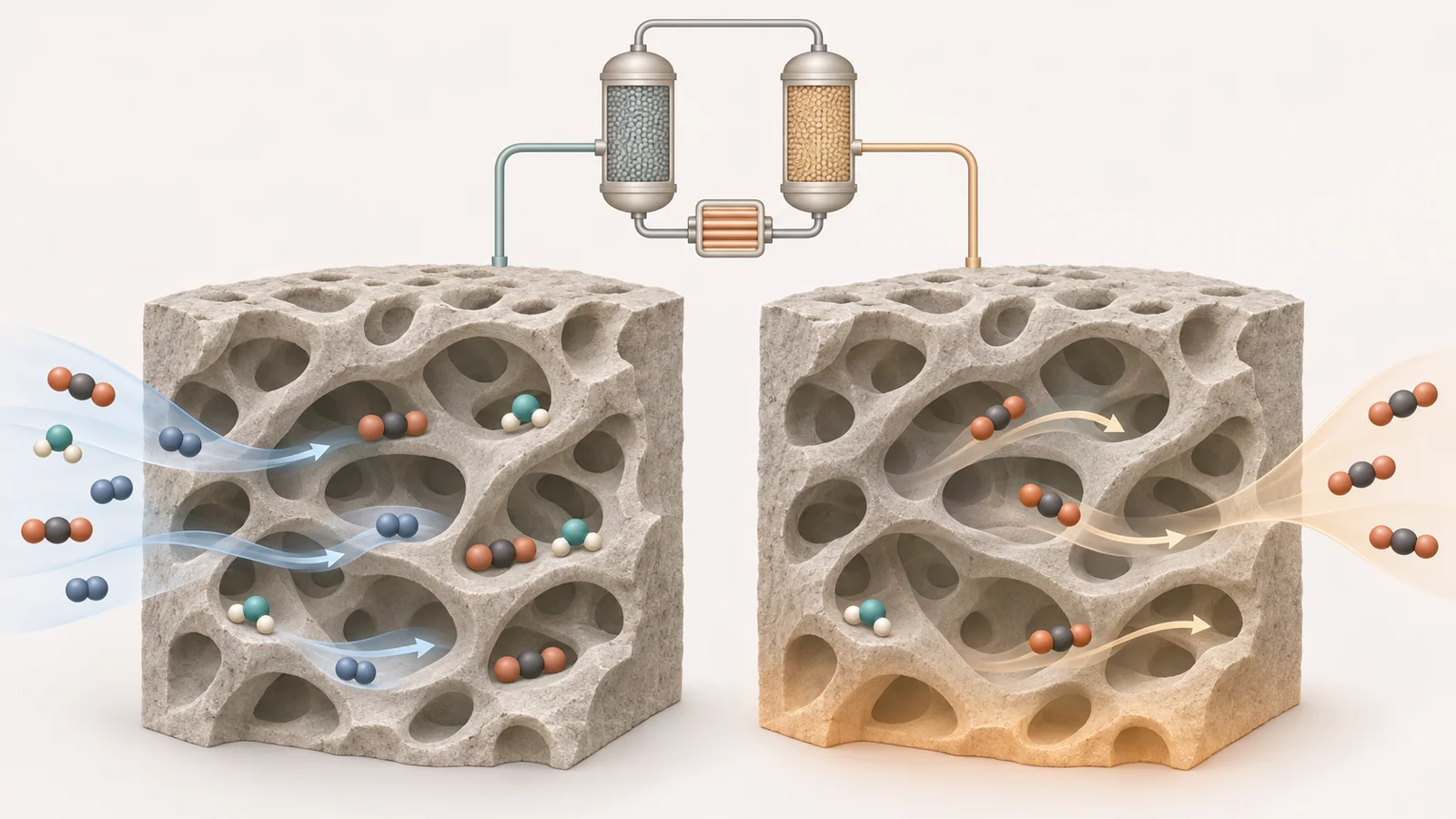
An adsorbent is a porous solid that holds carbon dioxide from a gas mixture on its internal surfaces. In a swing-adsorption process, the gas passes through the material during the capture step. The solid is then regenerated, or cleared so it can be used again. Depending on the process, regeneration can involve changing temperature, pressure or both.
Three measures help describe this cycle. Working capacity is the amount of carbon dioxide the solid takes up during capture and then releases during regeneration. Selectivity describes how strongly it favors carbon dioxide over other gases in the mixture. Regeneration energy is the energy needed to release the captured carbon dioxide and prepare the solid for another cycle. A material may score well on one measure and less well on another: stronger attraction can help capture at low carbon dioxide concentrations, for example, while making release more demanding.
A shortcut comparison can estimate these technical indicators for specified capture and release conditions. In the Account’s example, the researchers modeled a mixture of carbon dioxide and nitrogen at set temperatures and pressures for each step. This produced a useful initial ranking but assumed uniform conditions within the bed. It did not account for temperature or concentration gradients that can develop as gas moves through a process bed.
Exhaust impurities change the competition
Many material comparisons rely on measurements with pure carbon dioxide or a mixture of carbon dioxide and nitrogen. Actual exhaust streams can also contain water and other gases. Those molecules can compete for adsorption sites and change how much carbon dioxide a solid captures or how much energy is needed to regenerate it.
In one comparison discussed in the Account, water sharply reduced the carbon dioxide capacity of zeolite 13X. The effects were not identical across materials or impurities. For Mg-MOF-74, simulations indicated that small traces of some unwanted gases could, in certain cases, lower the energy required per ton captured while increasing the recovery and purity of the carbon dioxide stream. As competing molecules became more influential, though, they could displace carbon dioxide from preferred sites and drive the energy requirement sharply upward.
These results make clean-gas tests useful but incomplete. They can help describe a material’s behavior under controlled conditions; they cannot alone show how it will perform with the mixture and operating cycle used in a capture process. Molecular simulations can help fill gaps by predicting adsorption properties for mixtures that have not been measured as extensively, provided the underlying interaction models are checked against experimental data.
From molecular interactions to a plant model
The modeling chain begins with interactions between gas molecules and the adsorbent. Grand canonical Monte Carlo simulations can estimate how much gas enters a material’s pores at different conditions, as well as related properties such as heats of adsorption. Molecular dynamics can also estimate how molecules move through those pores. These calculated properties can then be used to compare materials or supply inputs to a more detailed process model.
Checking the interaction models against measurements is an important part of that chain. The Account describes comparisons with available experimental adsorption data before using simulations to extend the estimates to other conditions and mixtures. In one cited set of examples, the highest reported average absolute deviation was 5.8% for CuBTC. Agreement with those measurements supports using the simulations to inform further calculations; it does not turn every prediction into an experimental result.
The process model also had a separate, limited check. The authors describe validating it against pilot-scale experimental data, including the transient exit-pressure profile over 100 cycles. That test checked whether the model could reproduce a pressure pattern measured in a pilot process. It was not a long-term durability test of every material in the comparison, or a demonstration of performance under all realistic impurity conditions.
Why the detailed comparison changed the ranking
The researchers took leading candidates from simpler screening into a dynamic pressure- and vacuum-swing adsorption model and assessed a capture unit attached to a modeled 550-megawatt coal plant. The process calculation included operating conditions, equipment design and scheduling, then estimated recovery (the share of incoming carbon dioxide captured), purity (the share of carbon dioxide in the collected stream) and capture cost. Those added factors help explain why the material ranking shifted: a plant’s performance depends on how the cycle unfolds over time, how large and numerous its equipment must be, and the cost of the adsorbent, among other assumptions.
Zeolite 13X was estimated to meet a 90% recovery and 95% purity target at about $45.90 per ton of carbon dioxide captured. UTSA-16 was estimated to reach 90% recovery and 92% purity at about $60 per ton. Mg-MOF-74, despite its strong position in the simpler technical screening, did not meet the 90% recovery and 95% purity target in this dynamic comparison. It remained a candidate for a less demanding 90% recovery and 90% purity case, at an estimated cost of about $70 per ton.
Those cost estimates depended in part on assumed material prices. The comparison used $10 per kilogram for the MOFs, against $0.50 per kilogram for commercial zeolite 13X and $0.30 per kilogram for activated carbon. For UTSA-16, the authors estimated that assuming a price of $1.25 per kilogram could bring capture cost below $45 per ton. These are scenario results, not observed prices or costs from an operating commercial plant. The sensitivity to price illustrates why an attractive molecular profile cannot settle the practical comparison by itself.
Stronger binding can bring a tradeoff
The same molecular understanding can help researchers modify adsorbents. Adding amine groups to a support material can increase its affinity for carbon dioxide and may improve capacity or selectivity. The added groups can also occupy pore space, leaving less room for adsorption, while stronger binding can make regeneration more energy-intensive. The net effect depends on the material being modified.
The Account describes functionalized MOFs in which higher working capacity and selectivity came with higher regeneration energy. It also reports a contrasting example: chemical functionalization greatly improved the performance of mesoporous MCM-41 silica in the comparison discussed. The point is not that one modification produces the same outcome everywhere. It is that molecular simulations, paired with experimental checks, can help identify where a modification’s gains and costs may balance before more detailed process assessment.
Where this research could lead
A dependable solid-adsorbent option, assessed across its full operating cycle, could give plant operators another informed choice alongside established aqueous-amine systems for separating carbon dioxide from exhaust. The Account’s contribution is a way to connect molecular behavior with process-level selection, so promising materials can be judged against conditions and costs that matter beyond a single adsorption measurement. Reaching that future would still depend on affordable materials, availability, stability and further engineering.
A nearer milestone would be measured capture and regeneration performance over repeated cycles with humid, impurity-containing gas that agrees with process predictions. The Account’s pilot-scale pressure-profile check and its modeled 550-megawatt plant comparison address different parts of the evidence chain; neither supplies that combined demonstration. Such agreement would make it clearer whether the molecular-to-process approach can guide a reliable choice under the conditions a plant would face.
Key Sources
- Primary source: Importance of Bridging Molecular and Process Modeling to Design Optimal Adsorbents for Large-Scale CO<sub>2</sub> Capture.
DOI or Journal Page · Peer-Reviewed Paper · 2023-12-29
Keep exploring