
Research Signal – Source date 2023-10-05
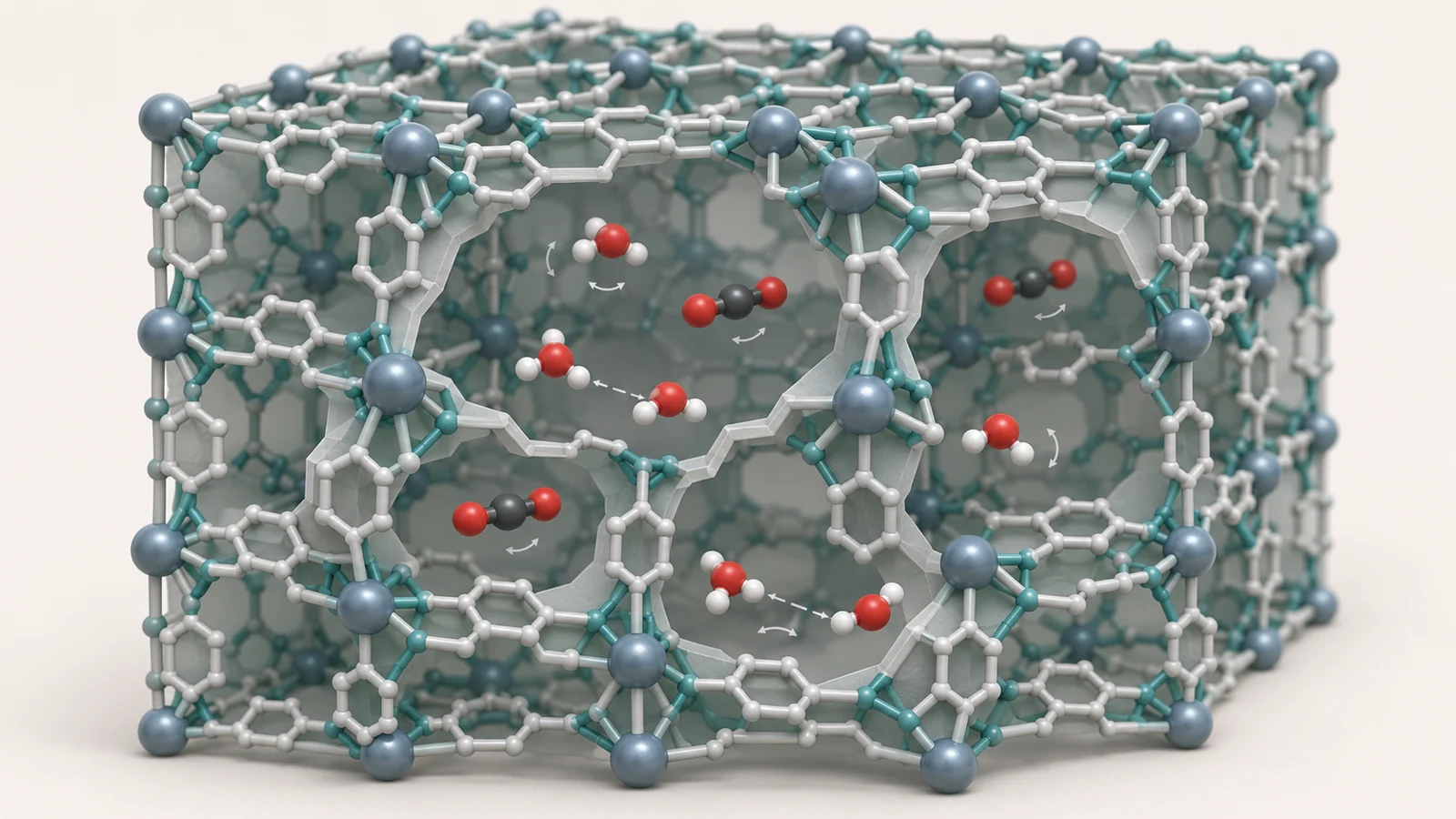
Water can make carbon dioxide more likely to settle into the pores of CALF-20, yet the two gases move more slowly when they are there together. That combination, reported in a 2023 computer simulation study, helps explain why moisture’s role in a carbon-capture material may be more complicated than simply blocking space.
The study examined water (H₂O) and carbon dioxide (CO₂) in CALF-20, a porous metal-organic framework, across different levels of relative humidity. Its simulations suggest that the two molecules compete for similar places in the material. Water also changes how carbon dioxide interacts with the pore environment. The result is a useful distinction: a molecule’s increased tendency to be adsorbed is not the same as how quickly it can move through a pore.
Two guests, shared space
A metal-organic framework is a material with a network of pores. Molecules entering those pores can interact with the framework and occupy spaces within it. In the CALF-20 simulations, water and carbon dioxide had similar interactions with the material, so they competed for the same binding sites and occupied similar void regions.
The overlap also matters for movement. The simulations find that each guest diffuses more slowly when the other is present, which the study attributes to competition for the same void spaces. Diffusion here means movement through the pores.
Water changes carbon dioxide’s local environment
The simulations describe an asymmetry in how the two guests respond to one another. With carbon dioxide present, water forms more connected hydrogen-bond networks within smaller regions. Hydrogen bonds are attractions between water molecules. In these tighter, more connected arrangements, water molecules turn into new orientations more slowly. This turning is called reorientation.
Water has a different effect on carbon dioxide. It speeds up carbon dioxide’s reorientation and strengthens interactions mediated by water—that is, interactions in which water helps connect carbon dioxide with its surroundings. The study associates those stronger water-mediated interactions with a greater propensity for carbon dioxide to be adsorbed in CALF-20.
Adsorption means molecules attach to or remain at sites in a material. A greater propensity for adsorption describes a stronger tendency to occupy those sites. It does not tell us how fast molecules arrive there or pass through the pores. In the same simulations, carbon dioxide diffusion slowed when water was present. So the adsorption result alone cannot tell us whether humid conditions would improve the amount captured, the speed of capture, or overall performance in an operating system.
The study also reports changes in entropy for both guests. Entropy is a measure of the arrangements available to molecules. The more connected, confined water networks were associated with lower water entropy, while water’s effect on carbon dioxide was associated with lower carbon dioxide entropy. These molecular-level results help describe how the guests behave together; they are not measurements of capture capacity or throughput.
What the simulations can tell us
The paper, published on October 5, 2023, reports computer simulations of water and carbon dioxide in CALF-20 as relative humidity varies. The supplied evidence supports a molecular account of shared sites, changing interactions and slower movement when both species are present. It does not provide measured capture performance under operating conditions or numerical effects that would show how large these changes are in practice.
That makes the finding informative as a mechanism, not a verdict on how a capture unit would perform. A material could attract carbon dioxide more strongly while also making its movement through the pores slower. Understanding both processes together is important for interpreting what a humidity effect might mean beyond the simulated molecular behavior.
What this could change
If later measurements show that a material takes up carbon dioxide and still lets molecules move through its pores in humid gas, it could be used to capture carbon dioxide from moist streams. The CALF-20 simulations offer a reason to test both properties together; they do not show that CALF-20 can deliver that performance.
A nearer milestone would be humidity-dependent measurements in CALF-20 that test adsorption and transport together against the simulation predictions. Such measurements could show whether the predicted combination of stronger adsorption propensity and slower diffusion appears in the material beyond the simulations.
Key Sources
- Primary source: Elucidating the Competitive Adsorption of H<sub>2</sub>O and CO<sub>2</sub> in CALF-20: New Insights for Enhanced Carbon Capture Metal-Organic Frameworks.
DOI or Journal Page · Peer-Reviewed Paper · 2023-10-05
Keep exploring