
Research Signal – Source date 2023-07-26
The silica particles in this study had less measured surface area after tiny clay tubes were added. Yet after both materials were treated with an amine that binds carbon dioxide, the tube-containing powder captured more CO₂ per gram at the best tested loading. The comparison is counterintuitive only if surface area is treated as the whole story: where reactive sites sit, and whether gas molecules can reach them, also matters.
The result comes from a laboratory materials study published on July 26, 2023. The researchers made composite particles from mesoporous silica known as MCM-41 and halloysite nanotubes, then attached amine groups to the silica. In a dry, pure-CO₂ test, the best-performing composite adsorbed 1.81 millimoles of CO₂ per gram, compared with 1.53 millimoles per gram for amine-modified MCM-41 alone—about a 20% increase.
Those uptake measurements concern the amine-treated adsorbents. The surface-area comparison concerns the untreated supports before amine attachment. Keeping those preparation stages separate helps explain what the experiment shows: the tubes reduced one measured property of the bare support while the finished composite captured more gas under the study’s test conditions.
Why the researchers attached amines to pore walls
Solid materials that capture CO₂ can hold amines in more than one way. One approach places water-soluble amine polymers inside a porous support. It can provide many capture sites, but the paper notes a drawback: in wet conditions, the polymer can leach out. Another approach chemically grafts amine groups onto the support’s pore walls. The bond is intended to make the amine less prone to washing away, though that durability advantage was not tested under humid conditions for this particular composite.
The researchers used 3-aminopropyltriethoxysilane, or APTES, as the source of the grafted amine groups. MCM-41 offers a great deal of internal surface, but its pores are only about 2–4 nanometers wide. As amines attach near a pore entrance, they can make it harder for more APTES to reach the deeper walls. A material can therefore have abundant internal surface that is difficult to functionalize fully.
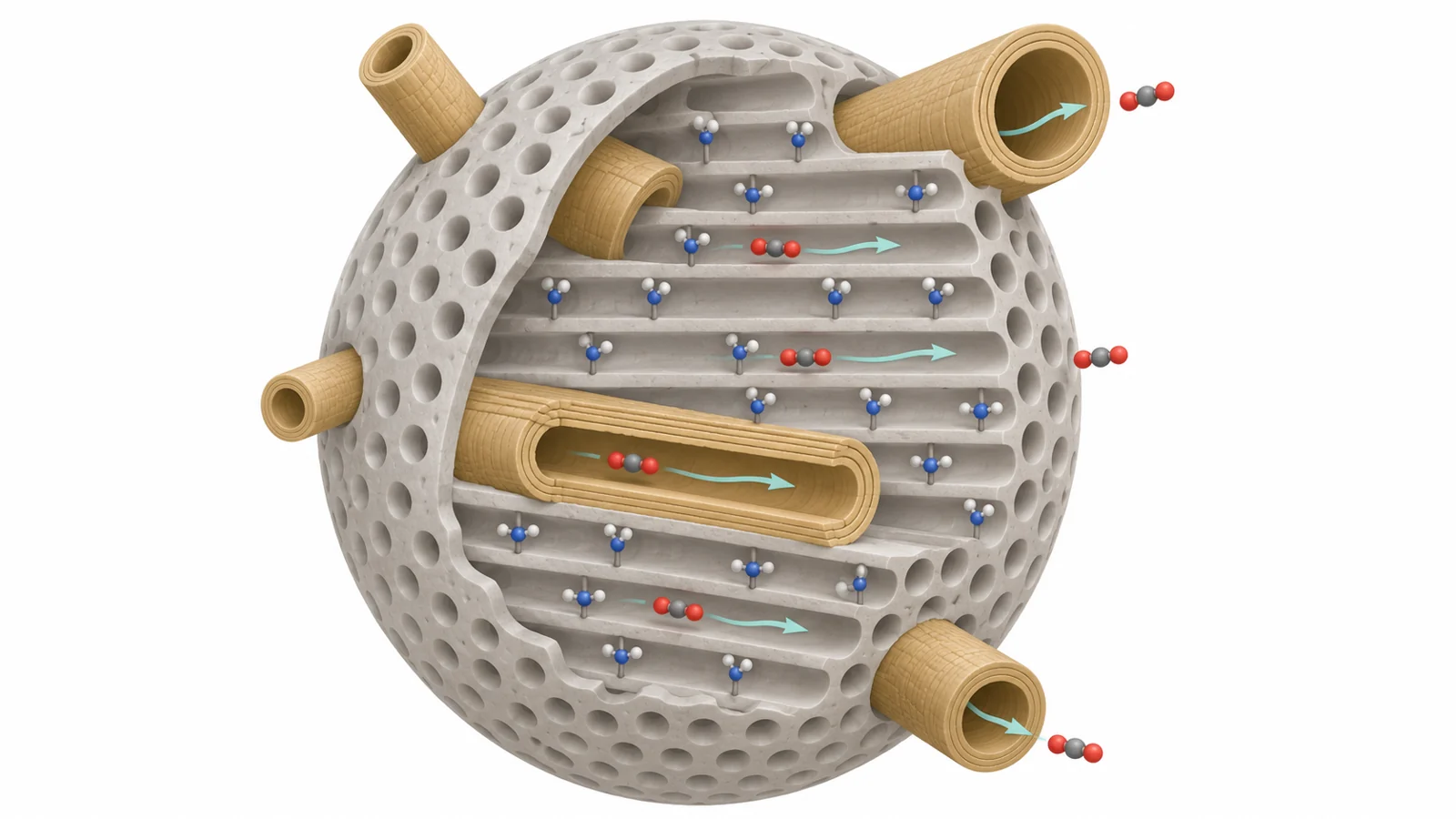
The design idea was to add wider passages that might improve access to the particle interior. Halloysite nanotubes are naturally occurring clay tubes with inner diameters around 15–30 nanometers—substantially wider than MCM-41’s pores. The authors proposed that these “nanostraws” could help APTES reach interior silica surfaces during preparation and later give CO₂ a route toward amine sites inside the particle. That transport explanation is a hypothesis tested indirectly through structure and uptake, not a filmed observation of molecules moving through individual tubes.
Building a particle with wider passages
To make the composite, the researchers incorporated halloysite nanotubes into the silica while forming MCM-41 particles with an aerosol-assisted process. The target composite, called M40H, contained 40% halloysite by weight on the paper’s stated basis. The tubes could be partly embedded in the silica and protrude from the particle surface, creating a particle with both narrow silica pores and larger tubular passages.
Keeping those tubes open during synthesis required an extra step. The researchers filled the halloysite interiors with polystyrene, a sacrificial polymer, before bringing the tubes into the silica-forming mixture. This helped prevent silica from forming inside the tube lumens. Heating the finished material removed the polystyrene along with the template used to form MCM-41, leaving the halloysite passages open.
Microscopy showed tube protrusions and a visible lumen in the composite. Structural measurements also indicated that the ordered mesoporous framework of MCM-41 remained after tube incorporation and amine functionalization. These checks support the claim that the researchers made a particle containing both structures. They do not, by themselves, establish the proposed route taken by APTES or CO₂ through the composite.
The bare MCM-41 had a measured surface area of 1,418 square meters per gram. The bare M40H composite measured 1,097 square meters per gram. The reduction is consistent with adding halloysite, which has much lower specific surface area than MCM-41. The tube-containing support therefore began with less measured surface area, even though the finished amine-treated composite captured more CO₂ in the later test.
More CO₂ at the best tested amine loading
For the capture measurements, the team used thermogravimetric analysis, which estimates gas uptake from a sample’s weight change. The amine-treated material was dried, brought to 35°C, and exposed to pure dry CO₂. The reported capacity reflects how much CO₂ the sample gained under that laboratory procedure. It is not a measurement of capture from humid, dilute industrial exhaust.
At an initial APTES loading of 0.5 grams, the modified MCM-41 captured 1.53 mmol CO₂ per gram of adsorbent. The matching M40H composite captured 1.81 mmol/g, about 20% more by the mass of the complete adsorbent. The researchers also reported a roughly doubled comparison after normalizing by the MCM-41 support area in the composite. That second figure uses a different denominator; it does not mean the whole composite captured twice as much CO₂ per gram.
The shape of the uptake curves adds context. At the selected loading, the two materials had similar initial uptake rates, but the composite continued adsorbing to a higher final level. That pattern fits an interpretation in which access to additional interior amine sites affects the total capacity more than the initial speed. It is consistent with the proposed role of the wider tubes, while remaining indirect evidence for that mechanism.
More amine eventually became a disadvantage
Adding more APTES did not keep improving the composite. Its uptake was highest at the tested 0.5-gram loading and began to decline at higher loadings. The tube-free, amine-modified MCM-41 also stopped gaining capacity beyond that loading: its uptake leveled off, which the authors associated with saturation and possible pore blockage.
For M40H, the downturn is a measured pattern; the suggested cause is an interpretation. The authors proposed that excess APTES could accumulate at the halloysite tube tips and on nearby surfaces. If those entrances became obstructed, additional amine might be harder to graft deeper inside, while CO₂ could have more difficulty reaching interior sites. Thermal measurements of the modified samples also showed the greatest estimated grafting at the 0.5-gram condition, with higher starting amounts not producing greater uptake of APTES.
This loading limit matters to the design claim. Wider passages may improve access, but they do not guarantee that every interior surface stays reachable as more reactive material is added. The best result came from a particular balance of support, tube content, and amine loading—not from maximizing the amount of amine precursor.
What the first tests leave open
The study reports that the composite retained its capture performance over five cycles. That offers an initial check that the measured advantage persisted through repeated use in the test, but it is a short observation. It does not establish long-term cycling behavior, the energy needed to regenerate the adsorbent, or performance in full-scale equipment.
The reported capacity came from dry, pure CO₂ at a controlled laboratory temperature. Real exhaust streams can contain water and other gases, and the study’s measurements do not show how the material performs in those settings or under continuous flow. Nor did this composite’s test establish a humid-condition resistance to amine leaching. The idea of grafting amines is motivated in part by that concern, but its practical benefit here remains to be measured.
The most useful next evidence would connect the proposed transport pathway to performance under realistic operating conditions: whether the amine remains attached, whether the tube-containing structure keeps CO₂ access open, and whether the capacity advantage survives repeated capture and regeneration. Those questions determine whether a promising powder-level comparison can translate to an operating capture process.
How this could shape the future
If wider channels let grafted amines reach more of a porous particle without sacrificing the stability sought from chemical attachment, future capture powders could make better use of their internal material. The possible payoff is a solid adsorbent that captures more CO₂ for its mass, which could help make compact capture equipment more effective if the advantage persists in damp, mixed gas and through extended regeneration. The study’s concrete step toward that possibility is a composite that kept MCM-41’s ordered structure and showed higher dry-gas uptake at an optimal loading. The practical milestone is whether that combination holds up beyond a five-cycle laboratory check.
Key Sources
- Primary source: Design of Nanostraws in Amine-Functionalized MCM-41 for Improved Adsorption Capacity in Carbon Capture.
DOI or Journal Page · Peer-Reviewed Paper · 2023-07-26
Keep exploring