
Research Signal – Source date 2023-07-13
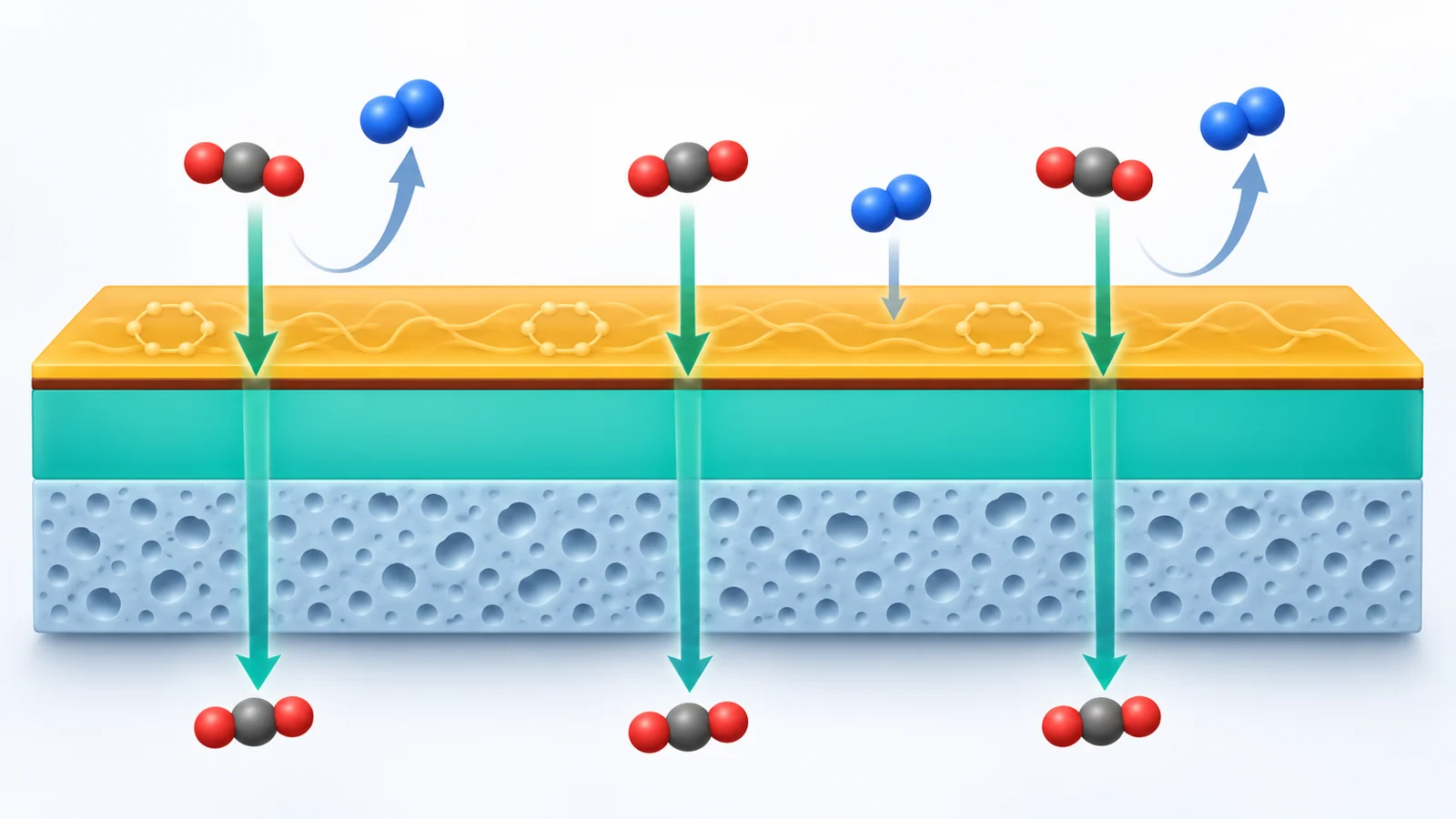
A 110-nanometer film of polyether and 18-crown-6 let carbon dioxide pass through more readily than a thicker film of the same blend. The thin film’s reported CO₂ permeability was 900 Barrer, compared with 420 Barrer for a thick film. In a completed membrane, the researchers also measured a preference for CO₂ over nitrogen. The result, published July 13, 2023, points to how controlling a material’s structure and the surfaces around it can help make a very thin selective layer.
The distinction between those measurements matters. Permeability describes how readily a gas moves through the selective film material. Permeance describes gas flow through the assembled membrane, which includes that film in its supporting structure. The study reported 2200 GPU CO₂ permeance and a CO₂/nitrogen selectivity of 27 for the membrane at 35 °C. Selectivity means that, under the reported measurement, CO₂ passed preferentially compared with nitrogen. Together, the figures describe both flow and separation in this membrane; they are not interchangeable measures.
Confinement changed the film’s structure
The selective material combined amorphous poly(ethylene oxide), or aPEO, with 18-crown-6, abbreviated C6. Although the blend is described as semi-crystalline, its ordered regions changed as the films became thinner. Crystallinity—the presence of regularly ordered regions in a material—decreased with film thickness and disappeared at thicknesses of 500 nm or below, according to the authors.
That observation shaped the design of the selective layer. The researchers aimed for a film far thinner than 500 nm, eventually reporting a 110 nm layer containing 40 mass percent C6 in aPEO. Its higher CO₂ permeability, relative to the thick-film comparison, is consistent with their approach of using thickness confinement to form an amorphous nanofilm. The supplied evidence does not isolate how much of the measured change came from the loss of crystallinity or from other parts of the membrane design.
How the interface helped form the thin film
A selective film only works as intended if it forms a thin, continuous layer over its support. The membrane used a porous support beneath a silicone-based polydimethylsiloxane, or PDMS, gutter layer. The gutter sits between the support and the selective film. The researchers modified the gutter’s surface with a layer of polydopamine less than 10 nm thick. They describe polydopamine as bio-adhesive and report that it has an affinity for aPEO.
This surface treatment enabled formation of the thin, defect-free, amorphous aPEO/C6 selective layer, according to the authors. In practical terms, the reported design joined the porous support to the very thin gas-separating material through an intervening gutter and a nanoscale surface coating. The abstract describes the combined design and its results; it does not provide a separate measure of the contribution from each engineering step.
Strong measurements, with an important boundary
The membrane’s reported CO₂ permeance of 2200 GPU and selectivity of 27 at 35 °C surpassed Robeson’s upper bound, a benchmark used to compare gas-separation membrane materials. That comparison places the reported material performance favorably against the benchmark. It does not show how the membrane would perform as part of a carbon-capture plant.
The evidence available here establishes measurements on a fabricated membrane and a separate permeability comparison between a thin film and a thick film. It does not establish sustained operation in realistic exhaust or performance in a larger membrane module. Nor do these measurements establish manufacturing yield, cost, or commercial capture performance. Those are separate questions from whether this particular thin film combined substantial CO₂ flow with a measured preference over nitrogen.
What this could make possible
If this combination of flow and separation preference can be maintained in larger, durable membranes, a future exhaust-treatment unit could route a CO₂-enriched stream toward collection while much of the nitrogen follows another path. Membrane separation for carbon capture already exists; the possible contribution here is a very thin selective material that paired reported gas flow with separation preference in a measured membrane.
That route from a small membrane result to an industrial unit still depends on fabrication at larger scale, integration, and durable operation. A useful nearer sign of progress would be a sustained module-scale test using a realistic mixed exhaust stream that reports both CO₂ flow and CO₂/nitrogen selectivity. Such a result would show whether the measured combination persists in the setting the technology is intended to serve.
Key Sources
- Primary source: Carbon Capture Membranes Based on Amorphous Polyether Nanofilms Enabled by Thickness Confinement and Interfacial Engineering.
DOI or Journal Page · Peer-Reviewed Paper · 2023-07-13
Keep exploring