
Research Signal – Source date 2023-05-04
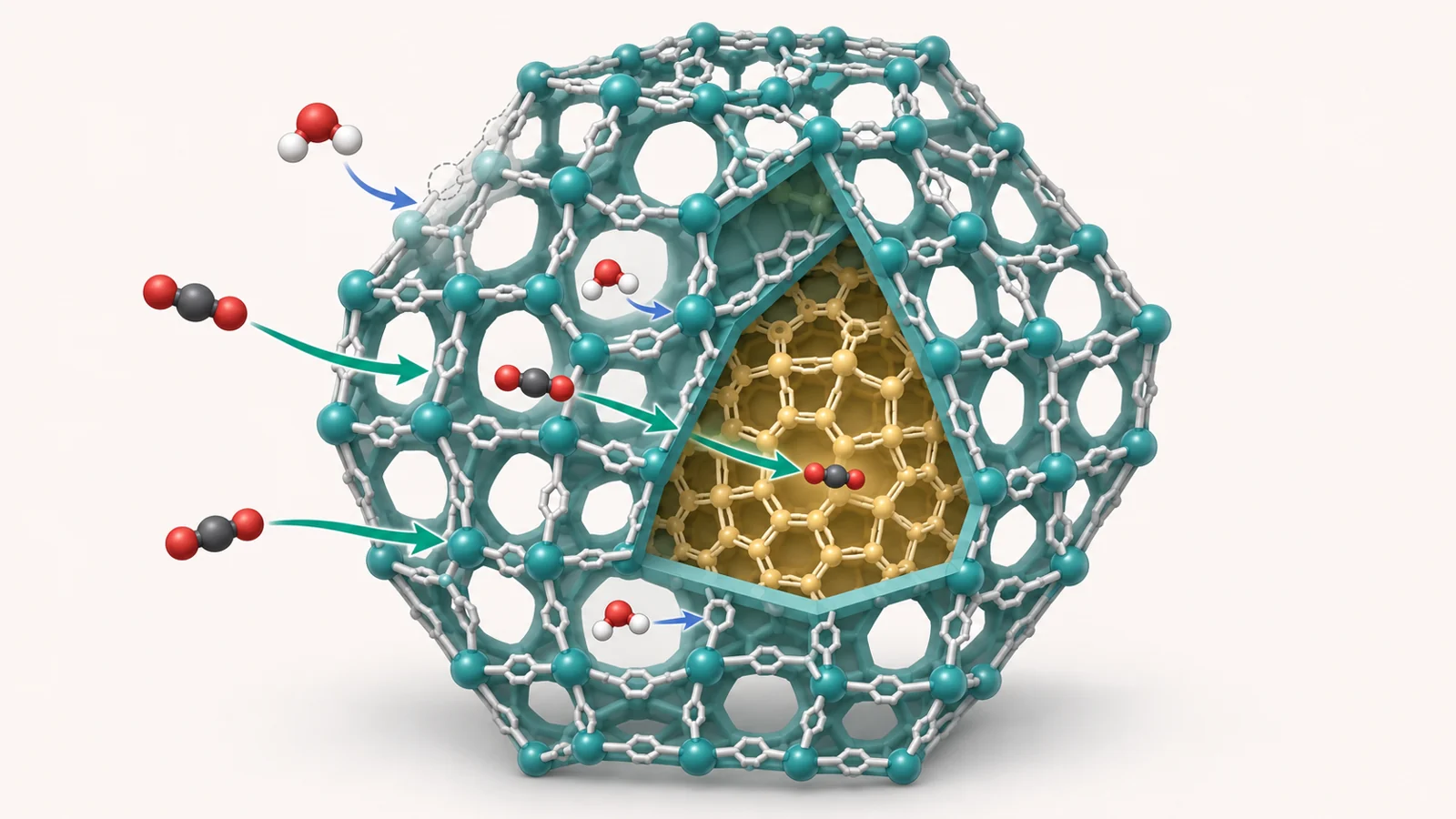
A porous crystal designed to capture carbon dioxide held on to far more of its dry-gas uptake when water vapor was added. At 15% relative humidity, the layered material’s CO₂ uptake fell by 3.7% from its own dry result. The uncoated core material fell by 56% from its dry result.
That is a comparison of how much uptake each material retained under one laboratory condition. It does not mean the layered crystal captured 96.3% of all CO₂ in the gas. At higher humidity, the layer still helped, but the advantage narrowed and the material showed signs of structural change.
A porous crystal with two jobs
Metal–organic frameworks, or MOFs, are crystals built with tiny pores. Their components can be varied to shape how gas molecules enter, move through, and bind inside those pores. In this study, the researchers used a zirconium-based MOF family called UiO, chosen for its relative structural rigidity and chemical stability.
The design divided the work between two regions. The core, made from (CyNH)₂-UiO-67, was selected for its CO₂ capture capacity and preference over nitrogen. The outer shell, made from NH₂-UiO-67, was chosen to let CO₂ move through while slowing water’s diffusion toward the core’s adsorption sites. Those sites are places within the porous material where gas molecules can be held.
The researchers had previously used computational screening to compare possible MOF building blocks and identify candidates for each role. They then made the selected materials in the lab. For the layered crystal, they grew the NH₂-UiO-67 shell around crystals of the CO₂-attracting core. Imaging and powder X-ray measurements were used to examine the resulting particles and crystal structure.
The idea was to preserve access for CO₂ while reducing water’s opportunity to compete for the core’s binding sites. The tests were designed to check whether that arrangement made a measurable difference.
The layer mattered when water entered the gas
The researchers compared four materials: the core on its own, the shell on its own, the core coated with the shell, and the reverse arrangement, with the shell material inside and the core material outside. Testing both layered orders helps show whether performance depends on where each material sits, rather than simply on mixing their ingredients.
They first measured dry-gas behavior, then exposed the samples to a mixture of 15% CO₂ and 85% nitrogen, a composition chosen to approximate flue gas. Water vapor was added to create tests at 15% and 30% relative humidity (RH). Each condition was tested twice.
Under 15% RH, uptake by the layered material, called cs-MOF-1, was 3.7% lower than its own dry-gas uptake. The core alone lost 56% relative to its dry baseline. At 30% RH, cs-MOF-1 lost 21%, while the core alone lost 62%. The percentages compare each material with itself in dry conditions; they are not a measure of the fraction of incoming CO₂ captured.
The shell material also lost uptake in humid gas, and at every tested humidity level cs-MOF-1 had lower absolute CO₂ uptake and CO₂/N₂ selectivity than the uncoated core. In dry tests, uptake for both layered arrangements fell between the values for the two individual MOFs. The benefit, then, was not a simple dry-capacity maximum. The selected arrangement performed better at retaining uptake as humidity rose, consistent with the intended role of its outer layer.
The reversed arrangement was included to test the importance of sequence. The reported results support a benefit for the selected core–shell combination; they do not establish that every layered MOF, or every ordering of the same materials, will perform similarly.
Moisture still affected the material
A smaller drop in CO₂ uptake under humid conditions addresses competition from water during these measurements. It is different from showing that a material can withstand moisture over long operation. Water vapor can also affect a MOF’s structure, which may in turn change its gas-sorption behavior.
After the humid tests, the researchers found that measured surface area had declined for all four materials. For cs-MOF-1, the decrease was 0.5% after the 15% RH test and 12% after the 30% RH test. The individual core and shell materials had larger decreases after the 30% RH tests. The crystal diffraction patterns remained, though peak intensity decreased for the individual materials at the higher humidity. These observations indicate that the humid exposure affected the materials’ structures, including the layered one.
The results come from a small set of laboratory measurements, with two trials per condition. They do not show performance through repeated operating cycles, in a deployed capture unit, or in direct air capture. And retaining a greater share of dry uptake does not by itself show that the absolute capacity, selectivity, or durability is sufficient for practical use. The authors identify improved stability, capacity, and selectivity as needs for further development.
Where this research could lead
A carbon-capture unit handling damp exhaust could someday retain its CO₂ uptake more reliably as moisture varies if a protective outer layer can keep water from disrupting useful adsorption inside a capture material. This study offers an early piece of that evidence: in a flue-gas-like laboratory mixture, one selected layered MOF lost less uptake than its core alone as humidity increased. It did not build or test a working capture unit.
Getting from a crystal test to that possible use would require materials that keep their structure over repeated humid operation, while also offering enough CO₂ capacity and selectivity. A practical system would then need to use such a material effectively in a complete capture process. Carbon capture methods already existed in 2023; the proposed contribution here is a way to design a porous material that may cope better with moisture, a challenge for adsorption-based capture.
A nearer milestone would be repeated humid mixed-gas operation that measures retained CO₂ uptake and selectivity alongside structural stability. If the advantage persists through those tests and the capacity is useful, layered crystals could become one route toward capture materials better suited to damp exhaust.
Key Sources
- Primary source: Implementation of a Core-Shell Design Approach for Constructing MOFs for CO 2 Capture.
DOI or Journal Page · Peer-Reviewed Paper · 2023-05-04
Keep exploring