
Research Signal – Source date 2023-03-30
A manganese-promoted magnesium oxide material was tested both for holding carbon dioxide and for helping an oxidation reaction that used carbon dioxide and oxygen. Those are two potentially useful roles, but the study reports them as separate tests. It does not show that gas captured by the solid was then fed into the reaction or became part of the product.
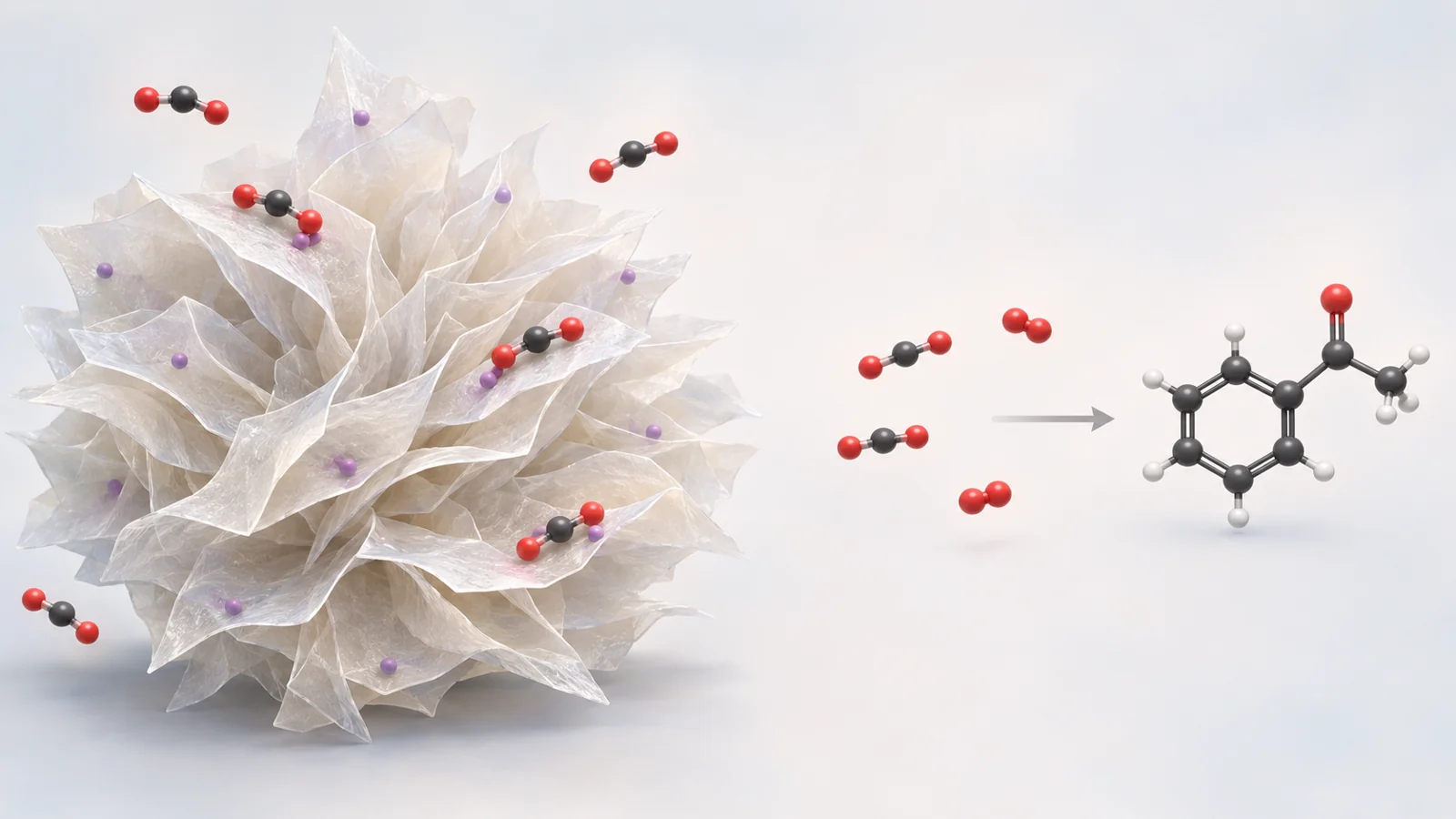
The work, published on March 30, 2023, explored a way to give ordinary magnesium oxide a more elaborate structure and add manganese to it. The researchers measured a higher carbon dioxide adsorption capacity than with pure magnesium oxide, then tested the promoted material as a catalyst for making carbonyl compounds from ethylbenzene derivatives.
More carbon dioxide held per gram
Under the reported ambient conditions, the manganese-promoted material adsorbed 0.74 millimoles of carbon dioxide per gram. Pure magnesium oxide adsorbed 0.28 millimoles per gram under the comparison conditions. Adsorption means gas molecules attach to the solid’s surface; the measurement describes how much the material held, not how much it removed from an emissions stream.
The increase makes the material interesting as a candidate for further carbon dioxide handling research. It is a laboratory comparison, however, and does not establish performance in an industrial gas stream or net carbon removal. The adsorption measurement also belongs to a different test from the chemical reaction described below.
A flower built from thin sheets
Microscopy showed a three-dimensional, flower-like architecture made of thin nanosheets. The material was magnesium oxide with manganese present in a mixture of manganese ions. Measurements of how nitrogen gas interacted with the solid indicated greater surface area with manganese and the presence of mesopores—small pores between 2 and 50 nanometres wide.
More exposed surface and pores can provide places where gas molecules meet the solid. The measurements associate manganese addition with greater surface area and higher CO₂ adsorption, but do not show how much the extra surface area or the pores contributed to that gain.
Carbon dioxide also played a role in oxidation
In a separate set of tests, manganese-promoted magnesium oxide helped oxidize ethylbenzene derivatives in the presence of carbon dioxide and oxygen. Oxidation changes a molecule through reactions involving oxygen; here, the researchers targeted carbonyl compounds, a family that includes acetophenone. The study reports that carbon dioxide had a role in the aerobic oxidation of ethylbenzene to acetophenone, based on control experiments.
For Mn-15/MgO, the abstract reports 97.4% conversion and 100% selectivity. Conversion measures how much starting material reacted; selectivity measures how much of the reacted material formed the intended product. Electron paramagnetic resonance (EPR) observations supported the formation of radicals, reactive molecular species involved in the reaction. Those observations do not, by themselves, establish every step of the reaction.
These reaction results do not show that the carbon dioxide previously adsorbed by the solid supplied the carbon or otherwise flowed into product formation. They show a catalytic test conducted with carbon dioxide and oxygen present, alongside a separate measurement of adsorption.
Reuse showed different results in each test
The adsorption material was reused for up to nine cycles, with a slight variation after the third cycle. In the catalytic tests, the material was reused for seven cycles; conversion decreased by about 11.63%, while acetophenone selectivity remained stable. These are separate durability observations, and the cycling results do not establish how a combined capture-and-reaction workflow would hold up.
What this could change
If a reusable solid could hold CO₂ and then help make acetophenone from ethylbenzene in a connected process, one material could serve both gas handling and chemical production. This study gives a reason to test that possibility: the solid adsorbed more CO₂ than plain magnesium oxide and separately catalyzed oxidation with CO₂ and oxygen present.
A useful next milestone would be an integrated test that tracks both carbon dioxide and product through repeated capture and reaction cycles under clearly stated operating conditions. Even success in that test would be a process-development step, not proof of net emissions reduction; that would require further independent assessment.
Key Sources
- Primary source: Designing of 3D Architecture Flower-like Mn-Promoted MgO and Its Application for CO 2 Adsorption and CO 2 -Assisted Aerobic Oxidation of Alkylbenzenes.
DOI or Journal Page · Peer-Reviewed Paper · 2023-03-30
Keep exploring