
Research Signal – Source date 2026-02-08
Cancer cells and senescent cells have very different relationships with growth. Cancer involves uncontrolled proliferation; senescent cells have stopped dividing. Yet both can display surface proteins that alert the immune system to cellular stress. Researchers are engineering T cells to recognize those proteins, raising the possibility that a strategy developed against tumors could also help remove persistent senescent cells that contribute to disease.
A paper published February 8, 2026, brings together receptor-engineering studies, cell experiments, animal models and early clinical development around this approach. Its central molecule is NKG2D, an immune receptor that detects cell stress. The work gives senescent-cell targeting a concrete experimental basis, while showing why experience in cancer cannot establish its value for age-associated disease. The challenge changes when the cells being removed may also participate in useful tissue repair.
Turning stress recognition into an attack
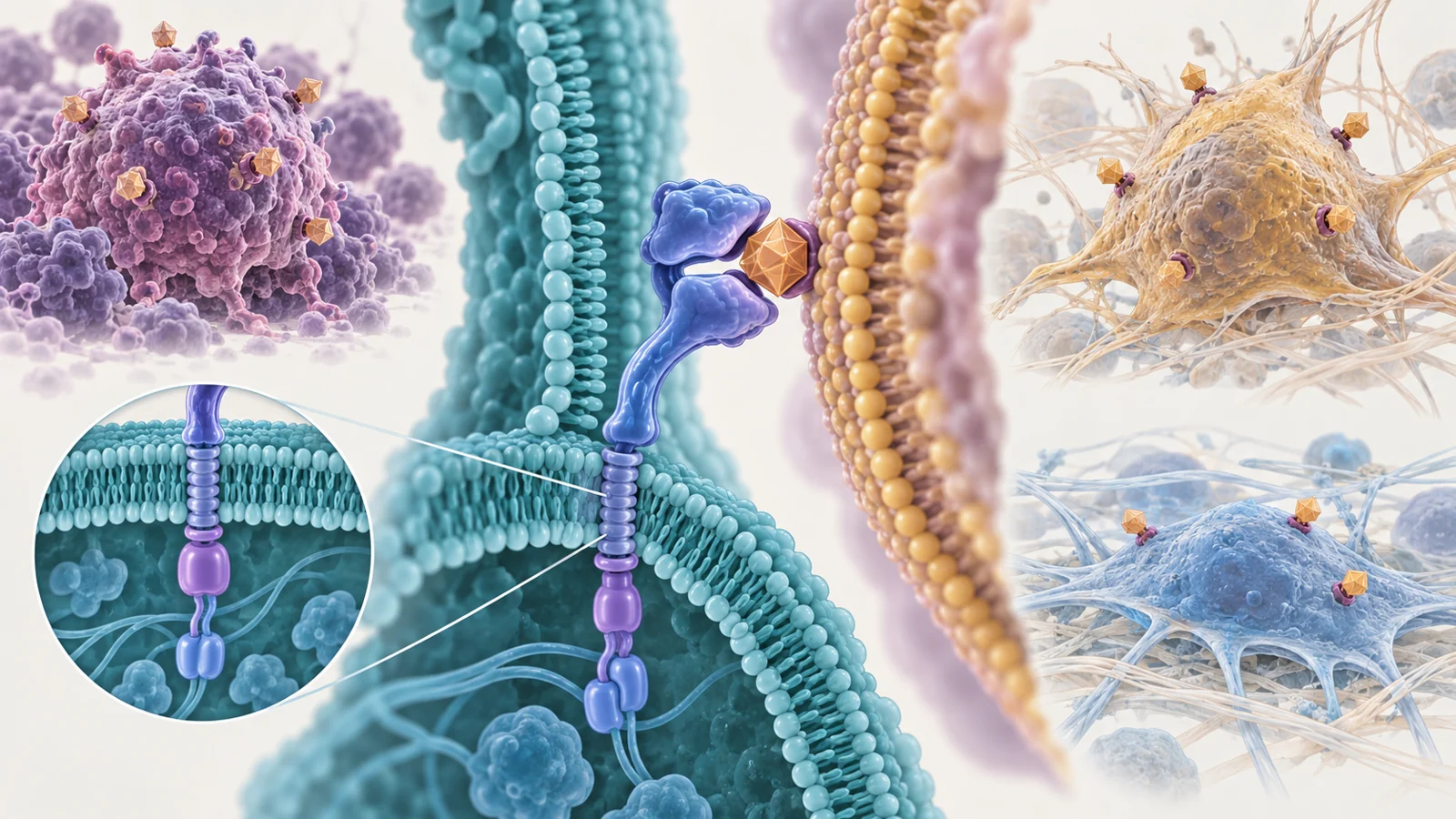
NKG2D occurs naturally on natural killer cells and several T-cell subsets. It recognizes molecules called ligands, proteins that bind to the receptor. Humans have eight NKG2D ligands: MICA, MICB and six members of the ULBP family. Their expression can increase in response to stresses including DNA damage, oxidative stress and viral infection. This gives immune cells several ways to detect that something has changed inside another cell.
Researchers harness that recognition through chimeric antigen receptors, or CARs—engineered receptors that connect target recognition to signals activating a T cell. In an early NKG2D design, investigators joined the receptor to a signaling component called CD3 zeta. Another protein, DAP10, helped support the receptor at the cell surface and supplied an additional activation signal. Binding to a stress-associated ligand could thereby trigger the engineered T cell to attack.
Recognizing eight ligands creates several possible points of contact, but none is a universal label for cancer or senescence. Cells differ in which ligands they display, and tumors can reduce or shed them. Shed ligands can also interfere with NKG2D by blocking binding or promoting removal of the receptor from the immune-cell surface. The biological opportunity rests on a shared stress response, with all the variation and escape mechanisms that accompany it.
Receptor design changes the result
“NKG2D CAR T cells” describes a family of engineered cells, not one interchangeable treatment. The original design developed into the human product CYAD-01 and entered Phase I cancer trials. The paper summarizes its clinical experience as showing modest antitumor efficacy. That history makes the details of receptor construction consequential: recognizing the same ligands does not guarantee that two products will activate, persist or perform equally well.
A different design, called NKG2D/DAP10-12, keeps the full NKG2D receptor alongside an adaptor combining DAP10 with the internal signaling portion of DAP12. In the cited experiments, this construct produced complete tumor responses in multiple mouse xenograft models, in which human tumor material is grown in mice. It also outperformed an analogue of CYAD-01 in pancreatic and ovarian tumor models and a mesothelioma model derived from a patient’s tumor.
The researchers attributed the adaptor’s performance to several features, including the arrangement of its signaling components, receptor abundance at the cell surface and the cells’ metabolic fitness. Those findings concern particular constructs in particular experimental systems. They do not establish that the same comparative advantage will occur in patients.
The paper describes the adaptor design progressing into a Phase 1/2 trial with an added chemokine receptor, CXCR2, intended to improve movement toward tumor sites. Entry into clinical testing is a step toward assessing a candidate in people. It does not turn the mouse responses into demonstrated patient benefit, nor does it validate the construct for senescence-associated disease.
What the senescent-cell experiments measured
The direct senescence experiments begin with deliberately altered cells. In one study summarized by the authors, researchers induced senescence in a human lung fibroblast cell line using the drug etoposide, increased activity of cancer-associated K-ras, or expression of the cell-cycle regulator p16. They checked for senescence-associated beta-galactosidase, an enzyme activity widely used as a marker of this state, and confirmed increased NKG2D-ligand expression.
When those cells were cultured together with NKG2D CAR T cells containing a signaling component called 4-1BB, the engineered cells eliminated them. This establishes a direct connection between experimentally induced senescence, ligand expression and susceptibility to the engineered T cells. A separate study using another NKG2D construct also demonstrated killing of induced senescent mouse fibroblasts and astrocytes, cells that support brain function. That experiment remained in cell culture; it did not demonstrate clearance within a living brain.
The next level of evidence involved mice exposed to X-rays to induce aging-like changes. After treatment with murine NKG2D CAR T cells, researchers reported lower NKG2D-ligand expression across the tissues examined. They also found less senescence-associated staining in fat tissue and lower expression of the senescence markers p16 and p21. These measurements addressed different parts of the proposed response: the abundance of target signals and signs of the senescent state.
The study went beyond molecular measurements. It reported improved bone and muscle physiology, together with better treadmill endurance, grip strength and walking speed. Functional observations matter because reducing a marker does not by itself show that an animal is doing better. An irradiation-based model, however, creates a particular form of damage and cannot stand in for the full course of ordinary human aging.
The paper also describes naturally aged mice showing reductions in senescence-related features and improvements in endurance after treatment. Together, these experiments support investigating whether senescent-cell removal can improve tissue function. They do not establish human rejuvenation, lifespan extension or an effective treatment for age-associated disease in people.
The therapeutic cells can become targets too
Stress recognition creates a practical complication before treatment even begins. Some activated T cells display NKG2D ligands during manufacturing. Engineered cells can therefore kill fellow T cells, a process called fratricide. For CYAD-01, this reduced cell viability and product yield. Adding a PI3K inhibitor improved viability but also suppressed proliferation, so yield did not improve. An antibody that blocked NKG2D recognition appeared to prevent the unwanted killing and helped address the manufacturing problem.
The adaptor construct had a different relationship with fratricide. In the studies discussed, it did not suffer a loss of yield; instead, the process promoted expansion and produced a highly enriched CAR T-cell product. The researchers interpreted this as selective removal of stressed or senescent T cells during production. The same general interaction could thus deplete one preparation while improving the composition of another. Manufacturing success depends on which cells survive and expand, as well as how many cells can be collected at the end.
Removing a cell can interrupt useful repair
Senescence can restrain damage as well as contribute to it. The liver provides a concrete example. After injury, hepatic stellate cells proliferate and become cells that produce extracellular matrix, the material supporting tissue repair. Entering senescence helps limit further proliferation and matrix deposition. Senescent stellate cells also release enzymes that break down that matrix, and NKG2D-mediated immune recognition can then contribute to their removal.
That sequence makes timing and cellular context central to any intervention. A senescent cell present during repair may be doing something useful, while persistent accumulation can contribute to inflammation and dysfunction. NKG2D ligands can also appear on stressed cells that are not senescent during wound healing and tissue regeneration. An engineered T cell recognizing such a ligand does not independently determine whether removing that cell will help the organ recover.
Immune toxicity adds a separate constraint. CAR T-cell activation can trigger inflammatory complications, including cytokine release syndrome, and neurological toxicity is a recognized concern for CAR T-cell therapy. The NKG2D animal studies discussed in the paper also show that apparent tolerability depends on experimental conditions. Toxicity differed between mouse strains, and in one setting chemotherapy preconditioning increased ligand expression and worsened toxicity. Quiet results in one animal system therefore cannot define the safety of every receptor design or treatment context.
These risks carry different weight in different diseases. A patient facing life-threatening cancer may accept hazards that would be unacceptable for a slowly progressing, nonlethal condition. For senescence-associated disease, the authors argue that benefit must be substantial enough to justify the possibility of immune activation, tissue injury or loss of useful senescent cells. Reduced dosing and temporary CAR expression are among the approaches they suggest exploring. Each would alter the duration or intensity of the intervention; none supplies a ready answer to the clinical risk-benefit question.
What this could change
If engineered T cells can selectively reduce persistent senescent-cell burdens, deliver sustained functional benefit and preserve useful repair without unacceptable immune toxicity, they could offer a way to protect tissue function in particular diseases. The potential beneficiaries would be patients whose damaging accumulation of senescent cells contributes to declining organ performance.
The causal hope is specific: remove cells that perpetuate inflammation and disrupt tissue function, and the remaining tissue may have a better chance to maintain or recover its work. Achieving that would extend engineered immune-cell therapy beyond tumor control toward treating a contributor to chronic dysfunction. The cell and animal experiments make that possibility worth pursuing; realizing it would require matching the engineered product to a disease in which clearance produces a durable net benefit.
Key Sources
- Primary source: Harnessing the NKG2D immune surveillance pathway using engineered T-cells for the treatment of human disease.
DOI or Journal Page · Peer-Reviewed Paper · 2026-02-08
Keep exploring