
Research Signal – Source date 2026-01-31
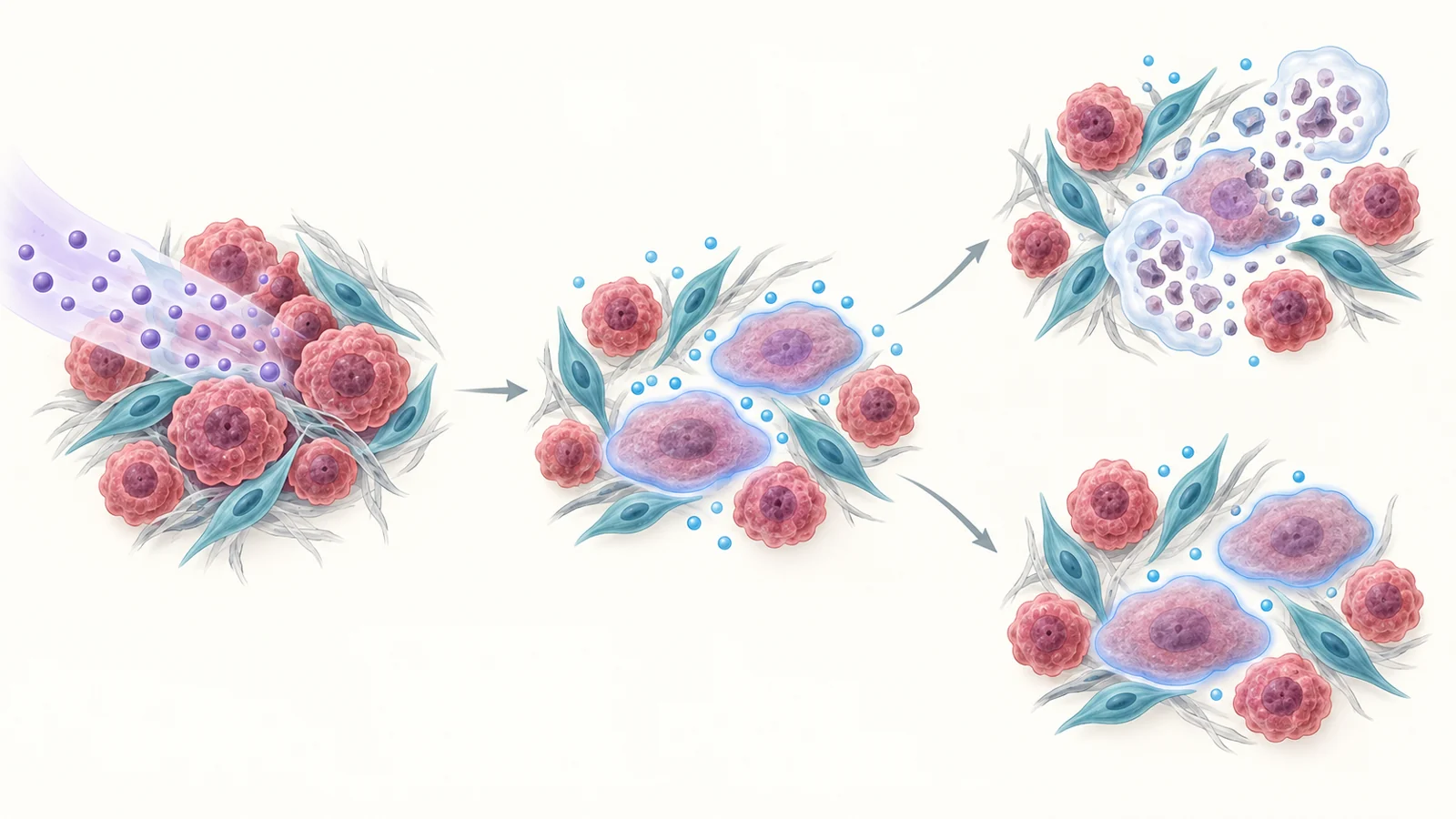
Stopping a cancer cell from dividing can be a useful treatment outcome. But a cell that stops multiplying can remain alive and influence the tissue around it. Cancer therapies can leave both tumor cells and nearby supporting cells in this state, called senescence. Their continued activity helps explain why researchers are testing an added treatment directed at what the initial therapy leaves behind.
A systematic review published on January 31, 2026, brings together 36 animal studies of this approach. The central comparison was a senescence-inducing cancer treatment alone versus that treatment combined with an agent intended either to eliminate senescent cells or to modify their secretions. Most reported tumor measurements favored the combinations, and all nine studies reporting survival found an extension. Some benefits were temporary, however, and an unsuccessful combination showed why identifying the intended cellular target matters.
The findings raise a question that tumor shrinkage alone cannot answer. Can changing the fate or behavior of surviving, growth-arrested cells help keep cancer under control for longer?
Cells can stop dividing without falling silent
Senescence is a stable arrest of the cell cycle—the process through which cells grow and divide. Chemotherapy, radiation and some targeted cancer treatments can induce it through therapeutic stress. Hormone withdrawal can do so as well. Treatments that induce this state are described as senogenic.
Growth arrest can initially restrain a tumor. Yet senescent cells may release inflammatory signals, growth factors and molecules that remodel surrounding tissue. Together, these secretions are called the senescence-associated secretory phenotype, or SASP. They can influence neighboring cells in ways that support tumor growth, invasion or treatment resistance. The relevant cells may include malignant cells and stromal cells, which form part of the tumor’s supporting environment.
The review includes two different ways of addressing that activity. Senolytic drugs aim to selectively kill senescent cells. Senomorphic interventions aim to change their behavior, including reducing harmful secretions, without necessarily removing them. The distinction matters because these approaches can produce similar changes in some measurements through different biological actions.
For example, the review describes a breast cancer experiment in which an added intervention suppressed several secreted inflammatory factors alongside reductions in tumor growth and lung metastasis. The authors characterize it as a senogenic–senomorphic strategy. That result supports targeting what growth-arrested cells release; it does not establish that the added agent cleared those cells.
Measurements must be interpreted accordingly. A reduction in a secreted factor such as IL-6 indicates a change in the signaling environment. A change in a senescence-associated marker indicates a change in that measured feature. Neither observation, on its own, proves that a treatment selectively killed the relevant senescent cells.
Smaller tumors, longer survival and delayed relapse answer different questions
The researchers searched from database inception through August 2025. That search endpoint precedes the paper’s January 2026 publication. From 1,262 records, they retained 36 studies for qualitative synthesis, comparing results descriptively rather than calculating a pooled treatment effect.
Tumor volume decreased with combination treatment in approximately 95% of the comparisons summarized by the authors. Tumor weight decreased in approximately 90% of studies reporting that outcome. These figures describe how often the measured direction favored a combination. They do not mean tumors shrank by 95%, nor do they represent a patient’s probability of responding. Multiple tumor models within one study could also contribute separate data points.
Tumor size measures the burden of disease at a particular time or over an observation period. Survival asks whether animals lived longer. Relapse asks whether control persisted before the cancer grew again. A smaller tumor can be an encouraging result without resolving either of the latter questions.
One prostate cancer experiment illustrates a survival result. As summarized in the review, the combination produced median survival of 137 days, compared with 92.5 days for the senescence-inducing treatment alone—about 48% longer in that experiment. This is a result for one animal model and regimen, rather than an estimate that can be applied across the review’s different cancers and treatments.
Another prostate model makes the durability distinction particularly clear. Surgical castration induced a senescent tumor state, after which the senolytic ABT-263 was given. The review reports delayed relapse and survival of about 70.5 days with the combination versus 56 days with castration alone. It also describes the antitumor response as temporary. Additional time under control was measurable even though sustained suppression was not achieved.
All nine studies that reported survival found extensions relative to the senescence-inducing treatment alone. That is a narrower body of evidence than the tumor measurements across the full collection. Survival findings from those nine studies cannot fill in the outcome for the other experiments, and delayed relapse cannot be read as permanent eradication.
A drug’s label does not establish its effect in every tumor
A liver cancer experiment supplies a useful counterexample to the mostly favorable tumor results. Doxorubicin reduced tumor growth, but adding dasatinib plus quercetin did not improve control compared with doxorubicin alone. The combination also failed to clear the treatment-induced senescent cells as assessed in that model. Dasatinib plus quercetin given on its own increased tumor burden in the reported comparison.
This failure connects the intended mechanism to the treatment outcome. Calling a combination senolytic does not establish that it will eliminate cells made senescent by a particular cancer therapy. The targeted cells must actually be susceptible in that tumor setting. Here, the expected clearance was unsuccessful, and adding the drugs did not enhance chemotherapy’s tumor control.
The same issue complicates broad claims about the whole strategy. Different senescence-inducing stresses and different tumor environments can leave cells with different dependencies for survival. A combination therefore needs evidence that it acts on its intended cellular target, alongside evidence of what happens to the tumor. Changes in tumor size alone cannot establish the mechanism responsible.
Reaching the target is a separate treatment problem
Even when a drug has useful activity against the intended cells, researchers must consider how it reaches them and what else is exposed. The review includes an experiment pairing a senescence-inducing treatment with nanoparticle-encapsulated navitoclax. In that mouse study, the combination reduced tumor volume and lung metastasis while increasing a marker associated with programmed cell death.
The reported tolerability observations included stable platelet counts, weight loss below 10% and no significant organ damage. These details make the delivery approach relevant to more than tumor activity: the experiment also examined whether the regimen could produce that activity alongside limited measured systemic effects.
Those observations have a defined scope. Final groups in the study contained only three to five animals after some animal loss. Stable platelet counts and modest weight changes in a small experiment cannot establish general safety, especially when toxicity reporting across the wider collection was inconsistent. Drug delivery, tissue exposure and tolerability remain treatment-design questions in their own right.
Why the experiments do not yield one expected benefit
The 36 studies covered 11 cancer types, with groups ranging from three to 20 animals per treatment arm and treatment durations ranging from two to eight weeks. Regimens, doses, models and measurements varied enough that the authors did not pool them into a quantitative meta-analysis. The descriptive pattern therefore does not identify one preferred drug pair, dose or sequence, or a single expected improvement in cancer control.
Most studies used human-derived tumors implanted in immunodeficient mice. Twelve used syngeneic systems, in which tumors grow in animals with functioning immune systems. This difference affects what can be learned about immune involvement in clearing senescent cells. Results from a model lacking normal immune function cannot fully resolve how the same intervention would interact with an intact immune response.
Descriptions of measures used to limit experimental bias were also incomplete. Random sequence generation and allocation concealment were seldom described, while blinding of caregivers and outcome assessors was usually unclear. That limits verification of how comparisons were protected against bias; it does not prove that researchers omitted those procedures. Some studies also had control-group limitations, inconsistent measurement timing or reporting inaccuracies.
The review depended on published data that its authors could not independently validate. It also identifies potential omission of non-English publications and exclusion of unpublished or negative studies as limitations. If unsuccessful experiments are less visible in the collected literature, the frequency of favorable findings can give an incomplete picture of performance.
Taken together, these constraints prevent the animal synthesis from establishing that adding a senolytic or senomorphic intervention improves survival, prevents recurrence or is acceptably tolerated in cancer patients. Discussion of human trials elsewhere in the paper does not turn the included animal experiments into clinical validation of the combined strategy.
What this could change
If researchers can identify which treatment-induced senescent cells sustain tumor-supporting activity, and safely remove those cells or reduce their secretions, an initial cancer response might last longer. The possible patient benefit would be additional time before cancer regrows or progresses, with longer survival as a further outcome to establish.
That would give cancer treatment an additional target after growth arrest has been achieved. Therapy could address both the initial tumor burden and the continuing influence of cells left alive by treatment. Making that capability useful would require a way to recognize the relevant cellular state, match an intervention to it and deliver the treatment with tolerable effects. The animal results provide concrete examples of extended control, while the temporary responses show why the duration of that control will matter as much as the initial reduction in tumor size.
Key Sources
- Primary source: Senogenic-senolytic treatment strategies enhance tumor control and can improve survival in murine cancer models: a systematic review.
DOI or Journal Page · Peer-Reviewed Paper · 2026-01-31
Keep exploring