
Research Signal – Source date 2026-01-01
Can a molecular program associated with stem cells help damaged tissue repair itself while keeping its specialized function? That question runs through research on miR-302/367, a family of small RNAs that regulate gene activity. These molecules can influence whether cells divide, change their identity, or respond to stress. Harnessing those abilities for repair requires control over how strongly—and for how long—they act.
A review titled The harmonies played by miR-302/367 cluster in pluripotency, reprogramming, and rejuvenation brings together experiments exploring those possibilities. Its evidence spans cells grown in culture, injured animal tissues, and naturally aged mice. Across those settings, “rejuvenation” can refer to very different achievements. Making a stem cell, reducing cellular stress, rebuilding tissue, and extending an animal’s life each answer a different biological question.
A family that regulates several cellular processes
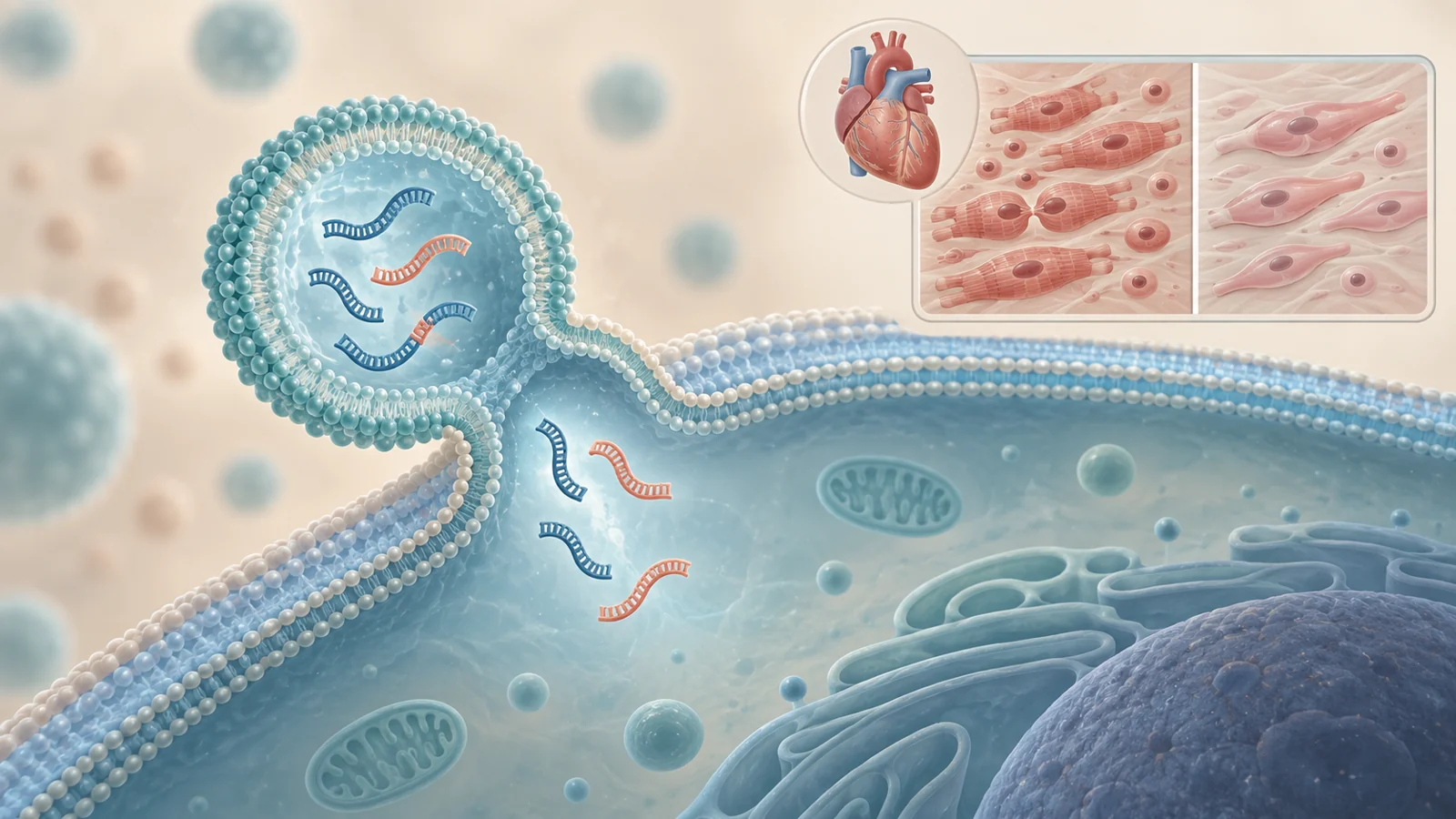
MicroRNAs are small RNA molecules that regulate gene activity by helping suppress the production of proteins from selected messenger RNAs. They work with a cellular protein complex that can block those messages from being translated or promote their breakdown. A single microRNA can influence many messages, allowing it to change several connected processes at once.
The miR-302/367 cluster contains five members: miR-302a, miR-302b, miR-302c, miR-302d, and miR-367. Each can produce forms distinguished by the labels 5p and 3p. Those suffixes matter when comparing experiments. A preparation containing miR-302a-5p is a different intervention from one containing miR-302b-3p, and neither is automatically equivalent to activating the entire cluster. Shared targeting features give family members overlapping activities, but do not make them interchangeable.
The review connects the cluster’s effects to three interacting areas of cell biology. It can alter proteins that govern progression through the cell cycle, including the division inhibitor p21. It can affect epigenetic regulators, which help determine how cells use their DNA without changing its sequence. It also influences signaling involved in shifts toward an epithelial state, in which cells form closely connected layers—a transition involved in some reprogramming procedures.
Together, these actions help explain why the family attracts attention in stem-cell research. Changing a cell’s state involves coordinating division, gene regulation, and interactions with its surroundings. These RNAs can act across that network, rather than affecting only one isolated step.
Making stem cells answers one part of the question
Pluripotency is the capacity to develop into many different cell types. Reprogramming an adult body cell into an induced pluripotent stem cell changes its developmental possibilities. In those experiments, success means producing cells with stem-cell properties; it does not by itself demonstrate improved performance in an aging organ.
The review describes multiple studies in which the cluster or individual members improved the efficiency of reprogramming. It also highlights a more ambitious report in which viral expression of the cluster generated mouse and human induced pluripotent stem cells without the conventional externally supplied reprogramming factors. The authors explicitly state that this factor-free result has not been independently replicated. That distinction separates a specific, unconfirmed claim about replacing the usual factors from the broader evidence that these RNAs can assist reprogramming.
Attempts at partial reprogramming pursue a different endpoint. They seek to restore aspects of cellular function without completing the transition to pluripotency. Here, changes in stress responses, division, or age-associated molecular features become relevant measurements. Such results need to be read alongside what happened to the cell’s identity and function. A higher yield of stem cells and a better-functioning specialized cell are different achievements, even when some of the same regulatory machinery is involved.
What the eye and mouse experiments measured
The corneal work summarized in the review offers a useful example of evidence at two biological scales. Researchers studied miR-302a-5p in cultured human corneal endothelial cells, using an inflammatory signal to induce cellular senescence. Senescence is a state in which cells stop dividing and develop other functional changes. Treatment improved cell viability and proliferation and reduced measures of mitochondrial oxidative stress and stress in the endoplasmic reticulum, a cellular compartment involved in protein processing.
Those are measurements in human cells, not outcomes in treated patients. The corresponding animal work used an injured rat corneal endothelium, where the intervention promoted regeneration. It therefore adds evidence about a tissue response in a living animal. The cell-culture and rat experiments complement one another, but an injury model and experimentally induced senescence do not reproduce every feature of an age-related eye disease.
A separate study summarized in the review asked an organism-level question. Naturally aged mice received an exosome-based intervention carrying miR-302b-3p. Exosomes are small membrane-enclosed particles that can carry molecular cargo between cells. The review reports improved physical ability and cognition, less progressive weight loss, and a 15.4% increase in median lifespan. Median lifespan describes the point at which half the animals in a group have died; it does not mean every animal lived 15.4% longer.
This is a more direct longevity result than a reduction in cellular stress. It also concerns a particular RNA member, carrier, and animal setting. It cannot be assigned to every member of the family or to another delivery method. The review reports no adverse safety outcomes during a 24-month observation period in that study, an observation whose relevance remains tied to the tested preparation and conditions.
Taken together, these examples explain why the endpoint deserves as much attention as the word “rejuvenation.” The corneal experiments measured cellular behavior and tissue regeneration. The aged-mouse experiment measured function and survival. Progress at one scale can motivate work at another, but the measurements cannot substitute for one another.
Duration can change the cardiac outcome
The cardiac experiments make control of exposure especially concrete. In a conditional transgenic mouse model, expression of the cluster promoted heart-muscle-cell proliferation and fibrotic scar repair through suppression of the Hippo signaling pathway. Yet prolonged overexpression produced cells with less differentiated features and impaired cardiac function. More cell division was therefore insufficient to ensure a better-working heart. The same discussion describes a different approach in which a hyaluronic acid hydrogel delivered synthetic miR-302b- and miR-302c-3p locally and over time, promoting regeneration after ischemic injury. These findings support investigating controlled exposure; they do not define a universal safe duration or establish that one delivery method is superior in a direct comparison.
Cellular context adds another layer. The review describes both tumor-suppressing and tumor-promoting activities of the family, depending on the setting. Its ability to replace the cancer-associated reprogramming factor c-Myc in some protocols may remove one source of concern, but cannot settle the safety of the resulting intervention. Likewise, delivering RNA without integrating genetic material into the genome addresses one delivery-related issue while leaving the biological consequences of changing cell behavior to be evaluated.
Delivery determines which cells receive the instruction
A useful RNA sequence still has to reach the intended cells in an active form. The authors discuss synthetic RNA mimics, lipid nanoparticles, extracellular vesicles, and local scaffolds as possible ways to protect and deliver the molecules. These approaches differ in where their cargo travels and how exposure is sustained. A locally retained preparation for damaged tissue poses a different distribution problem from a treatment intended to act throughout the body.
Delivery also interacts with dose. MicroRNAs use cellular machinery shared with the body’s own regulatory RNAs. Excessive amounts of an introduced mimic can compete for that machinery, while its many molecular targets create opportunities for unintended effects. Sequence design and chemical modifications may improve stability and specificity, but the useful dose has to account for both the desired response and disruption elsewhere in the cell.
The authors propose that a single family member could make therapeutic development simpler than delivering the whole cluster. A more defined cargo could be easier to manufacture and characterize. Whether it retains the desired activity, however, depends on the application. Overlapping targets do not establish that one member reproduces all the cluster’s effects in every tissue.
For extracellular-vesicle delivery, consistency is a further practical hurdle. The review identifies variation among preparations and production at scale as obstacles. A biological effect observed with one preparation must become reproducible across manufactured batches if it is to support a dependable treatment. Experience with delivery technologies used for other RNA medicines can inform that work, but does not establish the effectiveness of miR-302-based rejuvenation.
The remaining gap is a treatment effect in people
The review connects mechanisms with experimental outcomes, while calling for clinical confirmation of safety and efficacy. The findings described here do not establish that miR-302/367 treatment improves a human age-related disease or extends human lifespan. Cultured human cells provide evidence about cellular responses; clinical benefit requires a meaningful effect in people receiving a defined intervention.
That transition also requires understanding what persists after treatment. The authors identify long-term effects of epigenetic reprogramming, tissue targeting, and dose as unresolved questions. For a tissue-repair application, durable specialized function would matter alongside early proliferation or changes in molecular markers. The therapeutic prospect rests on carrying a useful response through delivery, manufacturing, and clinical testing—not simply reproducing one favorable laboratory measurement.
What this could change
If a selected RNA member can be delivered reliably to damaged tissue at a controlled exposure, this work could lead to treatments that recruit surviving cells into repair. In the corneal setting explored by the review, for example, improving the survival and regenerative activity of endothelial cells could offer a way to restore tissue after damage. Local delivery could concentrate that activity where repair is needed.
The practical benefit would be a tissue that recovers more of its useful function through a defined course of treatment. Connecting the right RNA cargo with reproducible delivery would turn a broad ability to alter cell behavior into a more specific regenerative tool—one directed at a particular tissue and a measurable functional need.
Key Sources
- Primary source: The harmonies played by miR-302/367 cluster in pluripotency, reprogramming, and rejuvenation.
DOI or Journal Page · Peer-Reviewed Paper · 2026-01-01
Keep exploring